
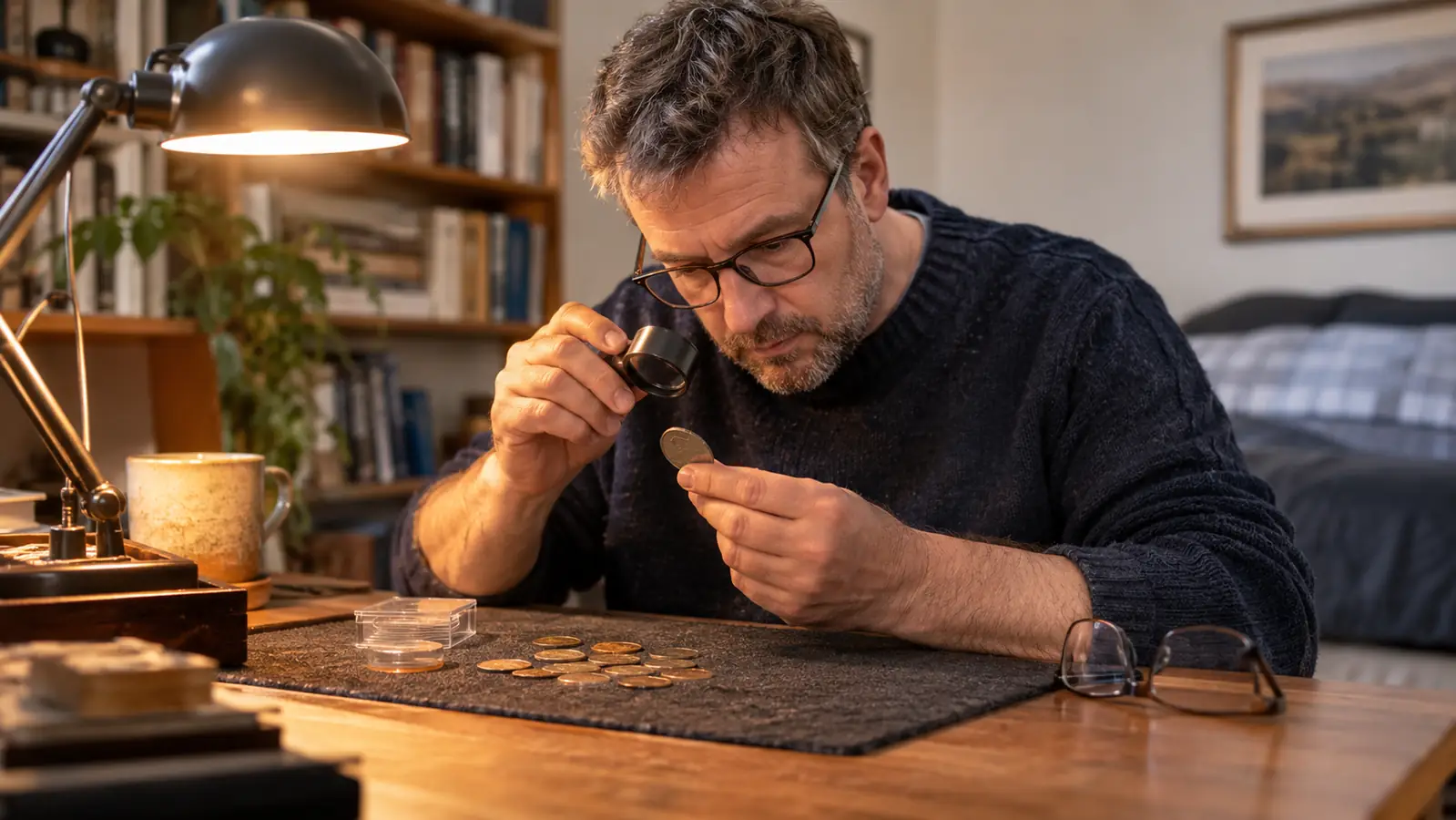
I keep two magnifiers on my desk and I use both of them, which is probably not the clean answer you clicked for. Here is the short version. For reading a mintmark, a die crack, or the thin lines of a wheat stalk, the JARLINK 30X 60X Illuminated Jewelers Loupe does a job a handheld glass cannot do. For dragging across a shoebox lid of wheat cents to find the three worth a closer look, a plain handheld magnifier is faster and a good deal less fuss.
I am 63 and retired out of a machine shop in Dayton, Ohio. I have been squinting at coins since my grandfather handed me a coffee can of wheat cents when I was eleven, and I picked the hobby back up seriously once the shop stopped taking my mornings. In that time I have bought more magnifiers than any hobbyist needs, and I have ruined a couple of coins by handling them with fingers I should have left alone. So this is not a spec sheet comparison. It is what I would tell a friend who asked me which one to set on the desk first.
If you are new to this, the two tools look interchangeable on a shelf. They are not. One of them shows you more, and the other one shows you wider, and the whole decision comes down to which of those you need at the moment you sit down.
| JARLINK 30X 60X Loupe | Plain Handheld Magnifier | |
|---|---|---|
| Magnification | 30x on the 22mm primary lens plus a 60x 12mm supplementary lens, so you can step up on a single detail | Usually one fixed power, and the ones I have owned run somewhere around 2x to 5x |
| Built-in light | An LED at the lens, lighting the coin from close to the angle you are looking from | None. You supply the room lamp and hope it is in the right place |
| Field of view | Small by design. At 60x you are looking at a fraction of the coin face | Takes in most or all of a coin face in one look |
| Lens material | Resin, which is light and does not shatter, and which does take scratches | Glass on the better ones, and glass wipes clean and stays clear for decades |
| Batteries | Three LR1130 cells, with a spare set in the package | Nothing to change, ever |
| Steadiness in the hand | Braced against your brow, so it settles quickly and stays put | Held out away from your face, and the further out it goes the more it wanders |
| Size and weight | 1.6 by 2 inches and 27.22 grams, with a fabric bag for the drawer or a pocket | Palm sized and bulky, awkward to carry and easy to set down somewhere unsafe |
| Sorting a pile fast | Too much power for it. You will re-focus on every coin and lose the rhythm | Drag it down a row of cents and the odd one out announces itself |
| Teaching a beginner | Nothing happens until you learn where to put your eye and how to hold still | Point it and look. A nine year old is reading dates in ten seconds |
| Best for | Mintmarks, die varieties, surface condition, rim problems | The first pass through a junk box or a roll of cents |
Where the JARLINK Loupe Wins
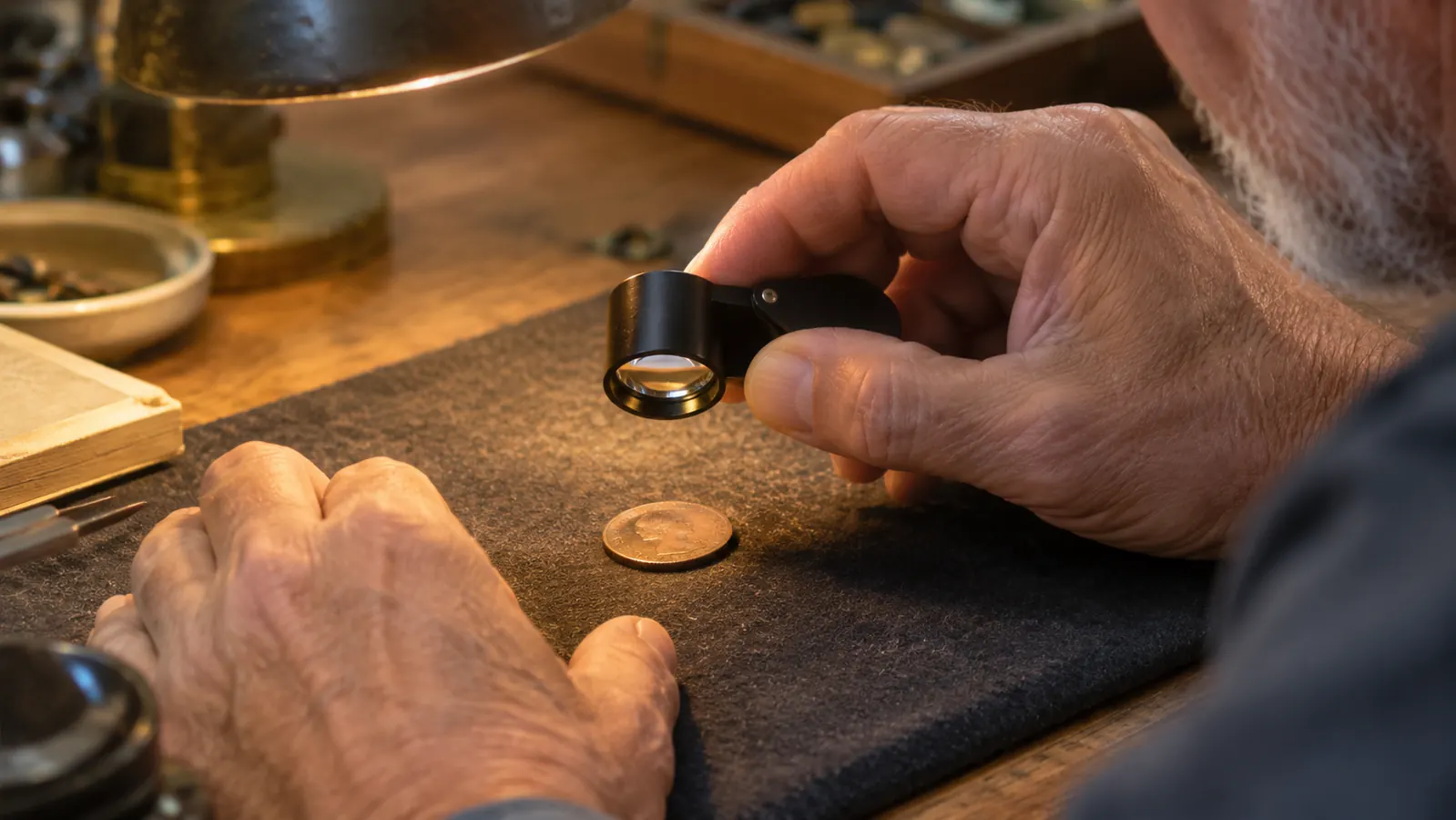
The first thing the loupe gives you is power, and power is the whole argument. Thirty power through a 22mm lens puts a mintmark across your entire field of view. Switch to the 60x supplementary lens, the small 12mm one, and a die crack that looked like a stray hair turns into something with edges. A handheld magnifier, the kind that lives in a kitchen drawer, runs somewhere around 2x to 5x. It is not in that conversation, and it is not trying to be.
The second thing is the light. My desk lamp sits above and behind the coin, and a polished Morgan dollar throws that light straight back up into my eye. The LED on the loupe sits right at the lens, so it lights the surface from roughly the angle I am looking from. On a worn wheat cent that is the difference between seeing wheat lines and seeing where the wheat lines used to be. I have used it in the church basement where my coin club meets, one dim fixture and forty years of dust on it, and I could still read a date. The first meeting I brought it to, three fellows borrowed it before the coffee was poured and one of them went home and ordered his own.
The third thing is that it fits in a shirt pocket. It measures 1.6 by 2 inches and weighs 27.22 grams, it comes with a fabric bag, and the bag lives in my desk drawer next to the felt pad. When I go to a show or the club meeting I drop it in a pocket and forget about it. The handheld stays home, because it does not fit anywhere useful and I have nowhere safe to set it down once I am there.
Where a Handheld Magnifying Glass Wins
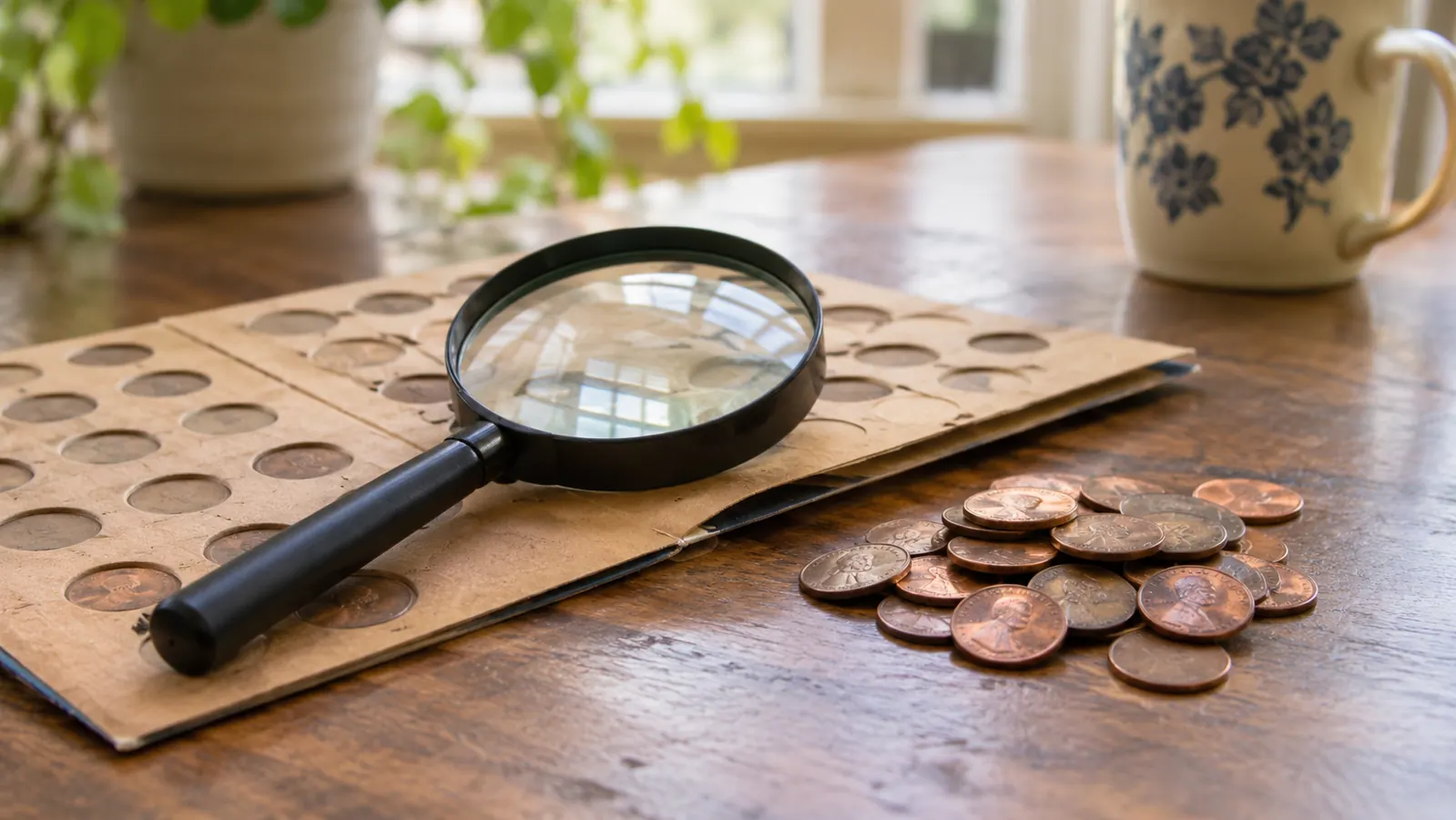
Field of view. This is the part people underestimate. A handheld shows you the whole coin face at once, and half of coin inspection is deciding whether a coin is worth inspecting at all. Date, mintmark area, rim, overall surface, all in one look. Try that through a 30x loupe and you are panning around like a tourist with one eye shut. You will miss the rim, because you never looked at the rim.
No batteries, and glass. The loupe runs on three LR1130 button cells. They last longer than you would think and the package includes a spare set, but they do go, and mine went in the middle of sorting a roll of cents on a Sunday when nothing in the house was open. The handheld needs nothing. Its lens is glass, and glass takes a wiping. The loupe lens is resin, and resin scratches. Mine has two faint marks on it after a few years. They do not bother me at 30x, but I know they are there, and a glass magnifier I have had since the 1990s is still clear as the day I got it. Carol wiped the lens on her sleeve once and I had to walk out of the room for a minute. She was right, of course. It came clean. But the resin smudges if you let it.
And the last one, which matters more to me now than it used to. My granddaughter Maddie is nine, and she comes over on Saturdays to learn the hobby. Hand her the loupe and there is a lesson first: where to put your eye, how to brace it against your brow, how to hold still. Hand her the handheld and she is looking at a coin in ten seconds and asking questions about it. For a beginner, the tool that gets out of the way wins.
The one that reads the mintmark, not just the date
30x on the main lens, 60x on the small one, and an LED sitting at the lens where the light actually helps. This is the loupe on my desk every Saturday when Maddie and I go through a roll.
Amazon Check Today's Price on Amazon →How the Two Split the Work on My Desk
In practice I do not choose between them. I run them in order. The shoebox comes out, the handheld comes out with it, and I go across the cents two or three at a time. Anything with a date I cannot read, a rim that looks off, or a surface with that grainy look gets set to the right of the felt pad. That is a sorting job and it moves fast. I timed it once out of curiosity, a full shoebox of about six hundred cents, and the first pass took me a hair under forty minutes. Sixty of those coins made the right-hand pile.
Then the pile on the right gets the loupe. That is where I am answering actual questions. Is that a doubled die or machine doubling? Is the mintmark a clear letter or a filled blob? Is the green on the rim surface crud, or the start of something worse? None of those get answered at 3x. The loupe does not just magnify more. It changes the kind of question you can ask. The sixty coins took me two evenings. Sort first, then study. Every time I have tried to do it in one pass I have ended up with the loupe in one hand, a coin in the other, and no system at all.
Last month I pulled a wheat cent out of a roll with a rim that looked hammered flat on one side. Through the handheld it was a maybe. Through the 30x lens it was post-mint damage, a gouge with a raised lip of metal pushed up around it, done by somebody with a tool rather than by the mint. That coin went into the reject tin. The point is that I would have kept it, and wondered about it, and eventually asked somebody at the club to look, all because a handheld could not settle it in three seconds. I have made that walk across the room at a club meeting enough times to know the trip is worth more than the tool.
At 60x, a die crack that looked like a stray hair turns into something with edges.
What the Numbers on the Box Actually Tell You
The listing gives you 30x and 60x, plus a stated magnification strength of 60x, which sounds like marketing and mostly is not. The 30x is the 22mm lens and it is the one I use most. It has enough field of view to catch a mintmark and the date together, and it does not demand that you hold perfectly still. The 60x is the 12mm supplementary lens. Smaller circle, less forgiving, and worth every bit of the trouble the day you need it. Get the 30x lens focused on a date first and the 60x becomes obvious. Start with the small one and you will think the loupe is broken.
The lens material is resin, listed plainly, and I would rather you hear that from me than find it out later. Resin is light, and it does not shatter when the loupe comes off the desk, which mine has, twice, both times onto a hardwood floor, and both times it worked fine afterward. It also scratches and it holds a smudge. I wipe mine with the fabric bag rather than a shirttail, and that has kept it usable. If you require optical glass in a magnifier, this is not that tool and I am not going to pretend otherwise.
The rest of it is small and specific. 27.22 grams. 1.6 inches long, 2 inches wide. Three LR1130 cells with a spare set in the bag, plus a small screw in the package. A fabric bag to keep the dust off between sessions. None of that is exciting, and all of it is the reason the thing ends up in my pocket instead of a drawer. One caution on the battery cover: it is small, and the little screw is smaller. Do that job over the felt pad with the tray out, not over a rug.
Who Should Buy Which
Buy the JARLINK loupe first if you are at the stage where you are asking questions about individual coins. You have a pile of wheat cents you have already sorted once. You want to know why one 1944 Lincoln cent looks different from the other forty. You are squinting, you are tilting a coin under a lamp to catch the light, and you are getting nothing. That is the loupe's job, and it does it at a level a handheld cannot reach.
Buy a handheld magnifier first, or keep using the one in the kitchen drawer, if you are still working in volume or if a kid is learning beside you. It is the right tool for the first pass, and it is the right tool to hand a nine year old who wants to look at a coin right now. Most of us end up with both. The ones who do not are usually the ones who bought the loupe first, found the field of view cramped, and put it away. I know, because that was me for about a year in the early two thousands.
If you are buying in order, buy the cheap one first and let the coins tell you when you have outgrown it. When you start setting coins aside because you cannot quite tell what you are seeing, that is the signal. Do not let the drawer decide for you.
Thirty power is where the questions get answered
The JARLINK loupe is the second tool I reach for and the one I would not give up. LED at the lens, 30x for the date and mintmark, 60x for the die variety, and a bag to keep it clean between Saturdays.
Amazon Check Today's Price on Amazon →