
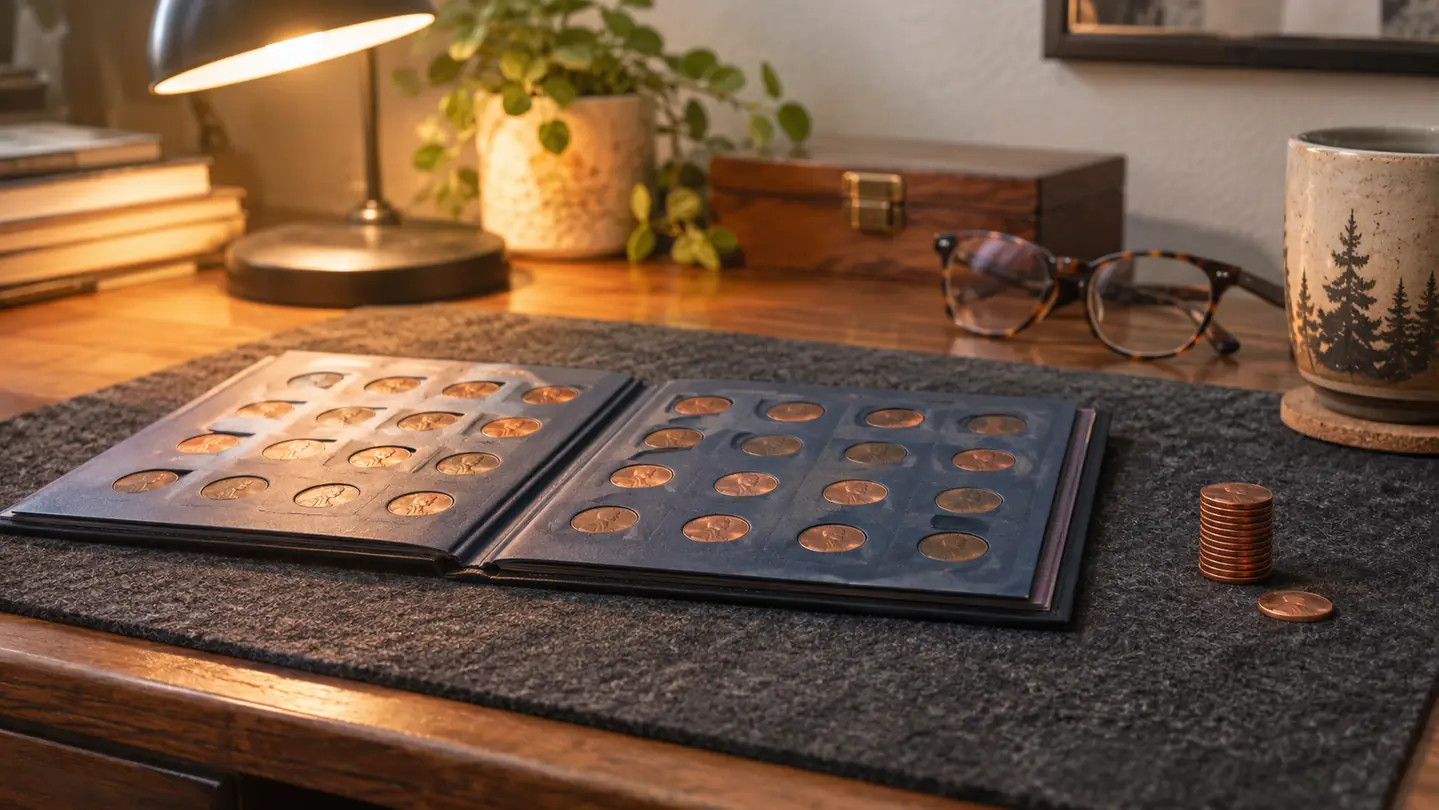
A nine-year-old will tell you the truth about a hobby in about four minutes. Maddie sat down at my desk on a Saturday in March, looked at the open folder, and wanted to know why half the pages were empty. I told her that was the point. She thought about it for a second, then asked whether we could fill them. That was eleven months ago. The Whitman Lincoln Cents Folder #2 has sat open on my felt pad most weekends since, and it has taught her more about patience than anything I could have said out loud.
Before this folder, the cents in this house lived in a coffee can, then a shoebox, then a plastic tube I am not proud of. None of those things tell you what you are missing. A can holds coins. A folder holds a plan. That is the whole difference, and it is why I bought a Whitman folder for the 1941 to 1974 run instead of handing Maddie another jar to sort through. She can see at a glance that there is a hole waiting where a 1943 should sit, and another where an S mint mark should sit, and she wants to know why. A jar never asked her a question in her life.
I am 63, retired out of a machine shop in Dayton, and I have been picking at Lincoln cents since my grandfather left me a coffee can of wheat cents when I was eleven. I am not a dealer. I do not tell people what a coin is worth and I am not going to start here. What I can tell you is how a folder holds up when a child uses it every weekend for the better part of a year, because that is exactly what happened at my desk.
The Quick Verdict
Three printed pages with a labeled hole for every date and mint mark in the 1941 to 1974 run. It does one job well and it will not protect a coin from air or humidity. The empty holes are the feature, not the flaw.
Amazon Check Today's Price →Half the pages start empty. That is what you are actually buying.
The Whitman Lincoln Cents Folder #2 covers 1941 through 1974 with a labeled hole for every date and mint mark in the run. Three pages, 3.21 ounces, 7.88 by 5.76 inches, and it opens flat on a desk.
Amazon Check Today's Price on Amazon →How I've Used It
I bought the Whitman folder in late February and had it open on the desk that same afternoon. It measures 7.88 by 5.76 inches and 0.28 inches thick, and it weighs 3.21 ounces, so it lies flat on the felt pad without sliding around and it still fits in the inside pocket of a coat if I want to carry it to a club meeting. Three pages, opening flat on the desk.
The first afternoon I dumped the coffee can out and sorted by decade, which took about two hours and made a mess I am still finding cents from. Of the holes in the 1941 to 1958 range, roughly a third already had a coin waiting in the can. The rest were empty, and some of them are still empty eleven months later. That is not a complaint about the folder. That is the honest arithmetic of a common-date collection built out of pocket change.
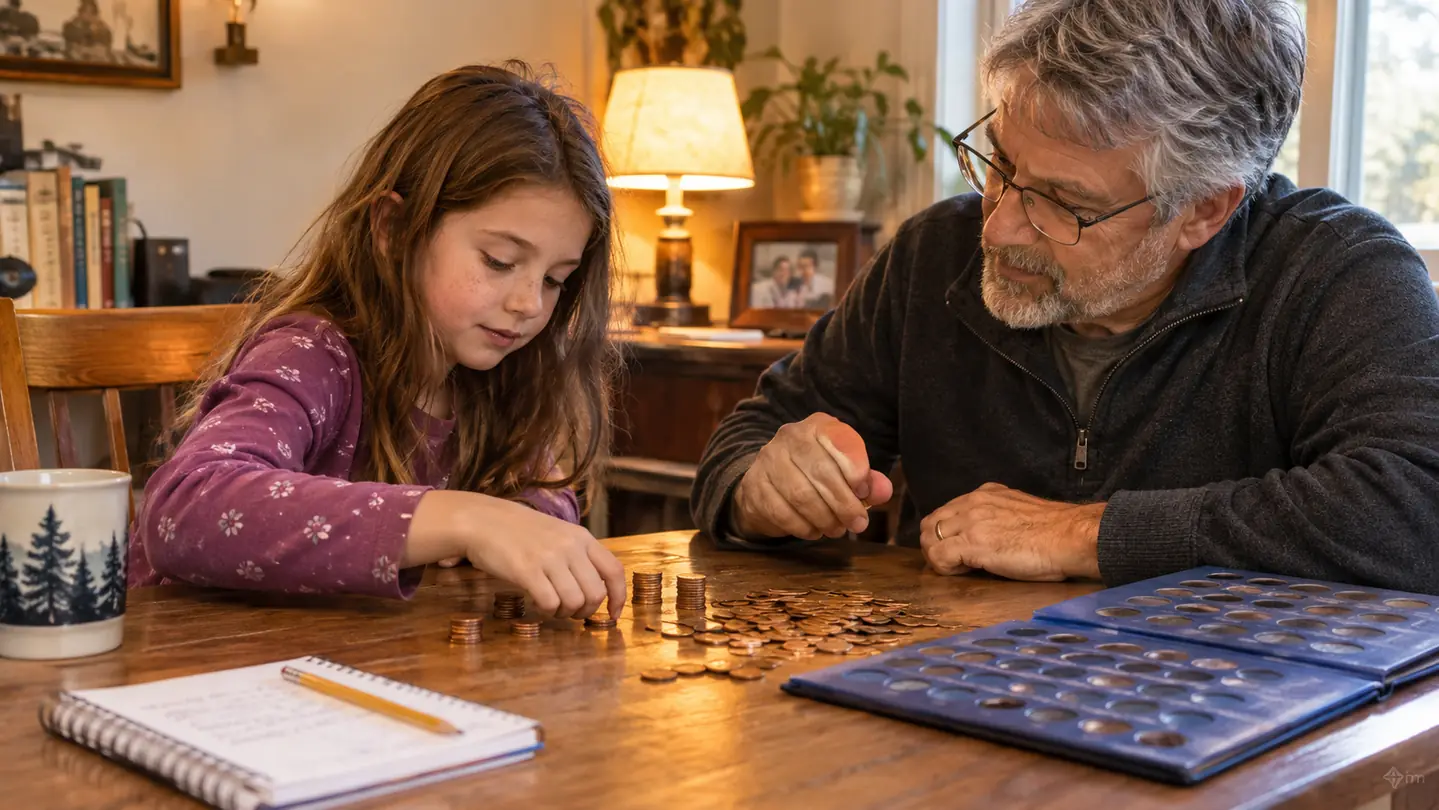
Since then the routine has been the same. Saturday morning, lamp on, felt pad down, folder open, and a small tin of cents between us. Maddie checks the holes, calls out the dates she still needs, and I do the looking. She has gotten better at reading a mint mark than I was at her age, and better than her grandmother believes, which is a separate conversation Carol and I keep having.
One thing worth saying up front: I have used this folder hard and it has held up. The pages have softened at the fold from being opened and closed every weekend, and there is a faint bend in one corner where a tin got set down on it. It has not come apart, and no hole has torn out. For a printed folder that costs less than lunch, that is more than fair.
What This Folder Actually Is
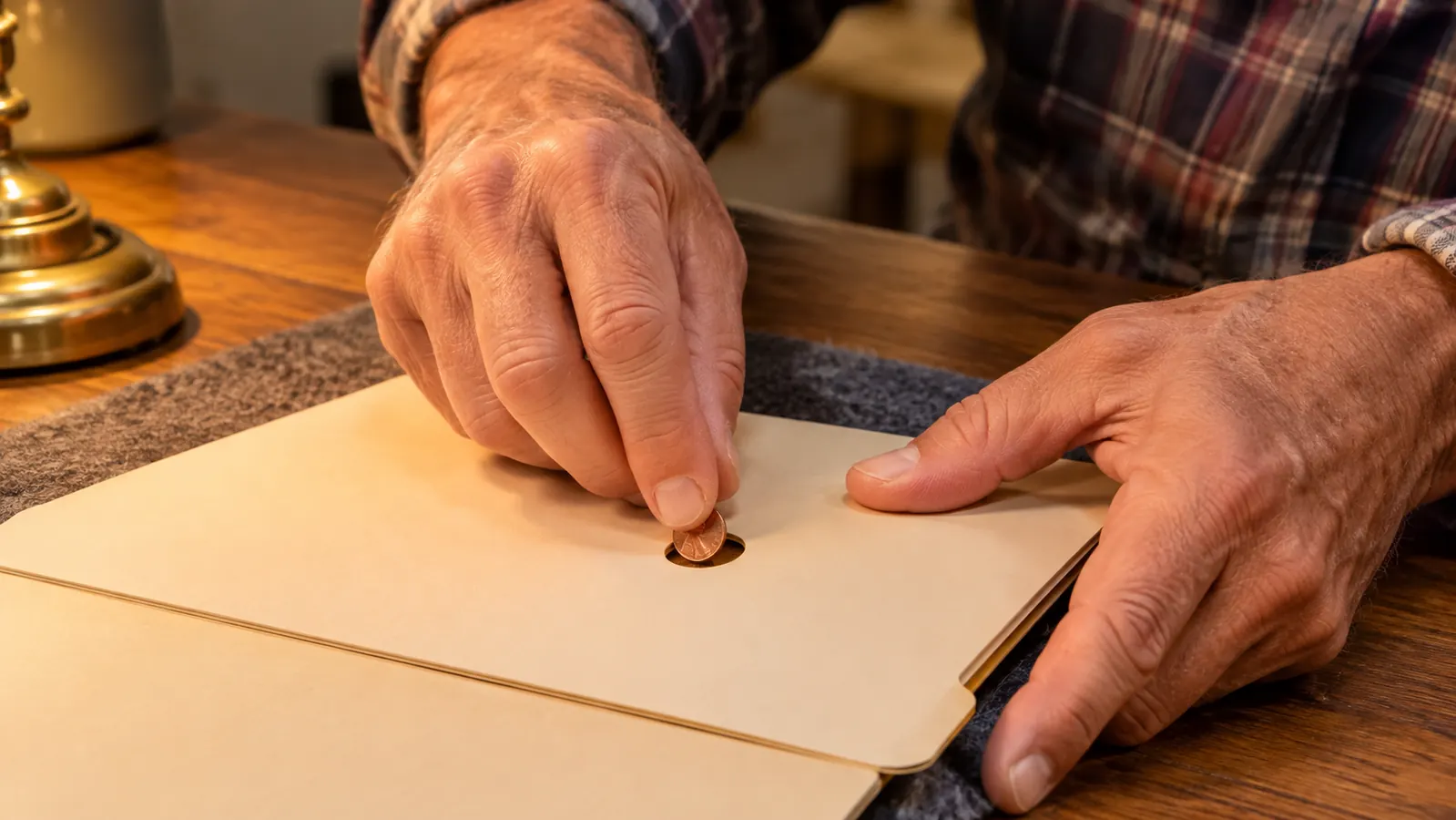
Whitman has been printing these folders a long time, and the design has not changed much because it does not need to. This one covers the Lincoln cent from 1941 through 1974, the second stretch of the series, and every hole is labeled with a date and, where the mint struck that year, a mint mark. 1941 through 1958 are wheat cents. 1959 through 1974 carry the memorial reverse. Both designs live inside the same three pages, which is a fine thing to be able to show a child in one look instead of two boxes.
The listing puts the reading age at 14 years and up, and I want to be straight about what that means in practice. It is not a warning label. It is a description of how much hand control the thing assumes. The holes grip a cent snugly by design, and a nine-year-old pushing one in with a thumb will bend the rim if nobody is watching. Maddie works with me, not alone. After a few months she stopped bending them, and that is the folder teaching her something a jar could not teach her in a hundred years.
What it is not: it is not an album with pockets, it is not a slab, and it is not sealed. It is three printed pages that hold coins in place so you can look at them and see what you still need. Everything a folder does well comes from that, and everything it fails at comes from that too.
The Wheat Years, 1941 to 1958
These are the holes my grandfather's can could actually fill. Wheat cents ran from 1909 through 1958, so the folder catches the last eighteen years of the design. When I was a kid those wheat cents were still turning up in pocket change, and I remember being annoyed by them because they were not the shiny new ones. I would like to apologize to my eleven-year-old self, who did not know what he was holding.
Mint marks are where the folder earns its keep. Denver and San Francisco struck cents in many of these years, and the labeled holes make that distinction visible in a way a pile on a table never does. You can look at a row for a given year and see two or three holes sitting side by side, and you can see which one is empty. That single visual is worth more to a beginner than a paragraph of explanation, and I have tested that theory on a nine-year-old.
The 1943 hole is the one that starts conversations. Copper went to the war effort that year and the cents came out in steel, and every collector who has ever explained that to a child has watched the child's face change. Maddie asked whether they were magnetic. They are. She spent twenty minutes with a refrigerator magnet after that and turned up two in the tin, and those two went into their holes before she would eat lunch.
What a Folder Will Not Do
A folder is an open book, not a sealed capsule. Air moves through it. Here in Dayton the humidity in July is enough to start a cent toning, and a coin left sitting in an open folder near a window will change color over a few summers. That is not damage the way rust is damage, but it is change, and some people care and some do not. I care, which is why nothing in this house sits in an open folder year after year without being looked at.
Fingers are the other thing. Skin oil is not neutral, and a cent handled by the face on a warm day will hold that handling for a long while. The rule at my desk is short and I say it out loud every Saturday: edge, not face. Maddie holds them by the rim now without being reminded. It took a few months and one coin I would rather not talk about, and she learned it faster than most adults at the club do.
The coins that matter most to me do not live in the folder. They live in a small fireproof box in the closet, in holders, and the folder is for the run I am building and looking at. A folder is a display and a checklist. It is not storage, and treating it as storage is how a person ends up with a set of cents that all went brown together while nobody was paying attention.
Teaching a Nine-Year-Old With Empty Holes
Here is the thing I did not expect. The empty holes do the teaching. Every one of them is a question, and a child who is allowed to ask the question will ask it. Why is this one missing. Why is this one harder to find. Why does this one have a letter under the date. I have been in this hobby since I was eleven and I have never once had a jar ask me anything.
I took her to the club meeting once, back in the spring. She walked the dealers' boxes with her hands behind her back, which is the rule, and she came home with a 1946-S she spotted herself. It went into the folder that night. She has not stopped mentioning it, and I have stopped pretending I am not proud of that.
She is nine. She may lose interest, or she may not, and I am not going to push her either way. What I wanted was something to hand her at a desk on a Saturday that was not a screen, and a folder with four decades of holes in it turns out to do exactly that. If she quits next year the folder stays on my desk and I keep filling holes. If she does not quit, she inherits a coffee can and a partial set of cents, and she will know what she is looking at.
What I Liked
- A labeled hole for every date and mint mark from 1941 to 1974, so you can see what you are missing instead of guessing
- Three pages that open flat on a desk, light enough at 3.21 ounces to drop in a coat pocket
- Turns a loose pile of cents into a project a child can actually follow
- Mint mark holes sit side by side, which teaches the D and S distinction faster than any explanation I have tried
- Inexpensive enough that a bent coin is a lesson and not a disaster
Where It Falls Short
- Open to air. It will not stop toning in a humid summer
- The holes are snug, and a young thumb will bend a rim if you are not sitting there
- Some holes, like 1943 and several S mint years, will stay empty a long time for most people
- Not storage. Anything you care about belongs in a holder and a box
- Pages will show wear at the fold if you open and close it every weekend for years
A can holds coins. A folder holds a plan. The empty holes are the only part of this hobby that ever made a nine-year-old ask me a question.
Who This Is For
Someone starting a Lincoln cent run who wants the visible, working version of it. Someone teaching a kid or a grandkid who wants a thing they can hold and point at together. Someone with a can or a jar of cents in a closet that has never been sorted, because the folder forces the sort whether you feel like it or not. It is also a reasonable buy for a collector who wants a working checklist for 1941 to 1974 that can sit on a desk and take a little abuse.
Who Should Skip It
Skip it if you already own an album with pockets and you are happy with the way it works. Skip it if the coins you are handling are the ones you care about most, because a folder is not storage and it is not protection. Skip it if you want a set that stays exactly as it looks today, because air is air and paper is paper. And skip it if you are buying it for a child under about ten to use unsupervised, not because anything in it is dangerous, but because snug holes and small thumbs do not get along.
One more. If you are the sort of person who wants that 1943 hole filled by this weekend, understand that the folder will not help you find one. It is a place to put a coin. It is not a way to get one, and no amount of staring at an empty hole has ever produced a steel cent.
Four decades of Lincoln cents, one hole at a time
The Whitman Lincoln Cents Folder #2 covers 1941 through 1974 with a labeled hole for every date and mint mark in the run. Three pages, 3.21 ounces, and room for a Saturday morning.
Amazon Check Today's Price on Amazon →