
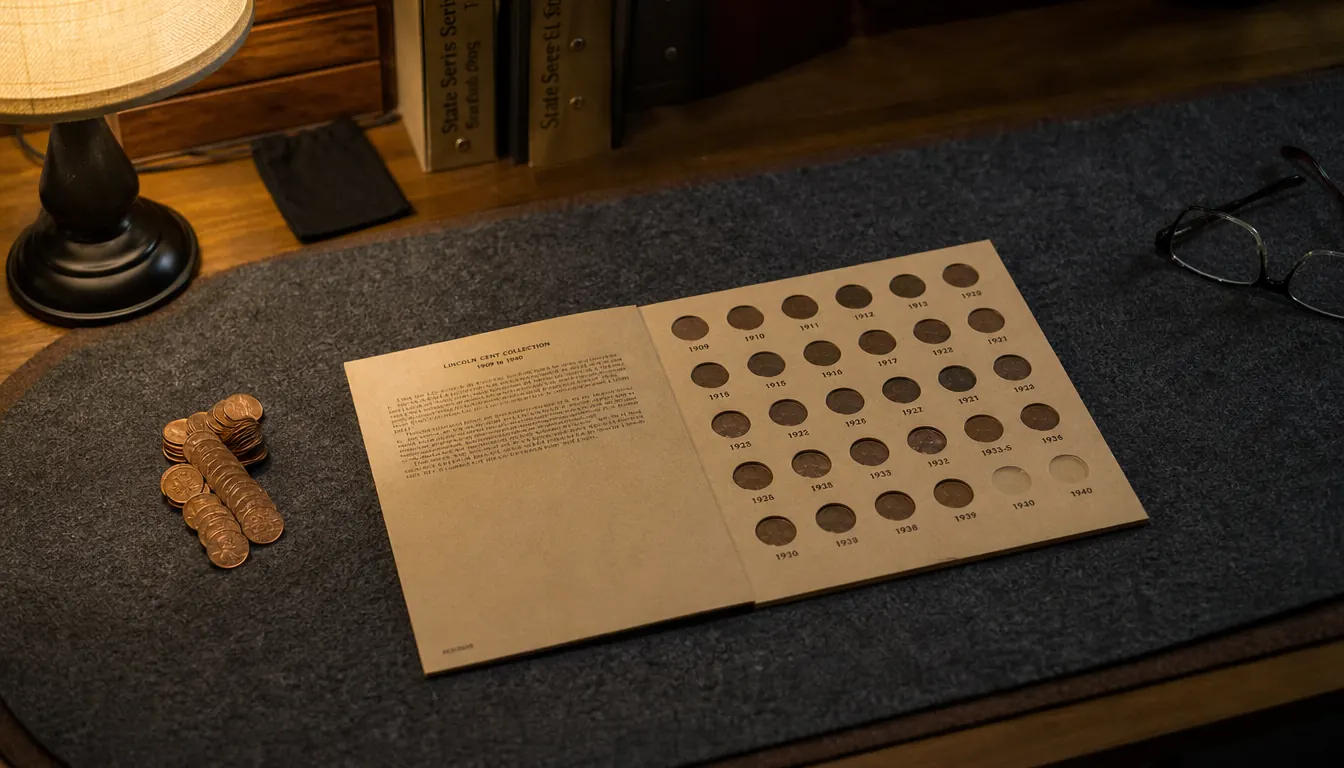
At the last club meeting, a fellow member passed around a soft pocket album he had bought to hold his wheat cents, and every copper in it had gone that flat, cloudy brown that does not wash off. He wanted to know what he should have done instead. I told him the same thing I tell my granddaughter Maddie when she gets impatient with a coin: put it in a Whitman folder and then leave it alone. The Whitman Lincoln Cents Folder #2 covers 1941 through 1974, which is the stretch most of us can realistically finish, and it does one job. It holds each cent in its own labeled hole, so the set stays in order and your fingers stay off the metal.
Here is the short answer. If you are building a date and mint mark run and the coins are going to live on a shelf, buy the folder. If you want something to carry to a meeting and flip through on the couch, a pocket album does that better, and I will not pretend otherwise. They solve different problems. Most of the arguing I hear about them comes from people comparing the two as though they were the same product wearing different covers.
| Whitman Folder #2 | Pocket Album | |
|---|---|---|
| Keeping a coin where you put it | Die-cut holes grip the rim, and a seated coin stays put when the folder is handled. | Soft pockets stretch with use, and a coin that has been slid in and out sits loose. |
| Finding a date in the run | Date and mint mark are printed under each hole, so the order is automatic. | No printed dates. You build the order yourself and then remember it. |
| Barrier against air and dust | Open cardboard. Both faces of the coin see the room. | A page of pockets covers the coins, and sealed pages more so. |
| Plasticizer risk to copper | No plastic anywhere near the coin. | Depends entirely on the pages. Soft vinyl can leave a haze on copper. Inert pages do not. |
| Carrying it to a meeting | Three cardstock panels that flex and fan inside a bag. | A bound book that closes and stacks with everything else. |
| Coins outside the date range | Covers 1941 to 1974 only. A 1932 Lincoln cent has no hole to sit in. | Takes whatever you put in it, dated or not. |
| Upgrading a coin later | Press the old coin out from the back and seat the better one. | Slide out, slide in, and the pocket loosens a little more each time. |
| Humidity over the long haul | Needs a dry box and silica. The board will not stop a damp summer. | Closed pages slow moisture down, though a wet room wins eventually. |
| Best for | Finishing a 1941 to 1974 run that lives on a shelf. | A mixed collection you want to carry and flip through. |
What Each One Actually Is
The Whitman folder is a folded piece of cardstock, 7.88 by 5.76 inches, a quarter inch thick, weighing about 3.2 ounces. It runs 3 pages and it is published by Whitman-CDN Publishing. This edition has been in print since December 1996 and the object has not changed in any way that matters. Coins press into die-cut holes above a printed date and mint mark. Nothing about it is sealed, lined or padded. That is the entire design, and it is the reason the thing has lasted as long as it has.
A pocket album is a bound book of plastic pages. Each page carries rows of soft pockets, and a coin slides in the way a photograph slides into a wallet sleeve. The appeal is easy to see. It closes, it stacks on a shelf, and you can look at a hundred coins without unfolding anything. What the pages are made of matters more than anything else about it. Soft vinyl pages can give off plasticizer over the years, and that is what leaves the haze on a copper surface and pits it. Good albums use inert materials. Cheap ones do not, and cheap is what most of us buy first.
I am not against albums. I keep a modest run of Morgan dollars in a proper album with hard, inert pages, and it is the right home for them. The difference is that those pages were made for long storage by people who thought about it. A soft pocket album out of a junk box was made to be affordable, and the coins pay for that.
What Both Get Right
Neither of these is the villain. The villain is a coin loose in a jar, knocking against forty other cents for twenty years, which is exactly what my grandfather's coffee can did to the wheat cents he left me when I was eleven. Whatever you choose, the moment a coin has a dedicated place and stops moving, you have done the most important thing that will ever be done for it. A folder does that. An album does that. So does a cardboard holder and a box, for that matter.
Both also assume the same two things of you. Clean, dry hands, because oil from a fingertip is what starts a fingerprint etch on copper and no product prevents that. And a dry place to keep the thing, because neither one fixes a damp basement. I have watched a well-kept album in a bad room go badly, and a plain folder in a good closet hold up for years. The storage around the product matters more than the product.
The cents I seated in a folder in 2019 still look the way they did the day I found them. The ones that spent three summers in soft pockets do not.
Where Whitman Wins
Order is the big one, and it is the thing nobody mentions. The date is printed under the hole. You do not write a label, you do not decide where the coin goes, and you cannot accidentally file a 1955 in with the 1956s at midnight. When Maddie works a page she is reading dates and mint marks without being told to, which is most of what I want her to learn at nine. A pocket album makes you build the order yourself, and the pockets do not announce a date, so the only thing keeping a run in sequence is your memory of where you put things last time.
No plastic is the second thing. In a folder the coin is held by paper board that touches only the rim, and nothing presses a film against the face. I have pulled cents out of cheap albums with a dull green cast creeping along the edge of the portrait, and once that is on the metal it stays. Cardboard is not airtight and I will get to that in a moment. But cardboard has never damaged a coin. Soft vinyl has, and I have seen it more than once.
There is also the small matter of how it changes your behavior. A folder with holes in it is a to-do list. You open it, you see what is missing, and you go looking. That is the whole engine of the hobby for a kid or for a man in his sixties with a fireproof box in the closet, and it costs you nothing but a Saturday.
Where a Pocket Album Wins
It travels, and it closes. A folder is three panels of cardstock that flex and fan when you put it in a bag, and the coins sit in open holes with nothing over them. If you take coins to a club meeting, or you want to look at them with a grandchild on the couch, the bound book is the more sensible object to be holding. I have carried a folder across a parking lot in the rain and spent the rest of the evening wishing I had not.
The other honest point is coverage. My folder runs 1941 to 1974. Anything earlier than that, any cent from 1909 through 1940, has no home in it, and neither does a stray Indian Head or a worn piece somebody hands you at a meeting. A pocket album takes whatever you put in it. If your interests wander, or you are the person who buys a mixed lot at a club auction, an album absorbs the leftovers and a date-specific folder simply does not.
And the album keeps dust off. That is real. An open folder exposes both faces of the coin to the room, and where I live the summers are humid enough that copper will start to tone in a folder left sitting out. Mine live in a fireproof box in the closet with two silica packets. That is management, not a cure. An album with tight, inert pockets does more of that work for you.
1941 to 1974, One Hole at a Time
If the wheat cents in your can start in the 1940s, this folder turns them into a set instead of a pile. Coins seat once, the printed dates hold the order, and your fingers stop doing the damage.
Amazon Check Today's Price on Amazon →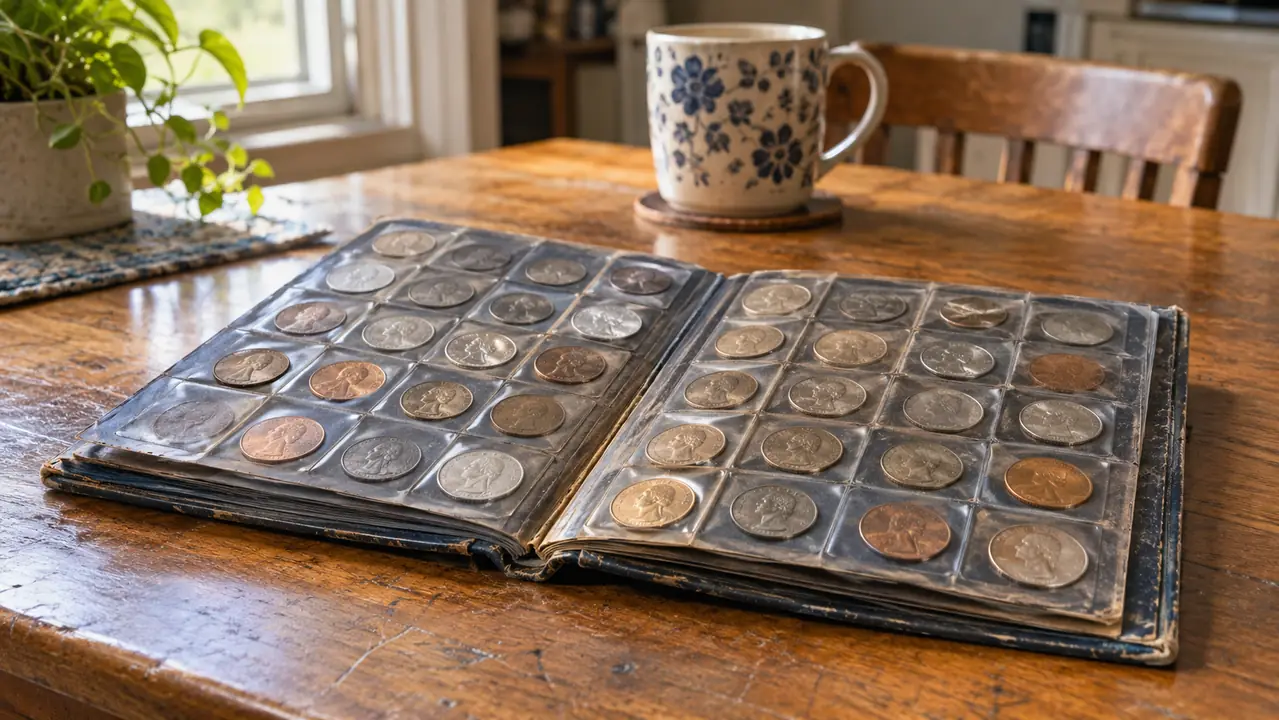
Mistakes I See With Both
The most common mistake with the folder is buying the wrong one. The #2 begins at 1941. If your coffee can starts in the 1930s or earlier, which mine did, you want the earlier folder for that stretch and the #2 for the rest of it. People grab the #2 first because it covers the cents they remember from pocket change, then find out that a third of the pile has nowhere to go.
The most common mistake with an album is not knowing what the pages are made of. If the pages feel soft and smell faintly like a shower curtain, that is information. Slide a common cent into one pocket for a year as a test before you commit anything you care about. I keep a single 1946 Lincoln cent in the back of an album for exactly that purpose and I check it every winter.
With either one, the mistake is handling. Pulling a coin out to show somebody, seating it again, pulling it out for the next visitor. Every one of those trips is a chance to drop it on a hard floor or drag a thumb across the field. The entire point of a labeled hole is that you stop doing that. Look through the hole, not at the coin in your hand.
How I'd Set One Up
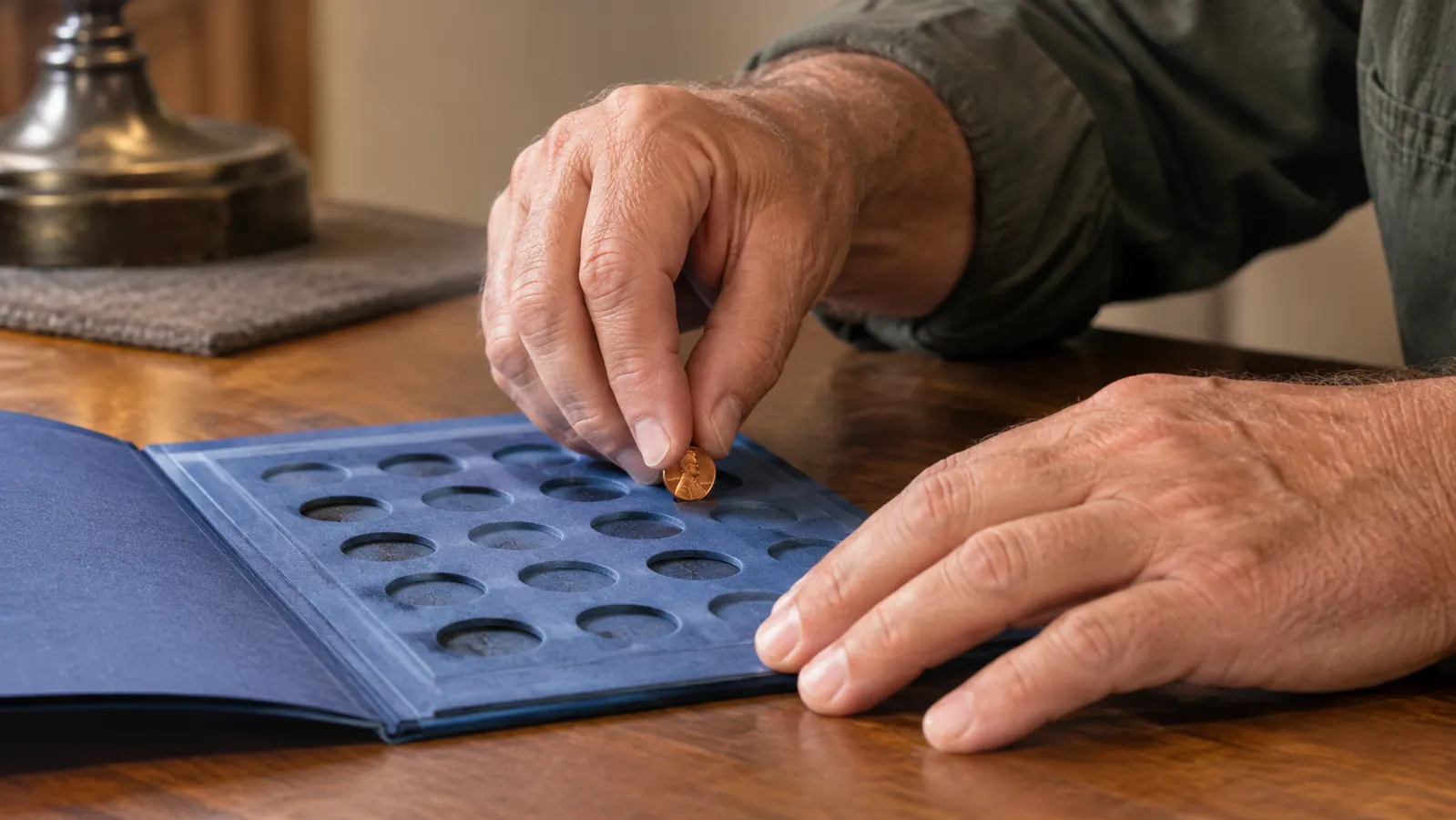
Wash your hands and dry them, then work on felt. I use the desk in my spare bedroom with a lamp over my left shoulder and a felt pad under the folder, and the pad is not decoration. A coin that lands on a hard surface takes a rim ding you will see every time you open that page. Hold a cent by the edges, set it over its hole, and press the rim with your thumb until it drops. If it will not seat, the hole is not the problem and your thumb placement is.
Fill with the coin you have, not the coin you want. A folder with forty holes filled and fifty honest placeholders is a working set, and the empty holes tell you what to hunt for at the next meeting. Upgrade a hole later by pressing the old coin out from the back and seating the better one. Never tape over a hole to hold a loose coin. I have seen what tape residue does to copper and it does not come off with anything I own.
Then put it away properly. Mine goes into the fireproof box in the closet. Not the garage, not the basement, not the top of a bookshelf where the afternoon sun lands on it. Humidity is the quiet enemy of copper and a folder left in a damp room will show it within a couple of seasons. Check the box a few times a year, replace the silica, and leave the coins alone the rest of the time. Handling is the thing you are trying to reduce.
Who Should Buy Which
Buy the Whitman folder if your wheat cents are 1941 or later, if you intend to finish a run, and if the set is going to sit on a shelf and be looked at now and then. Buy the pocket album if you carry coins to meetings, if the collection is a mixed bag with no clear date range, or if you want one book for everything and you are willing to pay for pages that are actually inert. Buying both is not silly. Plenty of us keep the run in the folder and the odds and ends in an album, and that is a perfectly sane way to run a desk.
Maddie works the folder, not the album, and that is deliberate. The printed dates teach her the run in order, and the empty holes give her a reason to look at a coin instead of shuffling it. When she fills a hole she stops and reads the date out loud. You do not get that from a sleeve.
The Empty Holes Are Your Shopping List
Fifty empty holes is not a gap in the set. It is a list of what to look for at the next meeting, and it starts with the dates you are missing. Seat the coins once, keep them out of your hands, and let the folder do the remembering.
Amazon See the Folder on Amazon →