
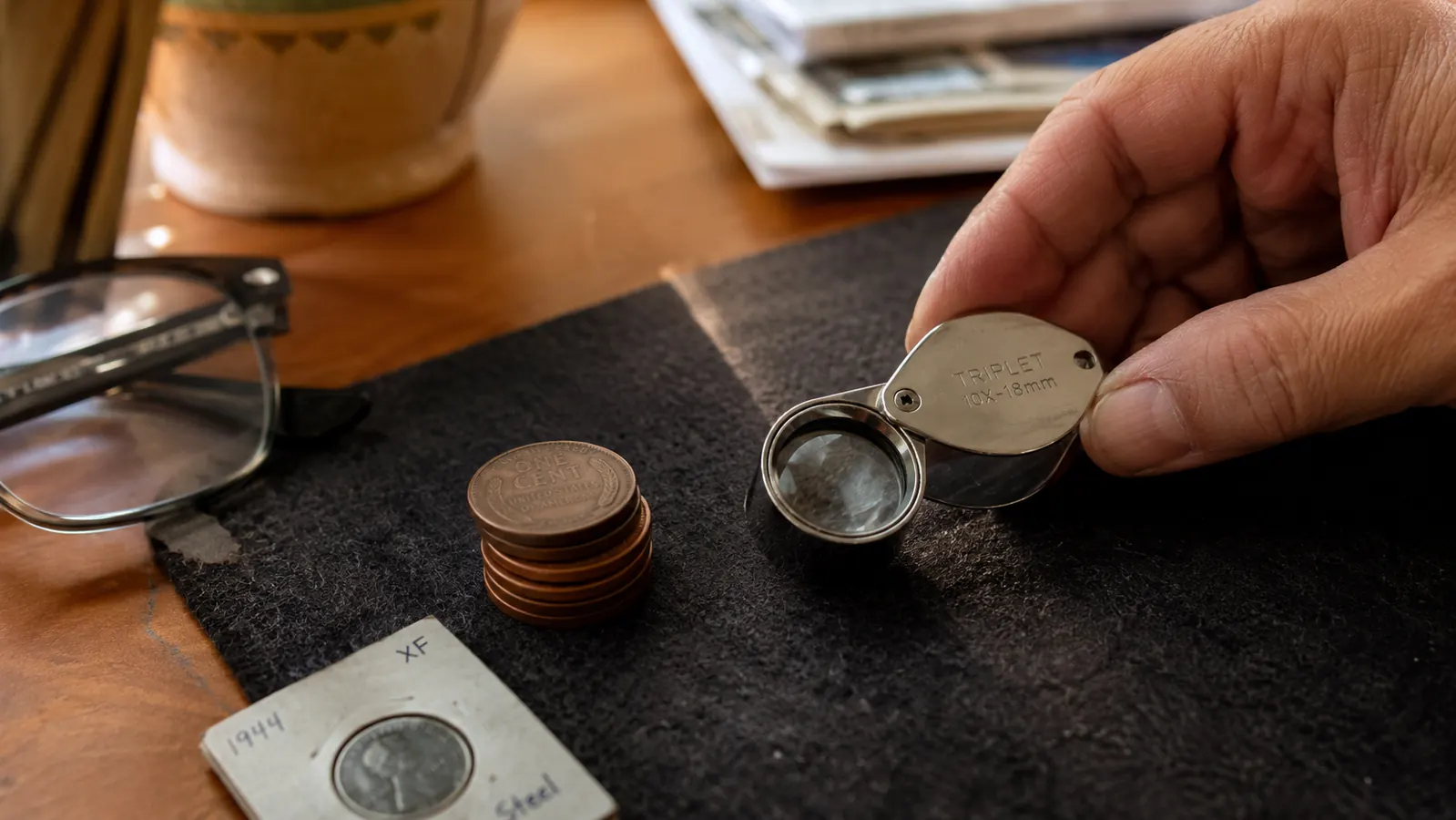
The mint mark on a wheat cent is about the size of a gnat's eyebrow, and it sits directly under the date, right where seventy years of thumbs have been polishing it down. I had a 1936-D in my box for the better part of a decade before I ever actually saw the D. I knew it was there because the folder said so. Seeing it is a different thing. That is the whole reason a loupe earns permanent space on the desk. Not because magnification is impressive on its own, but because a coin you cannot read is a coin you cannot sort, and sorting is most of what this hobby actually is.
I bought the JARLINK 30X 60X Illuminated Jewelers Loupe two winters back, mostly because my desk lamp and I had reached an understanding that stopped working once my eyes turned 60. It has been on the felt pad next to my chair ever since, and it has read a few thousand wheat cents, a couple dozen Morgan dollars, and one very suspicious 1943 that turned out to be exactly what it looked like. My granddaughter Maddie, who is 9 and comes by on weekends, calls it the spyglass. She is not wrong about what it does.
The Quick Verdict
Enough magnification to read a mint mark and the full date in one look, and a built-in light that does what my desk lamp cannot, which is get down inside the coin. The 60X side is fussier than the number suggests, and it eats button cells.
Amazon Check Today's Price →The Light Is What You Are Actually Buying
Every plain magnifier in my drawer has the same problem: it blocks the lamp the moment I put it to my eye, and I end up reading my own shadow. The JARLINK puts the light on the coin instead of behind my head. That is the difference between a tool I own and a tool I use.
Amazon Check Today's Price on Amazon →How I've Used It
My setup is nothing fancy. Spare bedroom, a desk lamp with a flexible neck, a felt pad, and a small fireproof box in the closet for anything I want to keep dry. Carol has opinions about the desk and none about the coins, which is a fair trade. On a typical evening I pull a roll of cents I bought at the club meeting, dump them on the pad, and work through them one at a time. The loupe sits in my left hand and the coin in my right, and I roll the coin, not the glass. That took me a while to learn and it is the single habit that made the whole thing faster.
The 30X side does 90 percent of the work. It is the primary lens, 22mm across, and it shows the whole date and the mint mark at the same time. That matters more than it sounds. When I have to move the glass to read the date and then move it again to find the mint mark, I lose the coin's position and I spend the next minute chasing it around the pad. With the wide side I get the date, the mint mark, and enough of the rim to tell whether I am looking at honest wear or a weak strike off a tired die. The night it clicked for me was a Tuesday in February, a roll of 1944 and 1945 Lincoln cents I had bought cheap because the seller had already been through them. I found eleven with mint marks in under forty minutes, and the reason was that I had stopped moving the glass. I turned the coin under the lens and let the light stay put. Forty minutes a roll is not fast by dealer standards. It is fast for me, and it is why the wide side stays in my hand.
Maddie uses it differently. She holds it flat against the pad with both hands and puts her eye right down on it, which is exactly right and took me two tries to explain. Her job on Saturdays is to pull every coin with a mint mark out of the pile and stack those separately. She is faster than I am now. She is also nine, so half her stack is Philadelphia and she knows it perfectly well, and she does it anyway because the rule is the rule.
What 30X and 60X Actually Show You
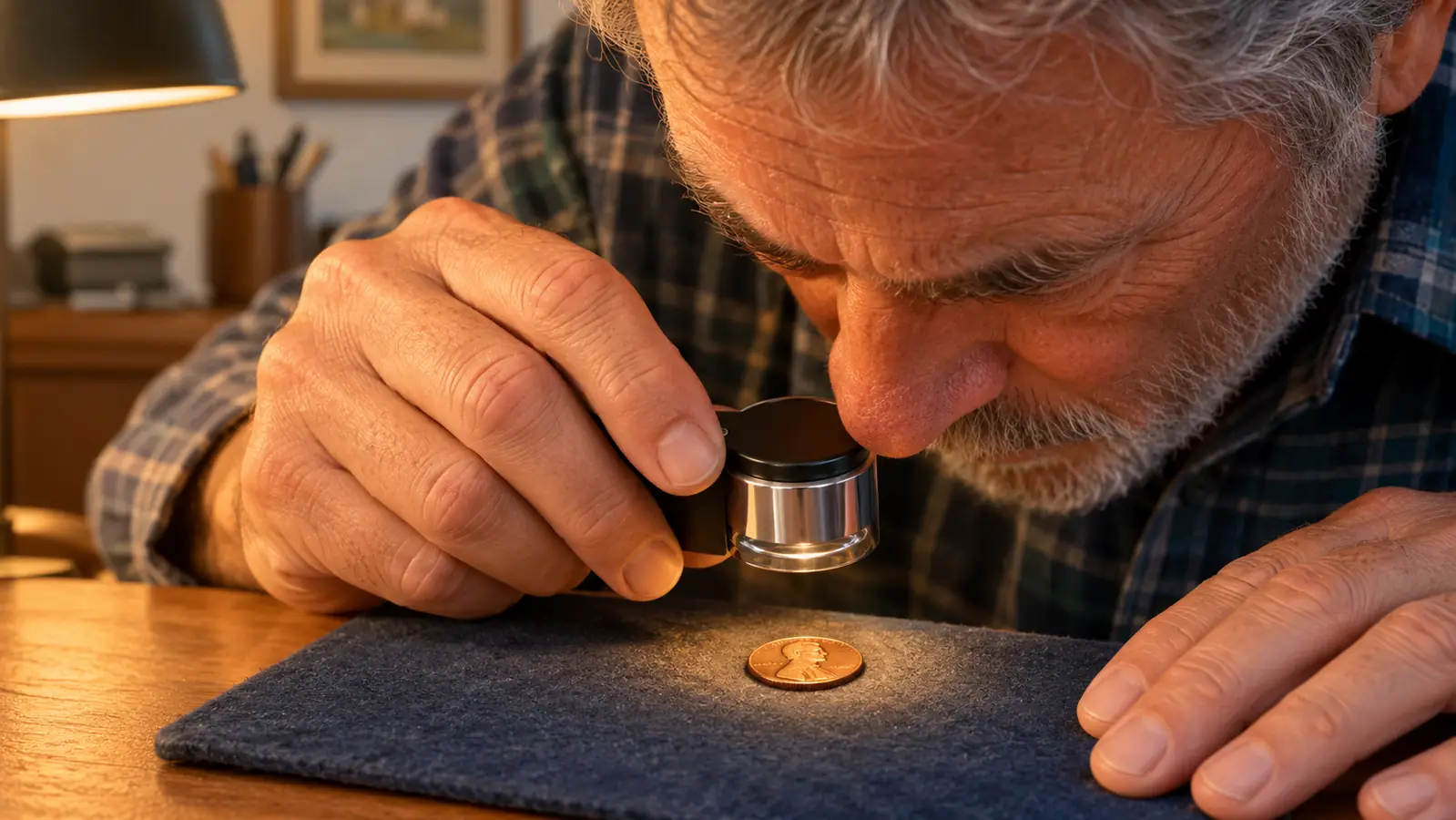
Thirty power is a working magnification for coin detail, not a laboratory number. At 30X the surface of a wheat cent looks like a small landscape, and you can see the difference between a mint mark that was struck and one that has been smoothed away by circulation. The field is wide enough that the coin does not feel like it is fighting you. The lens is resin rather than glass, and that shows up as softness at the edges of the field. In the middle, where the date sits, I have no complaints at all.
The 60X supplementary lens is 12mm across, roughly the width of a pencil eraser, and it is a different tool entirely. The field is small, the working distance is short, and your hand has to stay steady because breathing alone moves the coin in and out of focus. You focus by moving the loupe closer or farther from the coin, so a session with it is a slow back and forth at first. This is the lens I use for one job: checking for die doubling, which is how I talk myself out of most of the varieties I think I have found. The first time I used it I had the loupe pressed flat to the pad and saw a blur, because at that magnification the coin has to sit below the glass rather than under it. Once that clicked, the 60X stopped being a puzzle. It is how I confirmed that the doubling on a 1955 Lincoln cent a club member handed me was machine doubling and not the variety he was hoping for.
What neither lens will do is make a worn coin look sharp. I have heard people say a loupe reveals detail you did not know was there. It does not. It shows you the detail that is there and confirms what is missing. The first coin I put under the 60X was a 1919 that I had convinced myself was a sharper strike than it turned out to be. The loupe settled it in about four seconds. That is worth paying for even when the answer is not the one you wanted.
At 30X I read the date and the mint mark without moving the glass. At 60X I can tell whether the doubling on a 1955 Lincoln cent is real or a tired die. That is the entire job, and it does the entire job.
Reading Mint Marks: The Part That Matters
On a Lincoln wheat cent the mint mark sits below the date, just under the 9. D is Denver, S is San Francisco, and nothing at all means Philadelphia. That last part trips up every beginner I have ever sat with, because they go looking for a P that was never put there. On a Morgan dollar it is on the reverse, above the D and the O in DOLLAR, and it is smaller and shallower than the wheat cent mark. Both read cleanly at 30X in ordinary room light, provided the coin is not worn flat.
I tried other things first. A magnifying glass on a stand failed for the obvious reason, which is that it blocks the lamp. A plastic magnifier from the kitchen drawer was worse, because the light came from behind my head and my own shadow fell across the date. The JARLINK fixed both at once by putting the light on the coin, and it taught me something the books do not: the angle of the light matters more than the amount. Straight down flattens a mint mark. Low and across stands it up.
Light is the part nobody tells you about. Raised metal catches light at an angle and worn metal does not, so the trick is to get the light low and across the coin rather than straight down on top of it. With a plain magnifier that means fighting your own shadow, because your head sits between the lamp and the coin. The LEDs on the JARLINK ring the lens and point down at the subject, so the light travels with the glass. I still use the desk lamp, but now I use it to set the angle and let the loupe fill in the shadow it creates.
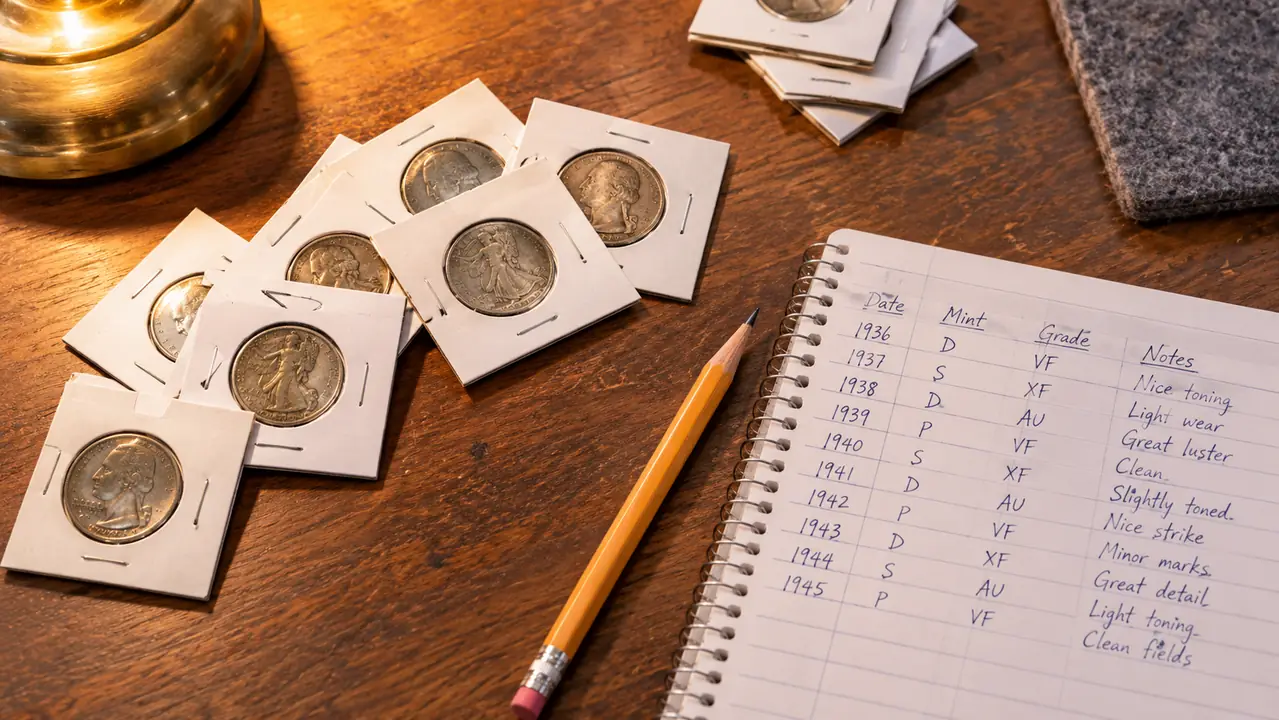
Maddie and I keep a notebook. Every coin that survives the first sort gets a line: date, mint mark, what we think we see, and what the loupe confirmed. She writes the lines because her handwriting is better than mine, which is a sentence I did not expect to write about a nine year old. The notebook is half the reason the loupe is worth having. Without a record you are just looking at coins and forgetting what you saw, and then looking at the same coin again next month.
Where It Falls Short
Three LR1130 button cells run the light, and the package includes a small screw, which tells you the battery door is not a thing you open with a thumbnail on the couch. I change them maybe twice a year at the amount I use it, so plan for it rather than being surprised by it. I keep a spare set in the desk drawer next to the pad. The set in the package got me through a winter and most of the next at a session or two a week, so the life of the cells is not my complaint. The timing is. Nothing on the loupe warns you it is getting dim. It works, and then it works less, and then it does not, and you are holding a glass over a coin in the dark with a full roll still to finish.
The resin lens is the other tradeoff. It is light, which is why the whole loupe weighs 27 grams and I can hold it over a coin for an hour without my hand cramping, and it is not glass. There is softness at the edges of the field on the 60X side, and if you are the sort of person who wants to photograph what you see through a lens, this is not that tool. The fabric bag it comes with keeps dust off. It will not protect the loupe from a hardwood floor, so I do not drop it, and neither does Maddie.
What I Liked
- 30X primary lens shows the date and mint mark together, so you stop repositioning mid-coin
- The ring of LEDs lights the coin from the lens, which keeps your head out of the lamp's way
- 27 grams and small enough to hold over a roll for an hour without hand fatigue
- 60X side is genuinely useful for checking die doubling, not just a number on the package
- Comes with a fabric bag and the button cells it runs on, so it works out of the package
Where It Falls Short
- Field edges go soft at 60X because the lens is resin, not glass
- Battery door needs a small screw, so it is not a tool-free swap
- Short working distance at 60X demands a steady hand and decent light
- The fabric bag protects against dust, not against being dropped
- No way to dim the light, and on a bright proof surface it is more than you need
Batteries, Screw, and Keeping It Working
Care is simple and I still manage to be lazy about it. The lens collects dust, and dust plus a shirt sleeve equals scratches, so I blow on it first and then wipe with a soft cloth rather than my thumb. The bag lives in the desk drawer and the loupe lives in the bag when it is not in my hand. Once a month I check that the LEDs still come on before I sit down for a session, rather than finding out halfway through a roll when I am already committed.
The screw is the only genuinely fussy part. It is small, it is the same size as every other small screw in my life, and it will roll off a desk if you let it. I do battery changes over the felt pad so that when it drops, it drops somewhere I can find it. That is not a complaint about the loupe. That is a note from a man who has spent twenty minutes on his knees with a flashlight, and who would rather you did not.
Who This Is For
This is for the person who already has a box of coins and has started squinting at them. If you are sorting wheat cents, reading mint marks, checking a Morgan reverse, or trying to settle whether a coin has doubling, the JARLINK does the job without asking you to learn a piece of equipment first. It is also a good first loupe to hand a kid. It is light, the light is built in, there is nothing to configure, and there is nothing on it that a bag and a little care will not protect.
Who Should Skip It
If you are photographing coins for sale, skip it. You want a camera setup and a proper macro lens, and this is not that. If your close vision is still good and you only sort by date, you probably do not need magnification yet, and you will know when you do. And if you work with slabbed coins, understand that you are now looking through plastic as well, so you are reading the coin through two layers. It still works. It works less well, and you should know that going in rather than being disappointed by it.
Get the Light, Then Get the Notebook
My grandfather sorted his coffee can by eye and gave up on the mint marks entirely, so a whole layer of the hobby never opened up for him. Whatever loupe you end up with, get one that lights the coin, keep it in the bag, and write down what you see. The writing is what turns looking into a collection.
Amazon Check Today's Price on Amazon →