
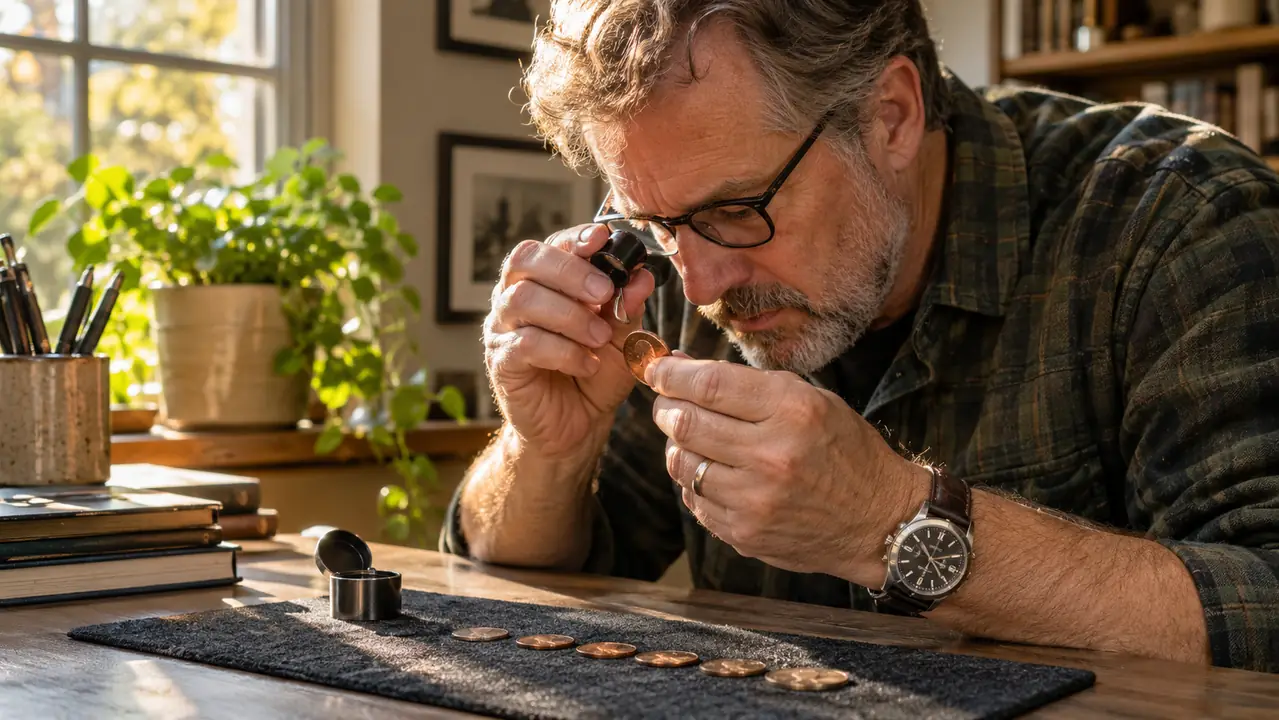
The mint mark is the smallest thing on a coin and the biggest reason people misread one. On a Lincoln wheat cent it sits under the date, one letter, pressed into the planchet by a punch the size of a pinhead. From arm's length it is a smudge. That smudge is the whole reason you set a coin aside instead of dropping it in the ordinary box. I have watched men at my coin club argue for ten minutes about a letter neither of them could actually see. I have been one of those men.
For a while I did what everyone does. I tilted the coin toward the lamp and squinted. Then I tried the phone camera, zooming in on the picture, which works better than people admit until the autofocus hunts and the letter turns to mush. A magnifying glass from the junk drawer got me closer, but it sat flat and the lamp bounced straight off the coin's surface into my eye. What finally fixed it was a jeweler's loupe. Mine is the JARLINK 30X 60X illuminated loupe, a pocket-sized magnifier with two lenses and a built-in LED, and it lives in my shirt pocket now the way a pen used to.
The letter is already on the coin. This is the lens that lets you read it.
Two lenses in one body: 30x for finding the mark, 60x for settling what it says, with an LED that rakes light across the surface instead of straight into your eye. Three LR1130 batteries, a small screw and a fabric bag come in the package.
Amazon Check Today's Price on Amazon →Step 1: Fix the light before you touch the magnification
Every bad read I have made started with bad light. The eye is willing, the coin is fine, and the letter still comes out wrong because light is arriving from four directions at once and the surface is throwing it back in your face. I work at a desk in the spare bedroom with one lamp, and I turn the ceiling light off. That single change did more for my reading than the first loupe I owned.
Set the coin on something that will not scratch it. A felt pad, a folded piece of clean cloth, a sheet of card stock. Something dark is better than something white if the coin is bright, because the edges stop blooming into the background. Then bring the lamp in from the side, low, almost skimming the surface. Light that rakes across metal shows you things that light falling straight down will hide.
The LED built into the JARLINK gives you that raking angle in a pocket. It runs on three LR1130 button batteries, which are in the package along with a fabric bag and a small screw, so there is no trip to the hardware store before you can use it. I still use the desk lamp to get the coin oriented and the loupe light for the fine read. Two lights, both from the side, and the letter stops being a shadow.
Step 2: Find the mint mark at 30x before you try to read it
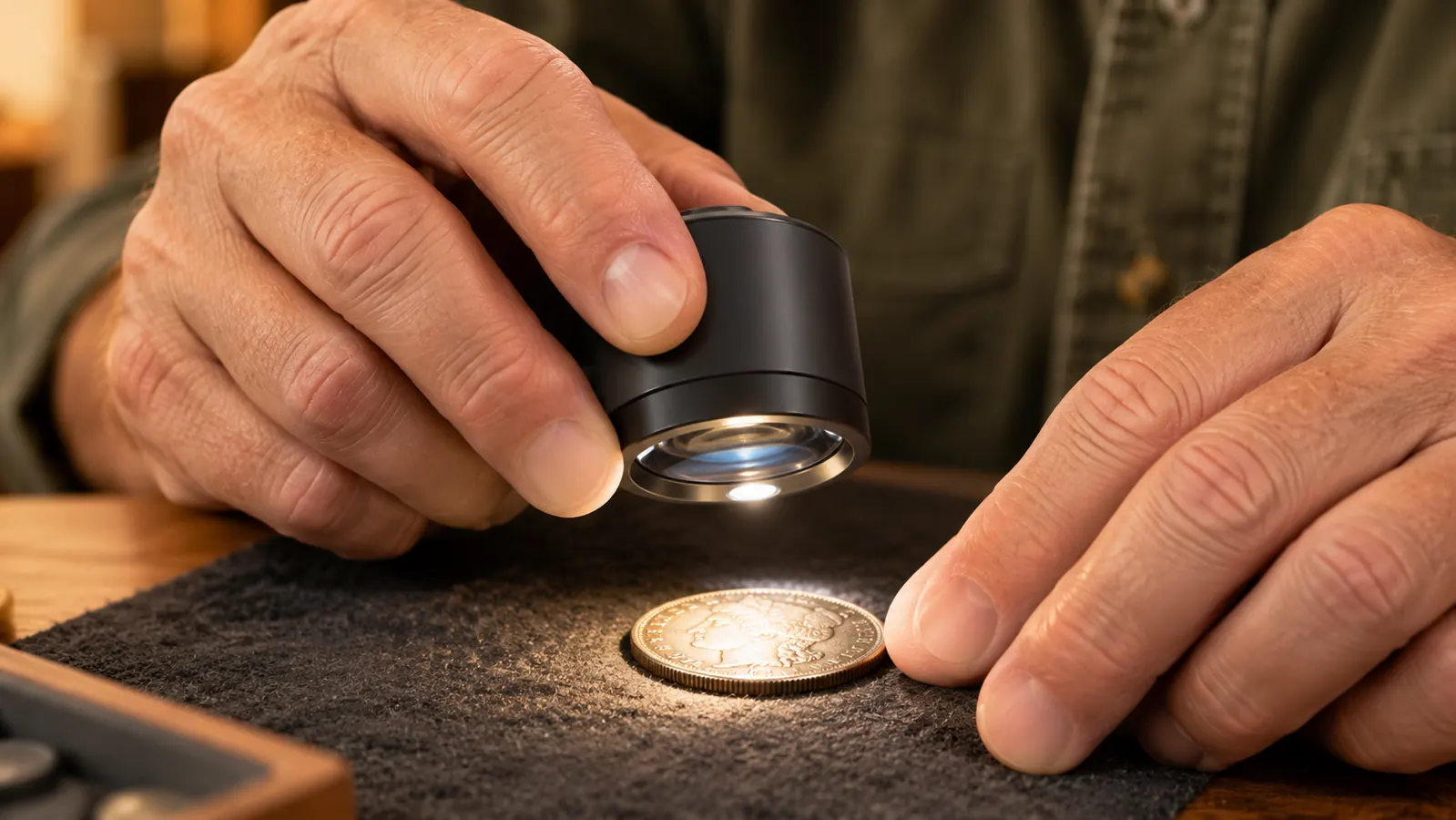
The primary lens is 30 power with a 22mm opening. That is the wide one, and its job is not to read the letter. Its job is to find it. At 30x you can hold the whole date area of a wheat cent in view and see where a mint mark ought to be before you worry about what it says. My grandfather's coffee can had cents in it from three mints, and I spent an entire winter looking at them wrong because I started at the highest magnification I had and never backed out.
On a Lincoln cent the mint mark is under the date. D for Denver, S for San Francisco, nothing at all for Philadelphia. On a Morgan dollar you turn the coin over and look at the reverse, in the wreath above the D and the O in DOLLAR. Knowing where to look saves you from scanning the entire face of a coin at high power, which is how most people give up and put the thing back in the box.
I sat Maddie down with a roll of wheat cents last month and made her find the mint marks at 30x before she was allowed to look at anything else. She found four Philadelphia coins in a row and got bored, which is the correct reaction. Then she found an S and did not believe it was there. That is the moment the hobby catches, and it does not happen at 60 power. It happens when the whole coin makes sense at once.
Step 3: Switch to the 60x lens to settle what the letter says
The second lens is 60 power with a 12mm opening, and it is a different tool wearing the same body. The field is narrow. You put the coin down flat, center the lens over the mark, and move the whole loupe toward the coin until the letter snaps. Trying to hold it steady in the air and lean in at the same time is how you get a headache and no answer.
At 60x a mint mark stops being a dot and becomes a shape. You can see whether a D has flat serifs or sloped ones, whether an S leans, whether the punch was struck twice and left a doubled edge. You can also see that what looked like a mint mark at 30x is a contact mark, which happens more often than anybody likes to admit at a club meeting. The narrow lens is the one that settles arguments.
What you give up is context. At 60x you are looking at a patch of metal the size of a grain of rice and you cannot tell where on the coin you are. That is why the order matters. Find it wide, read it narrow, then pull back out to confirm you were in the right place. I do that pull-back every single time now, and I catch a mistake maybe one coin in twenty.
At 30 power the mint mark was a smudge. At 60 it was an S, sitting a little left of where it should be. Same coin. Same ten seconds. The only thing that changed was the lens.
Step 4: Read wear from the high points, not the flat fields
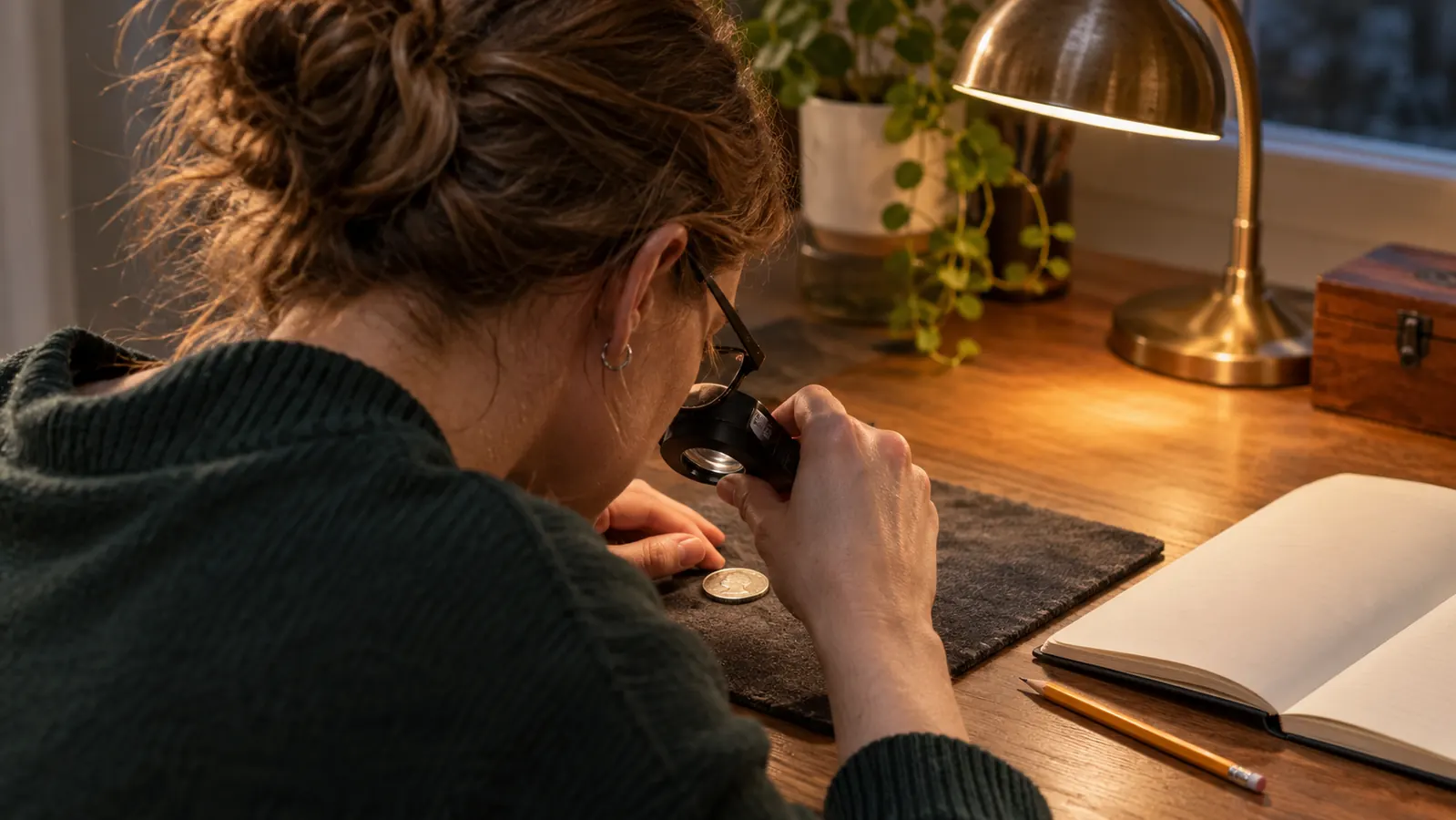
A loupe is not only for mint marks. Once the light is raking and the coin is steady, the high points tell you how much metal has been worn away. On a wheat cent that means the cheekbone, the jaw line, and the fold of the shoulder. On a Morgan it means the ear, the hair just above it, and the breast feathers of the eagle. Those are the first places to go soft on a circulated coin.
Wear is not the same thing as damage, and the loupe is how you learn the difference. A worn high point is smooth and gradual, like a stone in a creek. A hit is a crater with a raised lip around it. A cleaning shows up as a field full of fine parallel lines all running the same direction, and once you have looked at a few you will spot them from across the table without any magnification at all.
I use the 30x for wear and save the 60x for anything that looks suspicious at 30x. Judging a whole coin at 60 power is like reading a book through a keyhole. You will find flaws, and you will find so many of them that you talk yourself out of a perfectly good coin that was never going to be anything else anyway.
Step 5: Write down what you saw before you put the coin away
The last step is the one nobody does. Write it down. A 3x5 card, the date, what you looked at, what lens you used, what you concluded. Mine look like this: 1944 wheat, mark under date, reads S at 60x, cheek smooth, two hits on the rim, keep. It takes thirty seconds and it saves you from redoing the same work in two years with worse eyes.
Maddie has her own stack of cards now, in her handwriting, and they are mostly wrong in ways that are useful. She called a contact mark a mint mark on the first one. Having it written down meant she could look at that coin again later and see exactly what she had missed. That is the whole point. The card is a record of your own calibration, and calibration moves.
Keep the cards with the coins or keep them in a small box on the bench. Either way, when you come back to a coin you will know what you saw and when you saw it, and you will not have to lean on a memory that has been quietly rewriting itself since the day you first looked.
What Else Helps
Get your coins off bare wood and off anything soft plastic that smells like a beach ball. PVC holders give off gas that will etch a coin surface over years, and you will not notice until it is a permanent haze that no amount of careful wiping will lift. Cardboard 2x2 holders with Mylar windows are safe, and they give you a place to write the date and your conclusion right on the holder where you will actually find it.
Handle by the edges. Not because a fingerprint ruins a coin on contact, but because skin oil is acidic and it sits there, and thirty years later the print is a darker patch that will not come off without abrasive, and abrasive is how a coin gets ruined for good. I wash my hands and dry them before I sit down. That is enough for what I do. Gloves are fine if they make you comfortable, but clean dry hands beat a dirty glove every time.
Store the box somewhere the humidity does not swing. A closet shelf in the middle of the house, not a basement, not a garage, not the top of a furnace. Silver will tone, and tone is not the end of the world, but a damp environment is how you end up with the white powdery spots that are.
Keep the fabric bag that comes with the JARLINK in the drawer next to the loupe. Dust on a lens at 60 power is a snowstorm. Wipe the lens with a clean cloth, not your shirt, and keep the spare batteries where you can put your hand on them, because the light will die in the middle of the best coin you have looked at all month. It always does.
One lens to find it. One lens to read it. Start with the coin already in your hand.
The 30x finds the mark and the 60x settles what the letter says. Three LR1130 batteries, a small screw and a fabric bag are in the package, so it is ready the evening it arrives.
Amazon See the JARLINK Loupe on Amazon →