
Nobody tells you that the slab is only half the job. You mail a coin off, it comes back in a hard plastic holder with a printed label on it, and now you own an object that will not go in a Whitman folder, will not go in a tube, and will not stack square on a shelf. For about a month my first graded coins lived in a shoebox on the closet floor, which is a fine home for extension cords and a poor one for anything you hope to hand down.
I have had the PCGS Plastic Storage Box for 20 Slab Coin Holders in service for fourteen months. It has been full the entire time and it has not cracked, warped, or let go of a single holder. This is the honest pass at a review, which means I am going to spend as much room on the two things it does not do as on the twenty things it does. If you are weighing it against an aluminum case or a drawer insert, the paragraphs below are the ones that actually decide it.
The Quick Verdict
A tidy, sturdy 20-slot tray that does one job well. Buy it to organize graded slabs, not to protect them from moisture. The listing says so itself.
Amazon Check Today's Price →Twenty slabs, one tray, nothing sliding around
Fixed slots, a stackable footprint, and 16 ounces empty so a kid can carry it. It ends the shoebox era the day it arrives.
Amazon Check Today's Price on Amazon →How I've Used It
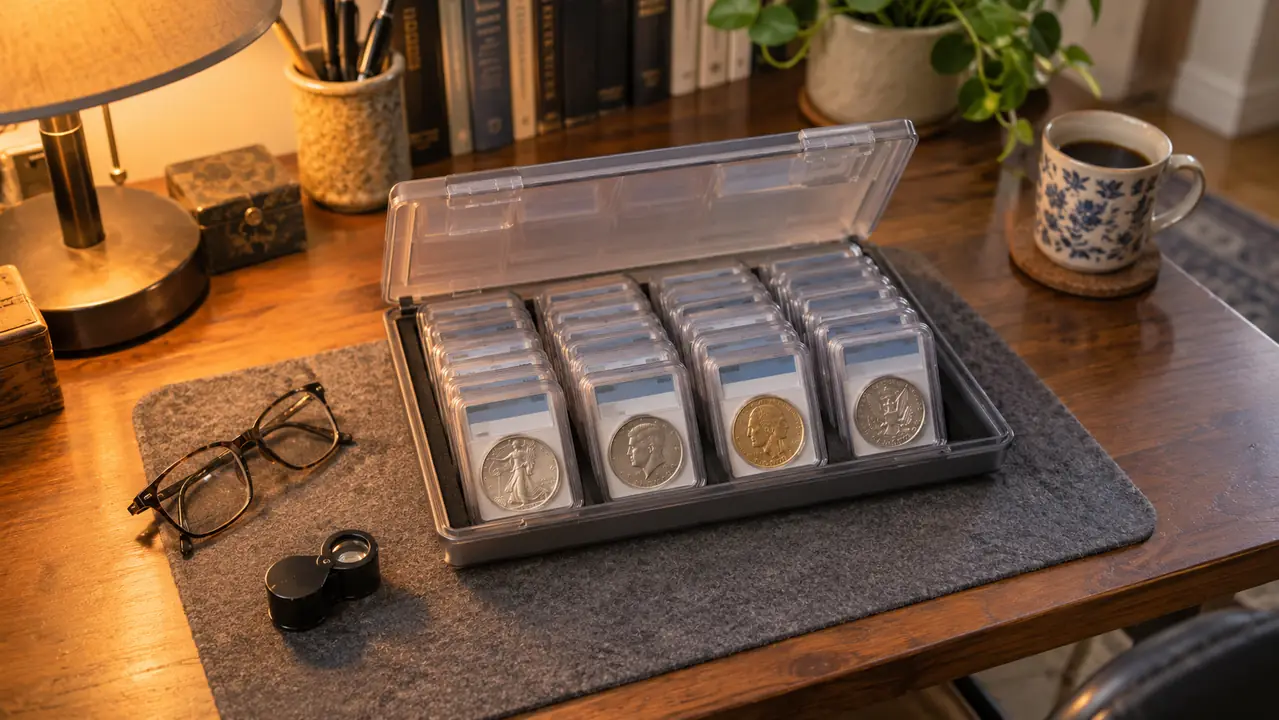
The box sits on the desk in my spare bedroom, next to the lamp and the felt pad. I am 63, retired out of a machine shop in Dayton, and I came back to collecting after forty years away, so the slabs arrived faster than any storage plan did. My first attempt was a plastic shoebox with strips of card glued across the bottom to make lanes. That lasted about six weeks. The card took up the least bit of damp in the air and went soft, the lanes drifted out of square, and the slabs leaned into one another until the printed labels were rubbing face to face. A machinist cannot look at a crooked row without wanting to square it up, so the shoebox had to go. The PCGS tray replaced it and the rows have been straight ever since.
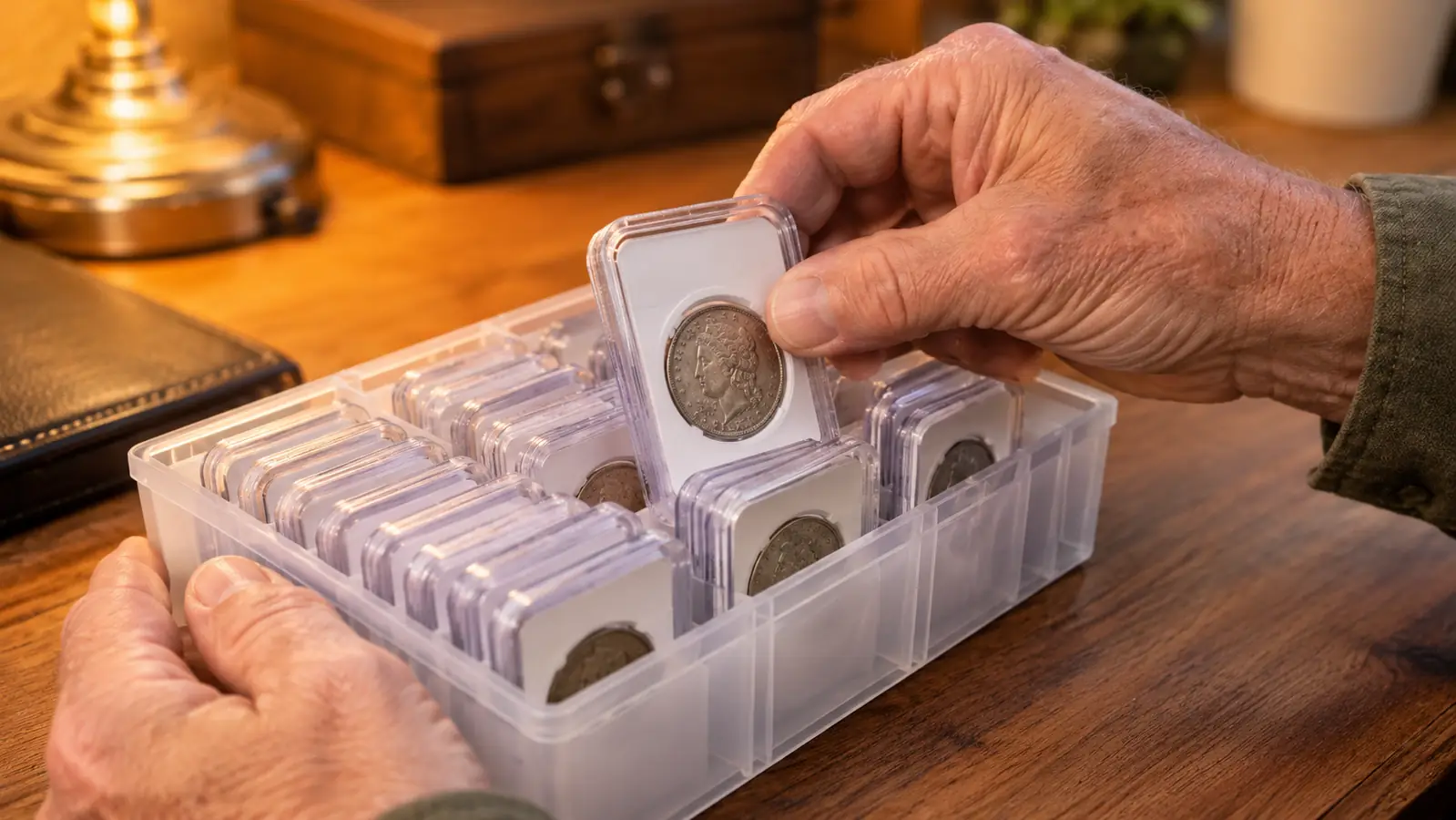
What I did not expect to care about, and do, is that the box makes the collection countable at a glance. Twenty slots is a fixed number. When it is full I know exactly where I stand, and when my granddaughter Maddie comes over on Saturdays she can pull the whole thing onto the felt pad and we can go through it in one sitting without a stack sliding apart halfway. She is nine. Handling is the entire lesson at that age, and a tray that stays put is a better teacher than a pile that does not. The first Saturday we used it she got through fourteen of the twenty before her attention went, and she put all fourteen back in the right slots without being asked. I have thought about that more than I probably should.
The box is light, 16 ounces empty, so a loaded one is still something a child can carry with both hands. It measures 9 inches long by 3.5 wide by 2.75 tall, which takes up less than a third of a shelf. I measured the shelf before I ordered, because I have bought enough plastic trays in my life to know that 9 inches of box plus a couple inches of clearance for fingers is not 9 inches of shelf. Capacity works out to 87.75 cubic inches if you are the sort of person who likes a number, and I am, so there it is. Carol tolerates the hobby and has so far said nothing about the shelf space, which I take as a warning to keep it tidy. Four of these stacked is roughly where I am heading.
What This Box Actually Is, and What It Is Not
Strip it down and it is a rectangular plastic tray with twenty slots and a snap lid. No assembly, nothing to put together, it comes out of the shipping carton ready to load. Material is plastic, closure is a snap, the shape is rectangular, the pattern is solid, and the listing carries stackable as a special feature, which is the one feature I actually use every week. Recommended use is storage. Mintage is listed as one count, which is Amazon's way of saying you are buying one box, and I laugh at that line every time I see it on a coin supply page, because a mintage of one is not a term anybody in this hobby would ever use.
What it is not is a display case, a safe, or a sealed environment. The listing says not water resistant, and that is the single most important line on the page. This is storage for graded slabs in the same way a cardboard flip is storage for a raw coin. It organizes, it keeps dust and light off, and it stops twenty separate objects from becoming a pile. It does not keep out air, and in Ohio from June through September that distinction matters more than the slot count does.
I keep a cheap humidity gauge on the same shelf. It did not come with the box and the box makes no claim about it. I put it there because I wanted to know what the room was doing rather than guess. In July it reads in the low sixties most afternoons. I wrote the number down twice, once with the lid sitting open while I worked and once with the lid snapped down overnight, and the two readings were the same to my eye. That is the whole argument in one line of pencil. A lid that snaps is not a lid that seals, and no amount of wanting it otherwise changes the arithmetic.
I want to be plain about that, because I have paid for the lesson. Years back I left a few raw wheat cents in a coffee can in a basement that got damp every spring, and the difference in those cents a year later was not subtle. Moisture does not announce itself. It works slowly through paper and cardboard and it leaves a mark that does not come off. Whatever you store coins in, if it is not sealed, it is not sealed, and this box is not sealed.
The Lid: What Snap Closure Actually Means in Practice
Snap closure sounds more substantial than it is. What it means here is that the lid presses down onto the box and stays there under its own tension. It comes off in one piece when you want it off. There is no latch, no clasp, no lock, and nothing that clicks to tell you the seal is tight, because it is not tight. It is closed. That is the whole claim, and the product does not overstate it.
For a shelf in a dry room that is enough. It keeps dust off, it keeps the slabs from shifting, and it stays on if you carry the box flat with two hands. Tip it on its side with a full load and you will want a palm under the lid. I found that out in the second week, carrying a full tray from the desk to the closet while tucking a loupe under one arm, and I caught it before anything slid. Nothing broke. But I carry it flat now, both hands, and I set it down before I open anything. That is not a defect, it is what a snap lid is, and I would rather have an honest snap than a fake latch that wears out in two years.
There is a second thing nobody mentions. Because the lid comes completely off, you have to put it down somewhere. On my desk that means the lid lands on the felt pad, and then the lid has to move before the pad is usable, and then I set it somewhere else and forget where. Fourteen months in, this is the one thing that still irritates me on a weekly basis, and it is the reason the verdict above says four stars and not five. My fix cost me nothing and I should have thought of it in month one. The lid now goes on the far corner of the desk, upside down, and it stays there until the box is closed again. That tiny piece of order took me a year to establish, which tells you something about me and possibly about you.
Twenty Slots, and Where the Fit Gets Tight
Twenty is a specific number and it will not suit everybody. The slots are cut for the standard graded holder. Mine all came back from PCGS, so they all sit the same way, and a full box looks like a full box should. If you have holders from another grading service, or older slabs from years when the plastic ran a little thicker, check the ones you own before you assume they will all glide in. I say that as a man who assumed.
Of my twenty, two older PCGS holders fit snug enough that I have to tip the box to get them out, and one sits loose enough to rattle if I shake the tray. That is not the box misbehaving. It is plastic tolerances meeting plastic from three different decades. What I did about it was load the tight ones in the end slots where my fingers can reach them and keep the middle for the ones that slide. When you tip the box to free a tight holder, hold the lid with your thumb, because a snap lid does not care how careful you were last time. Small workaround. It took me a year to arrive at it, which tells you something about me.
The other limit is the obvious one. Twenty slots means twenty slabs. There is no divider system, no adjustability, no room to add. When you outgrow it you buy a second box, and then you have two boxes that stack, which is plainly the design intent. What that means in a real collection is that you will eventually sort by category whether you planned to or not. My Morgans fill the front rows and the wheat cents take the back, and when the back rows fill I will not reshuffle, I will buy another tray and start a second category. If you want one container that grows with the collection, this is not that container and it never will be. It is a tray, and trays have a size.
Humidity, Dust, and the Water Resistance Line
Here is the part I would want a stranger to tell me before I spent anything. Plastic is a vapor barrier in the sense that water will not soak through it, but a snap lid without a gasket is not a seal. Air moves. Moisture inside the box will reach equilibrium with the room within days. If your spare bedroom sits at 60 percent relative humidity in July, so do your slabs, and the box is not going to argue with the weather.
So the box is excellent for organization and indifferent for protection. If you live somewhere dry, that trade is fine and you will never think about it again. If you live somewhere wet, or you store coins in a basement, a garage, or a porch closet, you need something this box is not. Silica packets help a little and they exhaust themselves in silence, so you have to remember to swap them, and most of us do not remember. I tried the packet route for one summer. I put three in the tray in June, wrote the date on the calendar in the kitchen, and by August the calendar page had been turned twice and the packets were still the ones from June. That is not a storage system. That is a good intention in a bag.
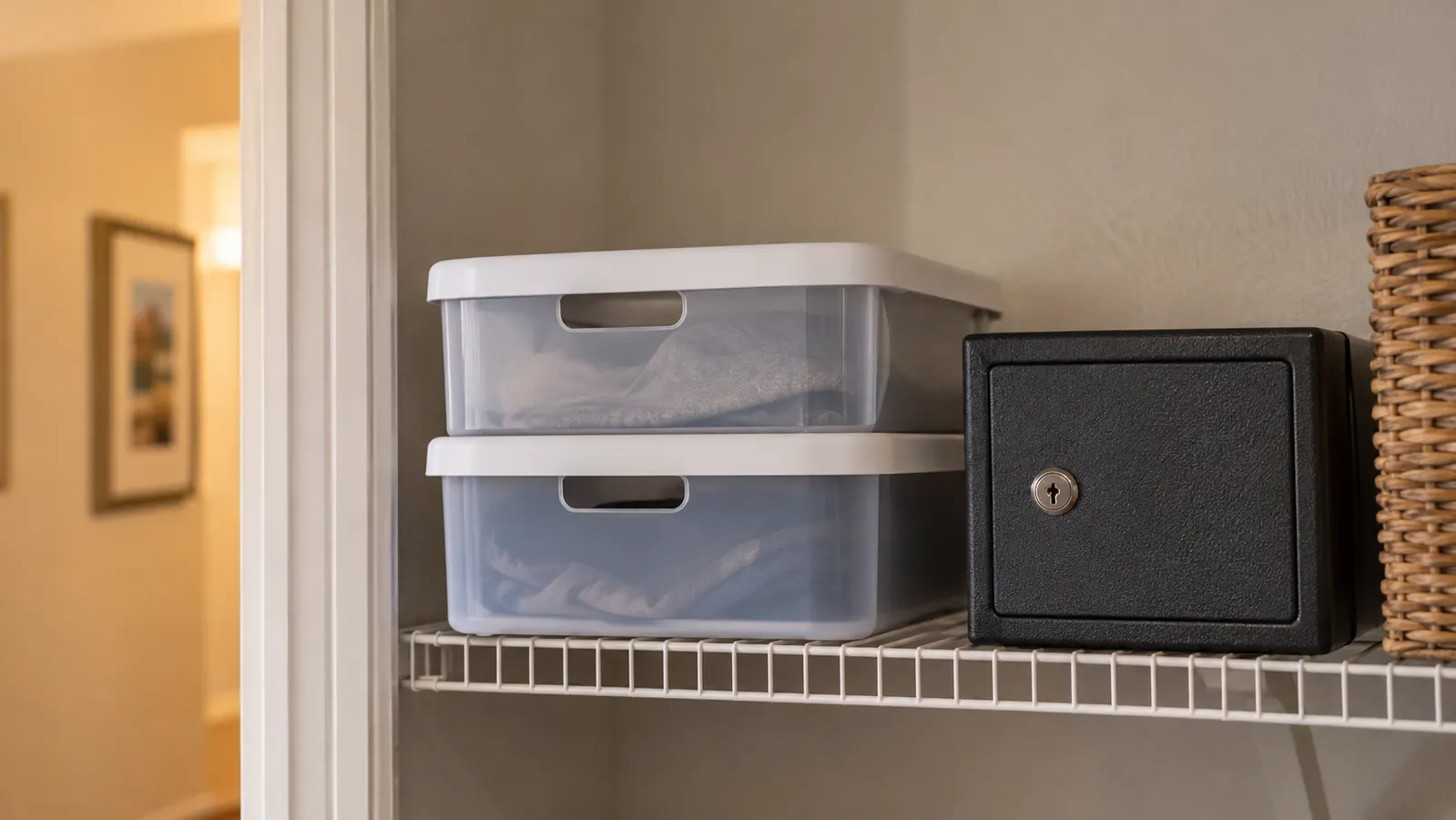
What I do costs nothing. The box lives in the closet in the spare bedroom, on a shelf above the floor, off the exterior wall, with the lid on and the light off. Off the floor, off the outside wall, out of the sun. The box handles the fourth job on its own, which is keeping twenty slabs from becoming twenty loose objects. That is a real job and I do not want to sound like I am dismissing it. I am just telling you where the job ends.
What I Liked
- Twenty slots hold a full run of standard graded slabs in one place instead of a pile
- Stackable, so a second box does not need a second shelf
- 16 ounces empty, light enough for a nine-year-old to carry with two hands
- Snap lid keeps dust off and stops slabs shifting when the box is carried flat
- No assembly, it loads straight out of the carton
- Fixed slot count makes the collection countable at a glance
Where It Falls Short
- Not water resistant, so it does nothing about humidity
- The lid comes fully off and has to be set down somewhere every single time
- Fixed at 20 slots with no dividers and no adjustability
- Thicker or older holders can fit tight enough to need tipping the box
- No latch and no lock, so it is not a security container
Plastic stops the dust. It does not stop the air, and in Dayton in July the air is the problem.
Who This Is For
This is for the collector who has crossed the line from raw coins in flips to graded slabs and needs somewhere to put them that is not a shoebox. If your slabs currently live in a drawer, on a stack on the corner of a desk, or in the bottom of a closet, this solves that completely and does it without asking you to reorganize the room. It also suits anyone teaching the hobby to somebody else. Maddie and I go through the box on Saturday mornings and the fixed slot count means nothing gets shuffled back into the wrong place while we talk. And it suits the collector storing in a climate-controlled room where humidity is already handled, because there the box's one real weakness never comes up and you are left with a tidy, stackable, lightweight tray that does exactly what it claims. That is the setting I am in, and in that setting I would buy it again without thinking about it.
Who Should Skip It
Skip it if your coins live anywhere damp. A basement, a garage, a shed, a porch closet, or a house without air conditioning in a humid part of the country. The listing says not water resistant in plain language and I am repeating it because a plastic box feels more protective than it is. Skip it if you are storing raw coins in cardboard flips, since the slots are cut for slabs and flips will slide around and the whole point is lost. Skip it if you want one container to hold everything forever, because twenty is the ceiling. And skip it if you need a lock, because there is not one. What I do with the Morgans is put the whole tray inside the small fireproof box in the closet, which gives me the seal the tray does not have and the organization the fireproof box does not have. Two objects, one job each.
The part of grading that keeps them sorted
Twenty fixed slots, a stackable footprint, and a price you can check yourself on the listing. Load it once and stop handling your slabs three at a time.
Amazon Check Today's Price on Amazon →