
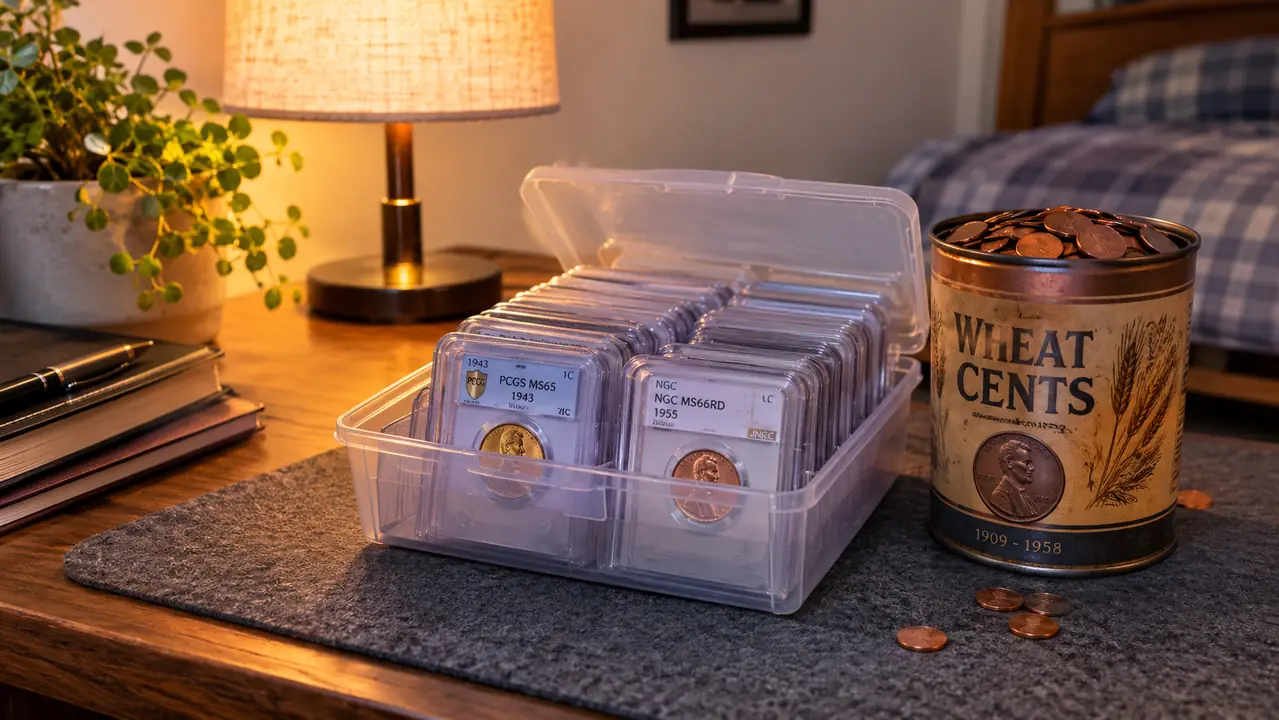
Ray Delcourt here. I keep my graded Lincoln wheat cents and Morgan dollars at a desk in my spare bedroom in Dayton, Ohio, and I have used both a PCGS slab box and a plain aluminum coin case for the same job. The short answer is that they are not the same tool. The PCGS Plastic Storage Box for 20 Slab Coin Holders is the better home for slabs that stay on a closet shelf. It holds 20 slab holders, stacks, and weighs 16 ounces empty. An aluminum coin case is the better shell when the coins travel and the box is likely to get knocked. Neither one is a safe. Neither one stops humidity. Pick the one that matches where the coins actually live.
I am 63 and retired from the toolroom, so I look at a box the way I look at a fixture: does it hold the part without rattle, can I get the part out, and will it stay where I put it. My grandfather left me a coffee can of wheat cents when I was 11. I picked the hobby back up after I retired. On Saturdays my granddaughter Maddie, who is 9, sits at the desk with me and learns to hold a slab by the edges and put it back where it came from. That is the real test for a storage box in this house. It has to survive a child's hands, a desk lamp, and a closet shelf. It does not have to survive a bank vault, because it is not in one.
How I Compared Them
I did not run a lab test. I used both boxes the way a hobbyist uses them. The PCGS box sat on my desk for a month while I sorted wheat cents by date and mint mark, then went to the closet shelf. The aluminum case went to two club meetings and rode in the back seat of my truck. I looked at four things: whether the slabs fit without rattle, whether I could get one out without dumping the rest, whether the box stayed closed in a bag, and whether it stacked or slid. Those are the questions that matter after the novelty wears off.
A note on the word test. I am not a dealer and I do not have a vault. I have a desk, a lamp, a felt pad, a small fireproof box in the closet, and a wife named Carol who tolerates the hobby. My standard is simple. If a box makes me more likely to put a slab away instead of leaving it out, it is doing its job. If it makes me avoid the closet because it is a hassle, it is not. That is how I ranked the rows in the table.
The first thing I tried was a plastic parts tray from the hardware store, the kind with the little molded dividers. It cost almost nothing and I thought I was being smart. It lasted one evening. The dividers are sized for screws and washers, not slabs, so a slab sat at an angle and the next one leaned on it. When I picked the tray up to move it to the shelf, two slabs slid out of their slots and dropped onto the desk. Nothing was damaged. But I sat there for a minute thinking about how close that was to the hardwood, and I decided I was done improvising. A tray that lets a slab shift is a tray that teaches you to leave coins sitting out. I walked it back to the garage where it belonged and ordered the PCGS box the next week.
Side by Side
| PCGS Slab Box | Aluminum Coin Case | |
|---|---|---|
| Holds graded slabs | Made for 20 slab holders, so the count is settled before you open it. | A general aluminum case holds slabs only if it has the right inserts; many ship set up for raw coins. |
| Shell rigidity | Plastic shell keeps its shape on a shelf, but a hard knock can crack it. | Aluminum shell takes a knock and dents instead of cracking, which is the main reason to pick metal. |
| Stacking | Stackable, per the maker, so several boxes sit square on a closet shelf. | Rounded metal edges and a latch make a pile of cases unstable. |
| Weight | 16 ounces empty, light enough to lift with one hand. | Metal shell and inserts add heft, which you feel on a walk to the meeting. |
| Access | The snap closure is the only step between you and the slabs. | Trays or foam often have to come out to reach the bottom layer. |
| Drop protection | A drop on concrete can pop the snap or crack the plastic. | A metal case is more forgiving of a drop, though a hard hit can still spring a latch. |
| Water resistance | Not water resistant. | Most basic aluminum cases are not water resistant either unless they have a gasket. |
| Travel in a vehicle | Fine for a desk or closet; in a bag, the snap can be knocked open. | A latch and rigid shell are more at home in a truck or a carry bag. |
Where the PCGS Slab Box Wins
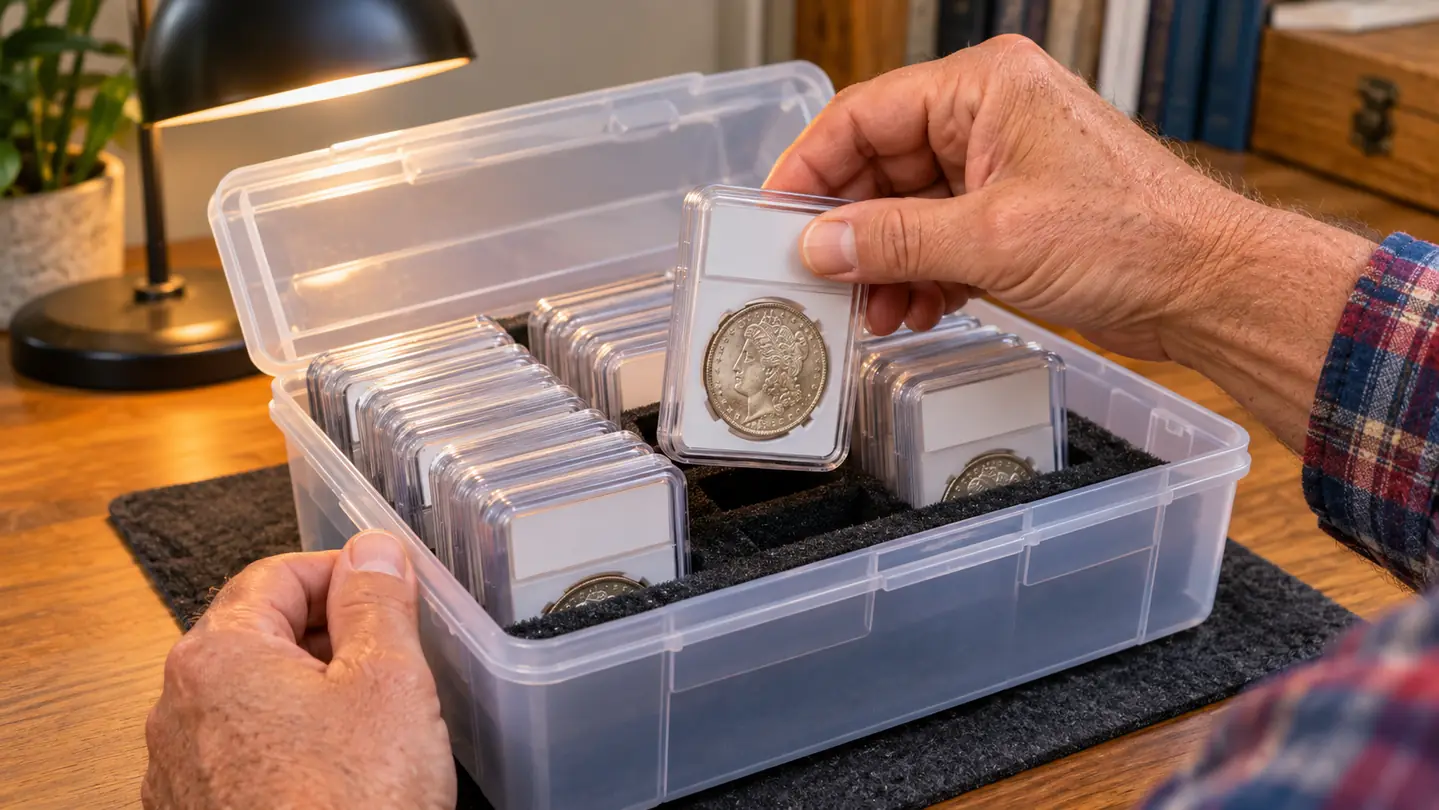
The PCGS box wins on fit and on the plain fact that it is made for slabs. The listing says 20 slab coin holders, and that is the number I plan around. I do not have to guess whether a tray will take a slab or whether a slab will slide around in a compartment made for raw coins. The outside is 9 by 3.5 by 2.75 inches, so it fits on a shelf beside a fireproof box without taking the whole shelf. Empty weight is 16 ounces. When my hands are stiff in the morning, a light box I can pull down with one hand is the difference between putting a coin away and leaving it on the desk.
I measured the closet shelf before I ordered anything, because I have been burned before by a box that did not fit the space I had. The shelf is 12 inches deep and the PCGS box is 9 inches long, so it leaves about 3 inches at the front edge. That gap is where the felt pad lives when it is folded. The 3.5 inch width means I can set one down between the base of the desk lamp and the edge of the desk without shoving anything aside, and the 2.75 inch height means a stack of two still clears the shelf above with room to spare. Three boxes fit side by side with the small fireproof box at the right end. Do that arithmetic before you buy your second box. A storage box that fits the space you actually have is a storage box you actually use.
The second win is stacking. The maker lists the box as stackable, and that is how I use it. I keep wheat cents in one and Morgan dollars in another, and they sit square on the closet shelf. The plastic is not water resistant, so I do not store them in the basement or against an outside wall. But for a dry closet in Dayton, the box does what I need. The snap closure is easy to work. Maddie can open it with two hands, and I can see at a glance whether it is closed before I turn out the light. That sounds small until you have found a slab on the floor because a lid was not seated.
The PCGS box does one job: it holds 20 slabs in a 9 by 3.5 by 2.75 inch footprint and 16 ounces of plastic, and it stacks. That is most of what a closet collection needs.
Where an Aluminum Coin Case Wins
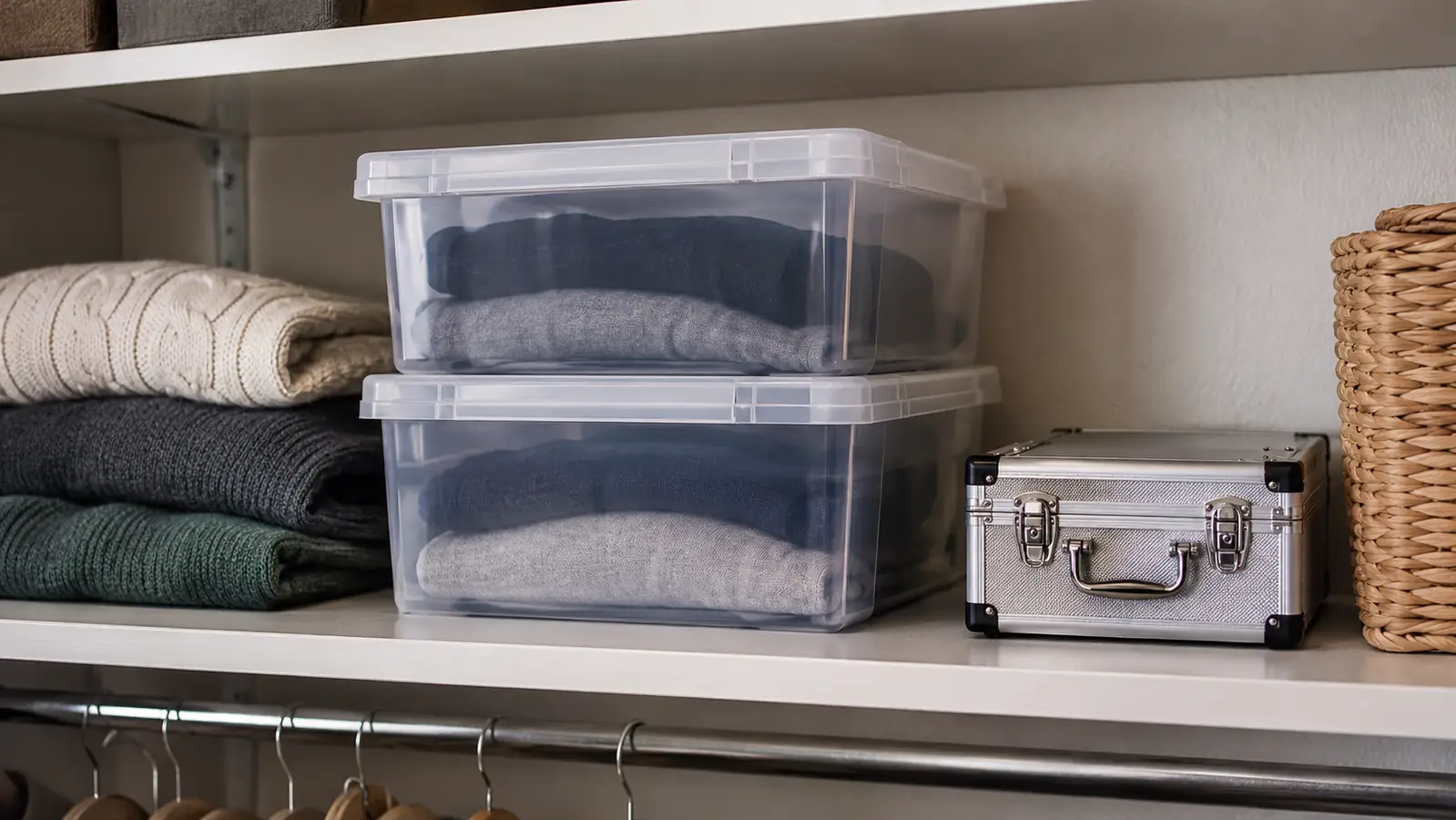
I am not going to pretend plastic is tougher than metal. If the box rides in a truck, a toolbox, or a bag that gets set down hard, an aluminum case is the better shell. It dents instead of cracking. That matters if you carry slabs to a club meeting or a show. The rigid sides keep pressure off the contents, and a metal case is less likely to pop open from a corner hit. A plastic snap box is a shelf box. It is not a travel case, and I would not ask it to be one.
The aluminum case also wins when your collection is mixed. If you want one case for raw coins in flips, a few slabs, a loupe, and a notebook, a general aluminum case with foam or trays can be arranged for that. The PCGS box is a slab box. It is not trying to be a general coin case. That focus is a strength on a closet shelf and a limit on a weekend trip. Neither case is water resistant on its own. Aluminum does not make a box dry. If the case has no gasket, a damp basement is still a damp basement.
The club meets once a month in a church basement, and I take the aluminum case, not the plastic box. Last February one of the fellows set his case down at the end of a folding table and somebody backed into the table and the case went off onto the tile. He picked it up, opened the latch, and everything inside was exactly where he left it, with a dent in one corner. That is the whole argument for metal in one story. I have watched a plastic container take a similar fall and the corner gave and the lid came apart. Nothing was lost that time either, but the difference is real and it is not subtle. If your slabs leave the house, plan for the day somebody else's elbow is involved.
If your slabs live on a closet shelf, put 20 of them in one box
The PCGS Plastic Storage Box holds 20 slab holders, stacks, and weighs 16 ounces empty. It is not water resistant, so keep it in a dry room. If that matches how you store your collection, look at the current listing.
Amazon See the Current Listing on Amazon →What Neither One Does
Neither box is a safe. Neither one is a dry cabinet. The PCGS box is listed as not water resistant, and a basic aluminum case is not a sealed container either. If your closet gets damp, fix the closet or use a dry box with a gasket and a hygrometer. Do not expect a plastic snap box or a metal case to stop humidity. I have seen what a damp basement does to paper and to copper. The box is not the problem solver. It is the place the slabs sit while the room stays dry.
I keep a cheap hygrometer on the shelf next to the boxes, the kind sold for a cigar humidor, and I look at it when I think about it. In July it reads high in the basement and fine in the spare bedroom, which is the reason the boxes live upstairs. One summer I left a paper flip in the basement for a month to see what would happen and it curled at the corners and went soft. That was enough of a lesson for me. A box with a snap lid and a box with a metal latch do the same thing in a damp room, which is nothing at all. If your reading is high, the fix is a dehumidifier or a different room, not a different case.
Neither box will make a coin better. I do not promise that and I do not buy coins for that reason. A slab protects a coin from fingers and from the air to some degree, and a box protects the slab. That is the whole chain. If you want to teach a child, the lesson is in the handling: hold the slab by the edges, put it back in the same place, close the lid. The box just makes that lesson easier to repeat. The aluminum case does the same job with more weight and more protection from knocks. Neither one replaces care.
Who Should Buy Which
Buy the PCGS box if your graded coins stay at home. It fits 20 slab holders, it stacks on a shelf, and it is light enough to move with one hand. It is the box I would hand to a new collector who has a first slab and a closet shelf, and it is the box I use when Maddie and I put a batch of wheat cents away. If you have several boxes, the stacking matters more than any single feature. You can keep series apart without building a cabinet.
Last Saturday Maddie sorted a pile of wheat cents into the box while I read the dates off to her, and she got nineteen in before she hit a snag. She is 9 and her hands are small, and the snap closure is easy for her, which is not true of every latch I have fumbled with. The twentieth coin had a bent staple on the flip and she asked me what to do about it. That is the kind of question I want her asking. The box made that afternoon easy. A case with trays and foam would have turned it into an adult job and she would have wandered off.
Buy the aluminum case if you travel with slabs or if you want one hard case for a mixed collection. It wins on rigidity, on drop protection, and on life in a vehicle. It loses on weight, on stacking, and on the simple fact that it is not made for 20 slabs unless you fit it with the right inserts. If you do both, use both. I do. The PCGS box is the closet shelf. The aluminum case is the go bag. That is not a compromise. It is the right tool in each place.
A closet shelf box should be light, stackable, and sized for slabs
The PCGS Plastic Storage Box holds 20 slab holders and is built for storage, not travel. If your coins stay in a dry room, see the current listing on Amazon.
Amazon See the PCGS Slab Box on Amazon →