
A graded coin comes home from the grading service sealed in a hard plastic holder, and the first thing nearly everyone does is set it down on the nearest flat surface and get on with the day. I did exactly that with a 1921 Morgan dollar the week it came back. Three weeks later the holder had a scuff across one corner, and I had eleven more slabs fanned out across the desk like playing cards in no order I could explain to anybody, including myself. That is the real problem a slab box solves. Not storage. Order.
My name is Ray Delcourt. I spent thirty-eight years in a machine shop here in Dayton, Ohio, and since retiring I have been teaching my granddaughter Maddie, who is nine, how to handle coins without wrecking them. Most of what I know about storage I learned by getting it wrong first, which is the usual way. The box I use is the PCGS plastic storage box for 20 slab coin holders. It measures 9 inches long, 3.5 inches wide and 2.75 inches tall, weighs 16 ounces empty, and it is about as complicated as a lunch pail. That is the point of it. What follows is the sequence I use to load one, in the order I actually do it, so the box stays a working collection instead of another pile with a lid on it.
Twenty holders, one lid, and a desk that stops growing piles
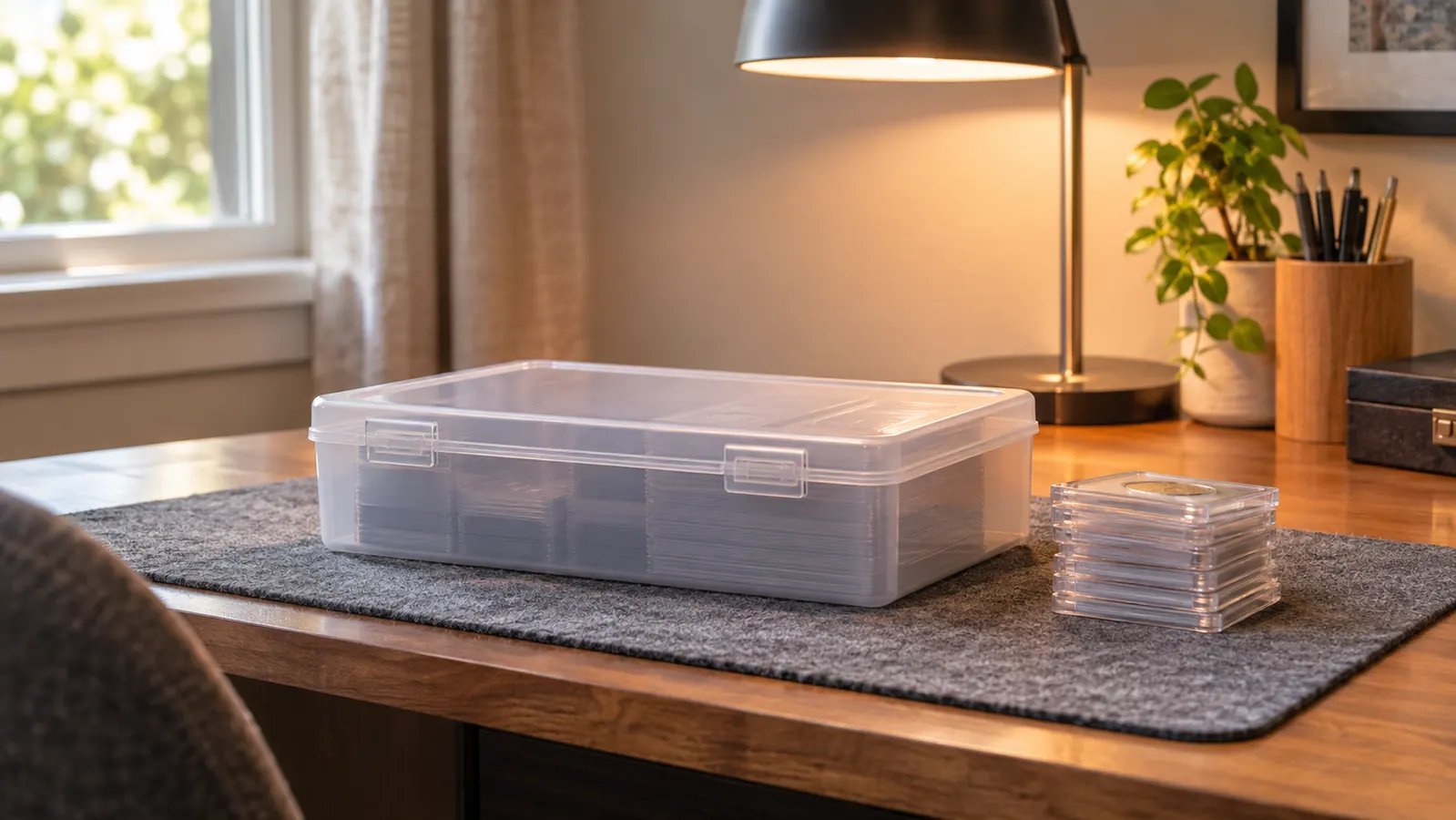
The PCGS storage box holds 20 slab coin holders in a rectangular plastic shell that stacks on a closet shelf and closes with a snap. It is the least interesting thing on my desk and the reason nothing on my desk gets scratched.
Amazon Check Today's Price on Amazon →Step 1: Clear the desk and sort every slab into three piles
Before anything goes into the box, everything comes off the desk. I move the lamp to the left so the light falls across the work instead of into my eyes, lay the felt pad down, and empty whatever stack has built up since the last time I did this. Then I sort into three piles: keep, trade, and duplicate. Not by date yet. Just those three, and nothing goes back in the box until the three piles are separated.
Keep is what belongs in the box. Trade is what I will carry to the club meeting and offer to somebody who collects that series harder than I do. Duplicate is always the biggest pile, because I buy the same wheat cent year twice more often than I will ever admit out loud. Work through the pile with the holders on the felt, not on bare wood. Handle each one by the edges. Finger oil on the plastic face is not the catastrophe it is on a raw coin, but it dulls the surface over a few years, and once it is there you are not wiping it off.
Wipe the desk down and let it dry before anything gets loaded. Grit under a box is how you get the scratches you were trying to prevent in the first place, and a 16 ounce box dragged across a dirty surface will grind whatever is beneath it into the holder faces. It takes one minute. It is also the difference between a clean holder and a scuffed one two years from now, and you will not notice which one you got until it is too late to change it.
Step 2: Decide the order before you load a single slab
The mistake I made with the first box I owned was loading it in the order I bought coins. What you end up with is a box that only makes sense in the order of your purchases, which is not an order at all, it is a diary. Now I decide the arrangement before I touch a holder. Wheat cents run by year. Morgans run by date and then by mint mark. Everything that fits neither run goes at the end, in whatever order I feel like, because those are the coins I pull out to look at anyway.
Write the arrangement down on an index card before you start loading. Mine says cents 1909 to 1929, then the thirties, then Morgans 1878 to 1904, then the odd ones. That is two minutes of writing, and it saves you from pulling twenty holders out to find one coin. Pulling twenty holders out is exactly how corners get chipped, so the card is doing more work than it looks like it is doing.
Maddie uses a simpler rule than mine. She sorts by what she calls the good face, meaning whichever coin she likes looking at most goes first, and the rest follow from there. It is not a catalog order, but she can find any coin in her box in seconds, and a nine year old who can find her own things without help stays interested in the hobby. The rule that matters is that there is a rule. What the rule is matters less than everybody, including you, being able to follow it.
Step 3: Load from one end and turn every label the same way
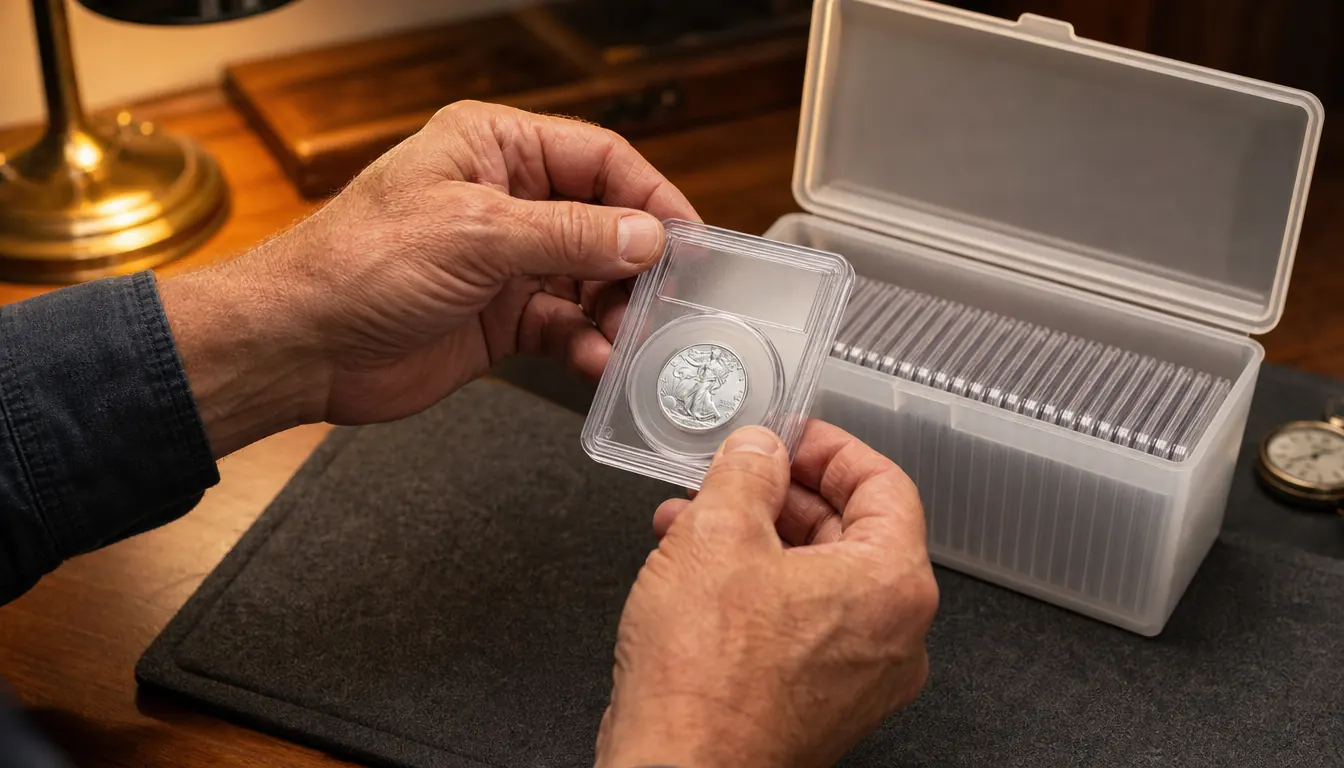
Open the snap lid and set it aside where you will not knock it onto the floor, because a lid on the floor is a lid somebody steps on. Start at one end of the box and work toward the other. I stand the holders on edge and slide each one in gently until it rests against the one before it. What you are trying to avoid is dropping them in loose and letting them settle at angles, pressing on each other's corners, which is the slow way to a cracked holder.
The most useful habit in the whole process is turning every label the same direction as you load. When the lid is closed you cannot see any of them, so this is not about display. It is about the moment you open the box hunting for a specific date. One consistent orientation means you read a row instead of lifting a row. I face the grading label toward me and keep the front of the holder up, and I have done it that way for so long that a box loaded the other way looks wrong to me now. Half a second per coin, every time you open it, for as long as you own the coin.
Do not force the last one. Twenty is the stated capacity and it is a real capacity, not a suggestion. If the lid does not drop down on its own, something in there is sitting crooked, and pushing it flat is how a corner cracks. Take the last holder back out and look down the row. Nine times out of ten it is the third or fourth from the end that has gone sideways, and it takes five seconds to straighten once you know where to look.
Step 4: Snap the lid and give the box a shelf it does not share
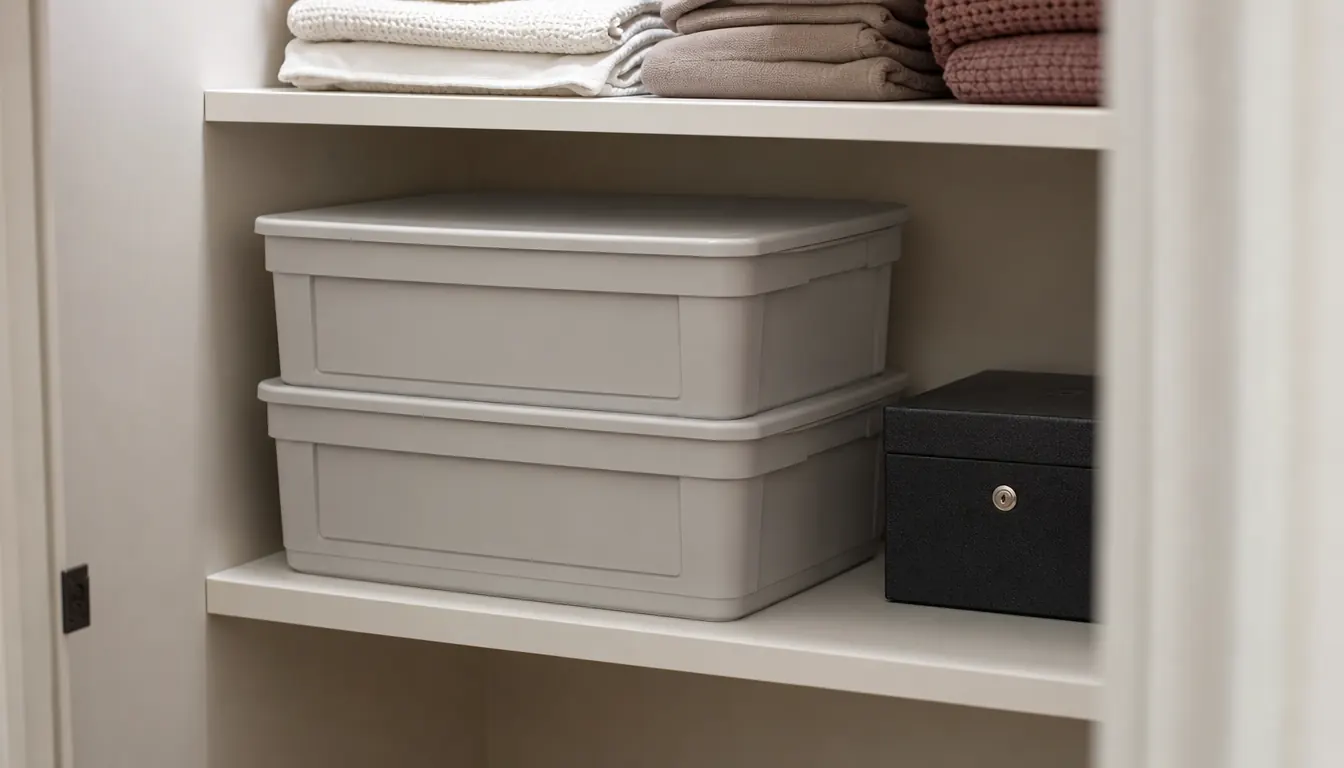
The lid is a snap closure and it does what a snap does. It holds the lid down so you can carry the box by the sides without spilling a row onto the carpet, and it lets you know by feel that the box is closed. It is not a seal, and I want to be plain about that. The box is listed as not water resistant. Mine lives on the second shelf of the closet in the spare bedroom, above the floor, away from the outside wall, and next to the small fireproof box I keep the better Morgans in.
The reason is humidity, not theft. A closet shelf in an Ohio house swings a fair amount between July and January, and a box sitting on a concrete basement floor or against an exterior wall swings more than the room does. Graded coins are protected from your hands by the holder, but the paper label inside that holder is not immune to damp, and a wrinkled or wavy label is a permanent annoyance on an otherwise clean coin. You cannot fix it later. You can only keep it from happening.
The PCGS box is stackable, and I do stack a second one on top of the first. Two high is where I stop, with nothing heavier above them. Sixteen ounces of plastic holding twenty slabs is not a structural member, and a shoebox of tax records set on top is how lids get bowed and how a snap closure stops lining up after a year. If you need more room than two boxes, you need a shelf, not a taller stack.
Step 5: Keep a card in the box and go through it twice a year
I fold a 3 by 5 card into the gap at the top of the box listing what is inside, in order, with the date I last checked it. Not because I forget what I own. Because two years from now I will not remember whether the 1914 in the second row is the better strike or the other one, and the card settles the question without opening twenty holders to compare them side by side. It also tells me at a glance whether anything has moved since the last time I looked.
Twice a year, in spring and in fall, the box comes out, the lid comes off, and I look at every holder in it. I am checking for cracks at the corners, scuffs on the face, and any label that has started to lift at an edge. Ten minutes, twice a year, and I have caught two cracked holders that way before the crack ran far enough to matter. That is a small habit next to replacing a holder you liked.
That is also when I re-sort. Tastes move. Something that was a duplicate in March is a keeper by October, and the box should follow what you actually collect now, not what you were chasing three years ago. This is the step most people skip, and it is the reason so many boxes end up as a time capsule instead of a working collection. A box you are afraid to open is a box you have stopped using.
A slab box does not make a coin better. It stops you from being the reason it gets worse.
What Else Helps
Felt. A square of felt under the box does two jobs at once. It keeps the box from sliding when you set it down, and it gives you a soft place to lay a holder while you are deciding where it belongs. Mine came from a fabric store years ago and has outlasted three boxes. Any soft, dry mat will do the same work, and it costs less than the mistake it prevents.
Clean hands, dry hands. Wash and dry before you sit down, and keep your fingers off the face of the holder. If you also keep raw coins, the rule there is stricter: by the rim, never the face, and never over a hard floor. I learned that one on a kitchen tile with a 1943 steel cent, and I can still picture it bouncing.
A second opinion. Bring your duplicates to a club meeting before you decide they are duplicates. I have been wrong about that more than once, and a fellow who has collected Morgans for forty years will spot a variety in ten seconds that I walked past for a month.
And a plain note on what the box will not do. It will not seal out moisture, it will not keep a room dry, and it will not organize anything you did not already decide to organize. The PCGS box is a rectangular plastic box with a snap lid and room for 20 holders. The order comes from you. The box just stops the order from falling over.
Stop re-sorting the same pile every six months
Decide the arrangement once, load from one end, turn every label the same way, and go through it twice a year. That is the whole system. The box is the easy part.
Amazon Check Today's Price on Amazon →