
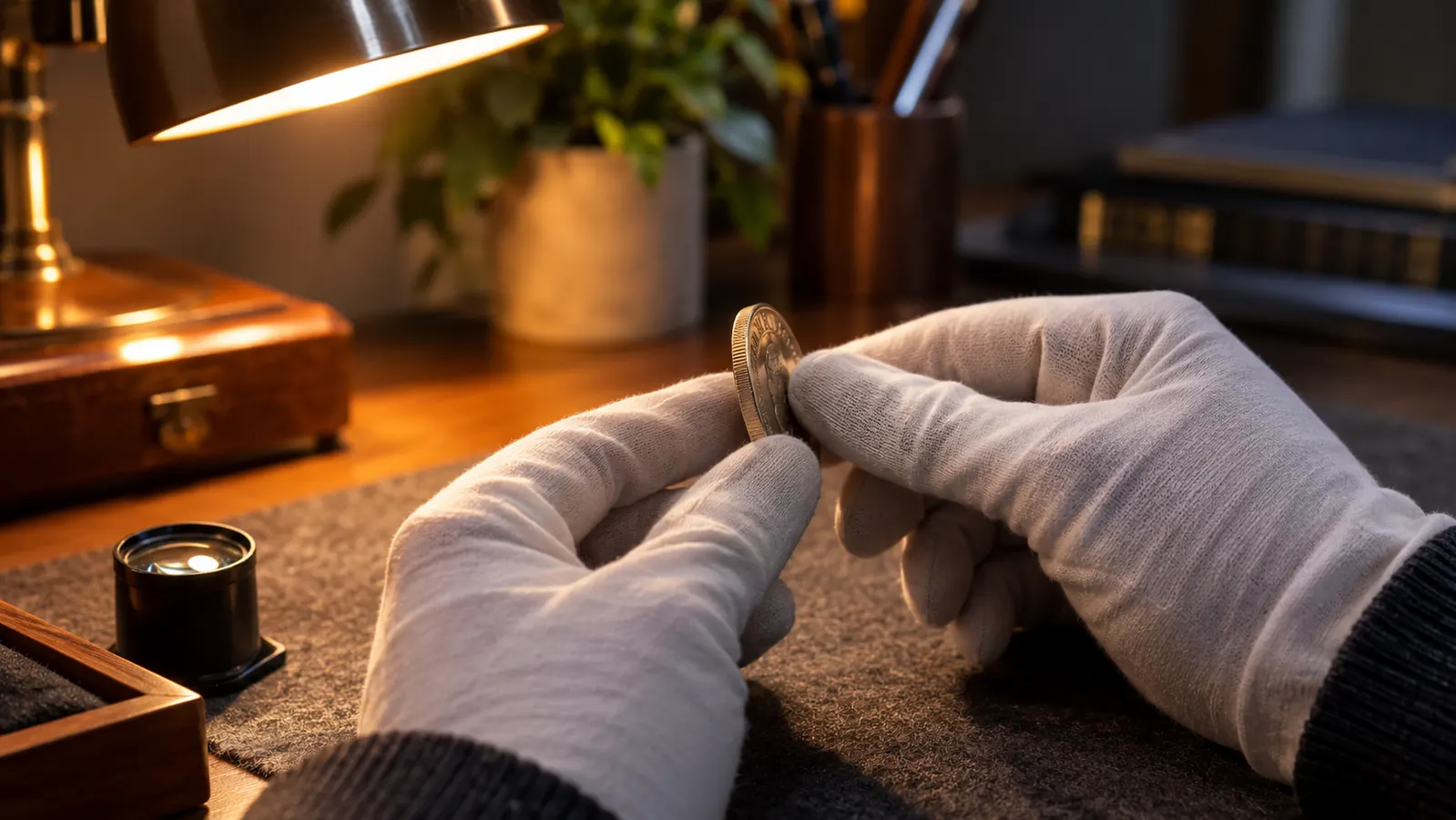
A thumbprint on a coin is not a small thing. It is a thin film of skin oil, salt, and whatever else was on your hands that day, sitting on the metal and holding onto dust. On a raw copper cent it starts working fairly fast. On a silver dollar it sits there quietly for years, and then one evening you tilt the coin under the lamp and there it is, a dull grey smudge in the shape of your own finger. Cotton gloves are the simplest fix in this hobby and the easiest one to get wrong, because most people put them on, feel protected, and then handle the coin exactly the way they did before.
I keep a bag of DOVORTEX cotton gloves on the desk in my spare bedroom, next to the felt pad and the lamp. The bag holds six pairs, twelve pieces, and that count matters more than it sounds like it should, because the whole system falls apart when you are rationing gloves. DOVORTEX sells them for coin handling and jewelry, and I have used them for both. What follows is the routine I settled into after ruining two coins early on and learning the lesson the slow way.
Glove up before the coin comes out, not after
DOVORTEX cotton gloves, six pairs to a bag, so a clean pair is always the next pair. Pull on fit, ambidextrous, long enough to cover the wrist.
Amazon Check Today's Price on Amazon →Step 1: Start With Clean, Dry Hands
The glove is a barrier, not a washing machine. If your hands are oily or damp when you pull the cotton on, the cotton takes up that oil and holds it against the coin the same way your bare finger would. Cotton is absorbent. That is the point of it. It is also the reason a glove stops protecting you before it looks dirty.
So wash your hands with plain soap and warm water, rinse well, and dry them completely, including between the fingers. Then wait. Ten minutes is not too long. Skin keeps giving off moisture after the towel comes off, a glove put on damp hands gets damp, and a damp glove is worse than no glove at all for anything copper or bronze.
I have been teaching my granddaughter Maddie, who is nine, and the first thing I taught her was not how to hold a coin. It was how to wash her hands and wait. She thought that was the boring part. Two weekends later she pulled a wheat cent out of a roll of pennies I had bought, wanted to look at it right away, and remembered she had been eating a peanut butter sandwich. She went and washed her hands without being told. That is the whole lesson, and it took.
Two things I skip before handling coins: hand lotion and hand sanitizer. Lotion is obvious. Sanitizer is not, and it is the one that catches people now, because it dries fast and feels like it is gone. It is not gone. The residue sits on the skin and transfers. If I have used either one, I am not touching a coin for the rest of the evening. Same rule after yard work, after eating, and after handling anything that has been out in the garage.
Step 2: Get the Fit Right Before You Touch Anything
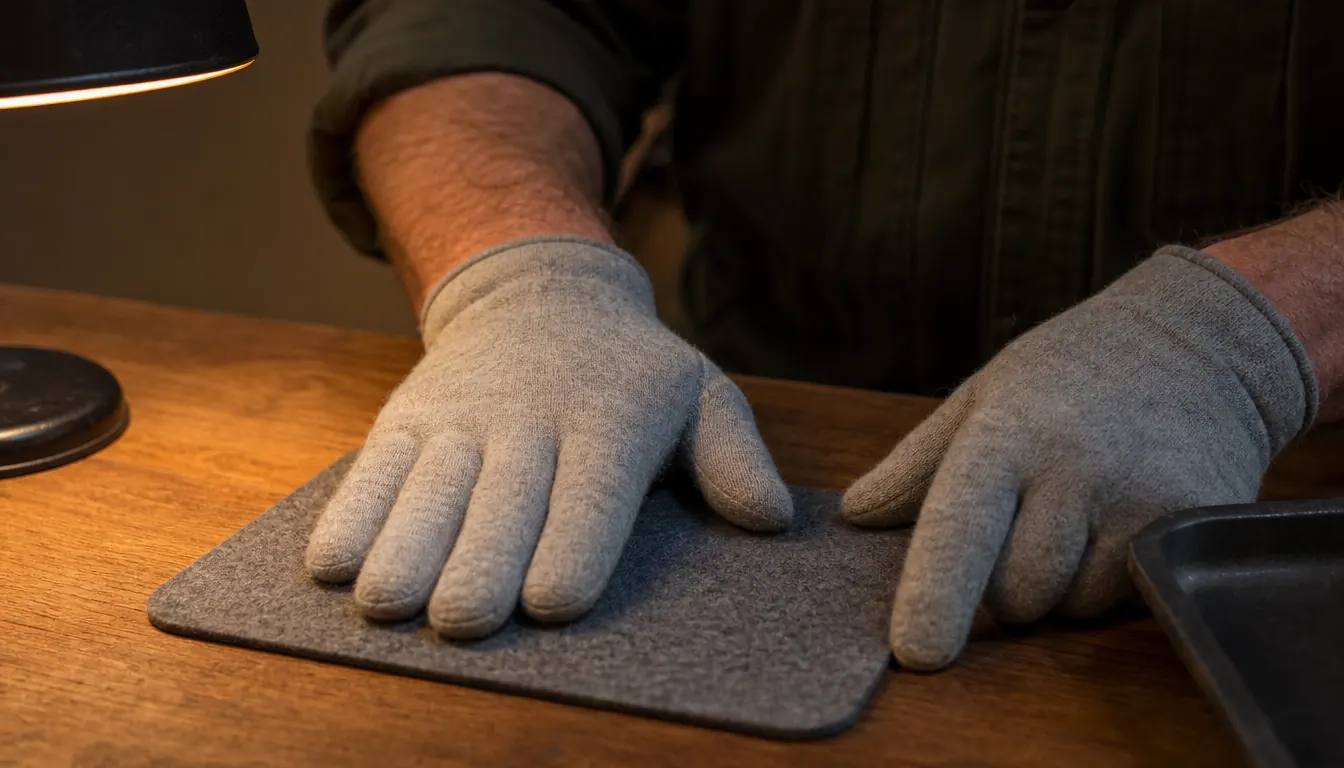
A glove that is too loose bunches at the fingertips, and a bunched fingertip cannot feel the rim of a coin. You press harder to compensate, which is the opposite of what you want. A glove that is too tight is worse in a different way, because you fight it, and fighting a glove means your hands are tense and your grip is unpredictable.
The DOVORTEX gloves are pull on, ambidextrous, and stretchable, with a regular fit and a long cuff that comes down over the wrist. That last part is not decoration. A glove that stops at the wrist leaves a gap where your sleeve and your skin meet, and that gap is where a coin gets fumbled. When I put a pair on, I check three things: the fingertips sit snug without pulling tight, the cuff covers the wrist bone, and I can pinch my thumb and forefinger together and feel it through the cotton.
One more thing about the fit. Do not pull the gloves on by the fingers. Take them by the cuff and work them on the way you would a dress sock. Pulling at the fingertips stretches the cotton out of shape in exactly the spot where you need the most control.
Sizing on a bag like this runs the same across all six pairs, so fit is about how the cotton sits rather than about picking a size. On my hands, which are an average machinist's hands after forty years of work, the stretch in the knit does the rest. Carol tried a pair for cleaning and found them loose but workable, which is about what I expected. If you have very small hands, expect some slack at the fingertips and slow down accordingly.
Step 3: Pick Up the Coin by the Rim, Every Time
This is the habit that does the actual work, and it takes the longest to build. Pinch the coin at the rim, between the thumb and the side of the forefinger, and lift it straight up. Never lay a flat finger across the face. Never slide it across the felt to get it to the edge of the pad. Sliding is abrasion, cotton or not.
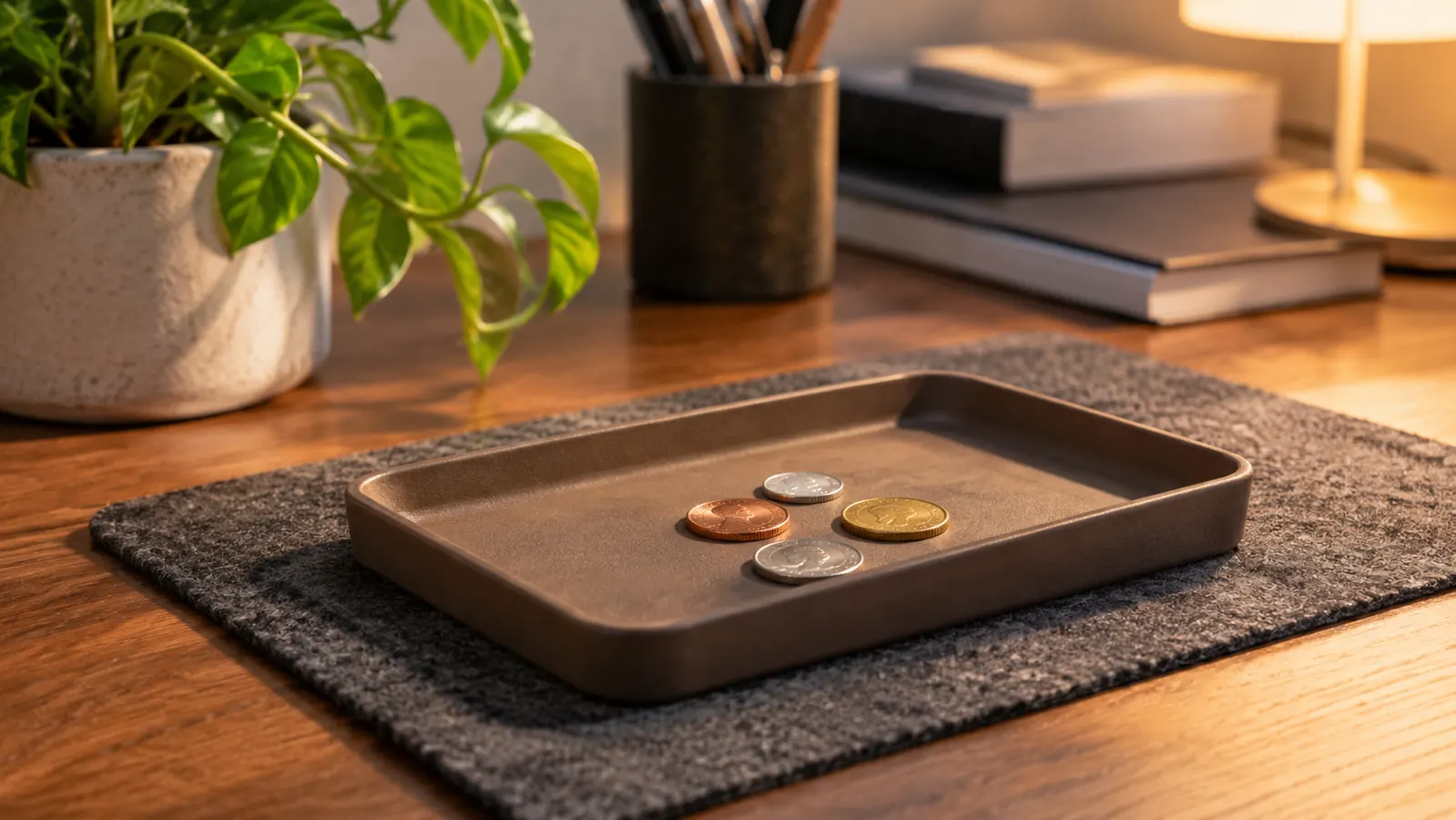
When you set a coin down, set it down. Do not drop it the last quarter inch because you are in a hurry. I keep a felt pad under the work and a shallow tray with a lip around the edge, and that tray has saved me more times than I want to admit. Coins do not damage easily from being held. They damage from being dropped, from being slid, and from being stacked on top of each other in a hurry.
For coins in a holder or a slab, the holder is what you handle. I pick a slab up by the edges with the gloves on, look at it, and set it back down. I do not take a coin out of a holder to look at it more closely. There is nothing on the other side of that plastic worth the risk.
The rim habit has a second benefit nobody talks about. When you always hold a coin the same way, you always look at it the same way, and you start to notice things. I found a repunched date on a wheat cent last spring that I had owned for six years and looked at a hundred times. It was not the light that changed. It was that my hands went to the same spot every time and my eye followed them.
Step 4: Set Up a Work Surface That Forgives a Mistake
Gloves stop the oil. They do not stop gravity. My setup is a desk in the spare bedroom with a lamp I can angle low across the surface, a felt pad about the size of a placemat, and a shallow tray. The low angled light is not for atmosphere. It is the only way I can see a hairline on a proof surface or a faint print that is already there.
The pad and the tray do two jobs. They catch a coin that rolls, and they give me somewhere to set a coin down that is not the bare desk. That room has a hardwood floor and I have heard a Morgan dollar hit it exactly once. That was enough. If your work surface sits over a hard floor, put a towel down on the floor as well. It sounds foolish until the first time it matters.
You also want the room to be boring. No coffee cup on the same desk. No open window with a breeze moving the pad around. No cat, though I do not have one and cannot speak to that. I clear the desk except for the lamp, the pad, the tray, and the box. Everything else goes on the floor or in a drawer. A coin session that gets interrupted is a coin session where something gets knocked.
Step 5: Keep the Gloves Clean and Change Them Often
Here is where the six pairs earn their keep. A pair of cotton gloves is good for one session, maybe two if the session is short and your hands were clean and dry when you started. Cotton is absorbent. It takes up the oil from your skin a little at a time, and after a few hours of handling it is no longer a barrier. It is a delivery system. The gloves will not look dirty. That is the trap.
My routine is simple. Fresh pair at the start of a session, that pair goes in the wash bin at the end, and the next session starts with the next pair. Six pairs gets me through a couple of weeks of weekend work, and then I wash the batch at once. Plain warm water, a little mild soap, no fabric softener, air dry. Fabric softener coats the cotton and cuts down on the absorbency you want. The DOVORTEX listing says these are powder free and alcohol free, and I still keep them away from anything harsh, because cotton holds onto residue.
The listing also says these are not waterproof and not water resistant, which is worth knowing. A wet glove is a bad glove. If you are handling a coin that came in wet, or you just washed your hands, dry everything first. Water and copper are not friends, and a damp cotton glove resting against a copper cent overnight is a good way to grow something green on it.
One habit worth building: keep the unused pairs in the bag and the pair in use somewhere else. I keep a small cloth pouch on the desk for the gloves I am wearing so I never lose track of which is which. It sounds fussy until the first time you pull on a pair that has been sitting out for a week and then wonder why a coin comes back looking dull.
What Else Helps
A few things around the edges. Do not talk directly over an open coin. It sounds like something an old club member tells you to mess with you, and then you look at a proof under angled light and see a faint spot pattern that is not a print, and you stop arguing. Keep coins in a box in a closet that stays dry rather than in a basement or an attic. Handle coins in the morning or after dinner, not right after you have been working with your hands.
A note on storage, because gloves and storage are the same conversation. A coin that is handled correctly and then stored in a hot, damp place will still go bad. My Morgan dollars live in a small fireproof box in the closet. The box is not there to stop a fire. It is there because it is a dry, closed, temperature stable place, and that is most of what a coin needs from storage.
And if a coin already has a print on it, leave it alone. Do not rub it, do not polish it, do not reach for anything in a bottle. A print on a coin is a small problem. A cleaned coin is a permanent one, and every collector who looks at it afterward will know. I learned that on a steel cent I thought I could improve. I could not.
A word about nitrile as well. It has its place, particularly if you are sorting a lot of material or handling something you are unsure about. But for looking at coins, cotton is what I reach for, because it is soft, it breathes, and it does not trap moisture against the metal the way a non breathable glove can. For a session at the desk with a box of wheat cents, cotton.
Cotton is absorbent. That is the whole point, and it is also why a pair of gloves quietly stops protecting a coin long before it ever looks dirty.
One last thing. At the club meeting each month there is always a table where somebody is passing a coin around bare handed, and it is always the same somebody. That is not a moral failing. It is just that the habit takes a while to build, and the glove only helps if it is on before the coin comes out of the holder. Put them on first. Everything else follows from that.
Six pairs means a clean one is always the next one
Cotton, breathable, ambidextrous, with a cuff that covers the wrist. Wash a batch, rotate, and stop rationing the pair you should have retired two sessions ago.
Amazon Check Today's Price on Amazon →