
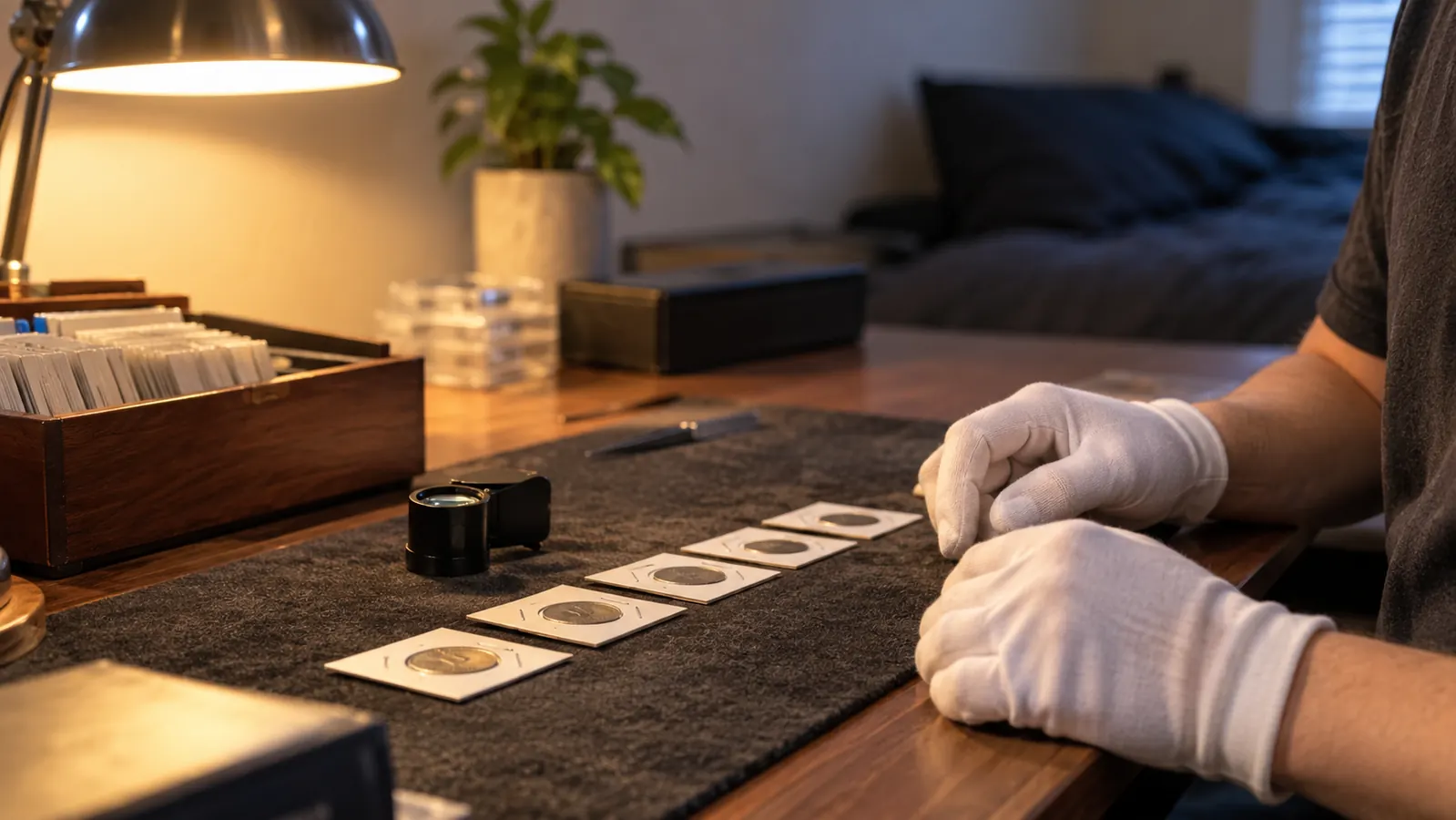
Maddie asked the question two Saturdays ago, somewhere between the 1955 wheat cents and the 1958-D. We had a felt pad on the spare-room desk, a loupe between us, and she wanted to know why I bother putting on gloves to pick up a coin that had already spent forty years in a coffee can. Fair question for a nine-year-old. The honest answer is that the can did its damage a long time ago, and I would rather not add mine on top of it.
Short answer first. For desk work, meaning sorting, reading dates and mint marks, photographing, and moving coins into flips, cotton is the better glove. For anything wet, dirty or chemical, nitrile is the better glove. I keep both in the same drawer. The pair I actually reach for at that desk is the DOVORTEX cotton glove set, twelve pieces that work out to six pairs, because a clean dry glove is the entire point and six pairs means there is always one that is clean and dry.
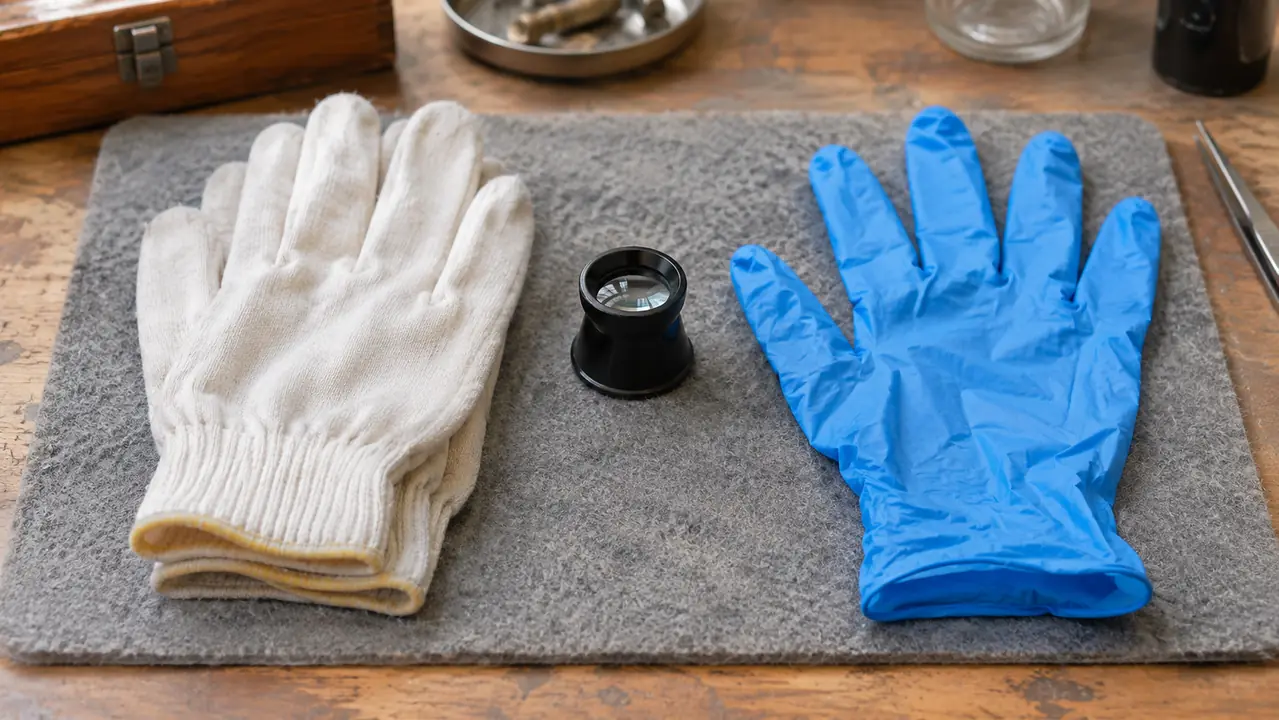
| DOVORTEX Cotton Gloves | Nitrile Gloves | |
|---|---|---|
| What it is | Woven cotton, 6 pairs per pack, ambidextrous, pull on | Synthetic nitrile film, sold in boxes of 50 to 100 |
| Blocks skin oil | Absorbs some, slows the rest | Nothing crosses a nitrile film |
| Leaves on the coin | Nothing chemical, just the odd fiber | No lint, but powder or plasticizer film is possible |
| Grip on bare metal | Soft, a little slick on a proof surface | Tacky enough to pick a dime off glass |
| Lint | Sheds a few fibers, mostly at the seams | None |
| Breathability over an hour | Breathable cotton, hands stay dry | Hands sweat, fingertips prune |
| Wrist coverage | Large length, long enough to cover the wrist | Usually stops at the wrist |
| Fit | Stretchable, ambidextrous, one size in this pack | Sized XS to XL, snug seal at the cuff |
| Reusable | Wash and hang dry, 6 pairs to rotate | One session, then it goes in the trash |
| Best for | Desk sorting, photography, transfer into flips | Dirty bulk lots, wet work, first-pass sorting |
I did not weight those rows evenly, and I do not think a reader should. Lint and grip matter a great deal on a proof surface and hardly at all on a worn wheat cent. Skin oil matters on everything, all the time, which is why that row sits near the top. Sort the rows by what you are actually handling and the table stops looking like a tie.
How I Tested Both
I did not build a lab in the spare bedroom. I sat down four evenings in a row with the same roll of wheat cents and the same short run of Morgan dollars, and I did the same job twice. Sort by date into piles. Move the piles into cardboard flips. Put them back. Cotton one night, nitrile the next, same lamp, same felt pad. I paid attention to three things. How the coin felt coming off the pad. What my fingers looked like when the glove came off. Whether the coin had anything on it afterward that was not on it before.
Four evenings is not science, and I know that. But four evenings with the same coins, the same pad and the same lamp is enough to notice which glove you stop thinking about, and that is the only measurement I trust. By the third evening I had a routine going. Lamp on, pad squared up, coin tray on the left, flips on the right, loupe at the top of the pad. Same setup both nights so the only thing that changed was the hand covering.
Thirty years in a machine shop taught me the difference between a glove that protects the part and a glove that protects the person. Nitrile was for solvents and coolant, and it was good at it, because a nitrile glove is a film and nothing crosses a film in either direction. Cotton was for inspection, because you can feel a burr through cotton and you cannot feel much of anything through a glove with your hand sweating inside it. Coin handling is closer to inspection than it is to coolant.
Maddie ran the second test without knowing she was running one. She is nine, she is not careful, and she drops things. Hand a child a slick coin and a glove and you find out inside four minutes which glove lets a coin squirt out of a small hand and roll under the radiator. That is not a small consideration if you are teaching somebody, and it is the reason I stopped handing her nitrile for the good tray.
Where DOVORTEX Cotton Gloves Win
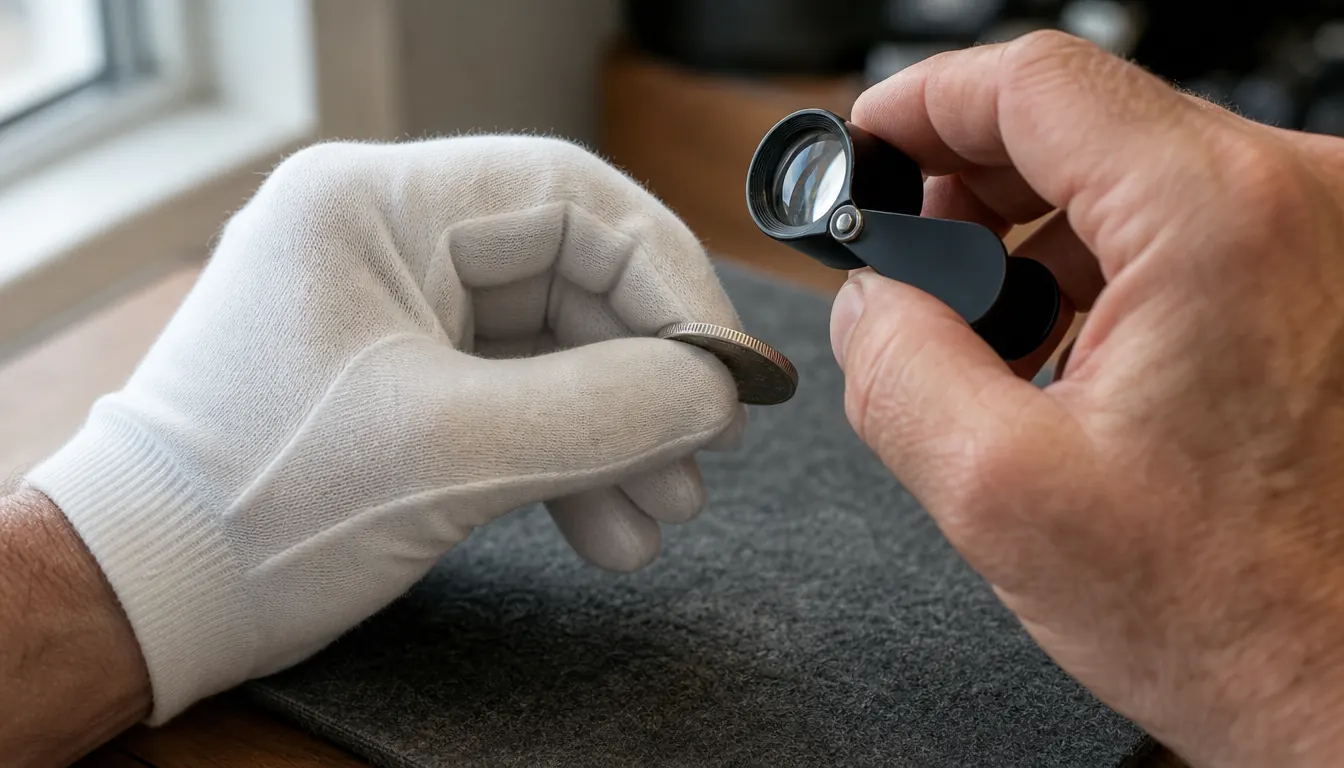
Breathability is the first thing, and it is not a small thing. The listing calls the cotton breathable and absorbent, and after an hour of sorting my hands were dry. With nitrile, by the forty minute mark, my fingertips were damp and wrinkled and I was thinking about the glove instead of the coin. A damp hand is a hand that transfers moisture onto whatever it touches next. Dry is the whole job.
One of those evenings was the kind of Ohio July where the window unit runs all night and loses anyway. That was a cotton night, thankfully. I could feel air move across the back of my hand every time I lifted a pile of cents out of the tray. The nitrile night came a week later in the same weather, and the glove fogged from the inside by the half hour mark. I took it off twice just to dry my fingers on my shirt, which is not a thing you want to be doing over an open tray of coins.
Six pairs in the pack is the second win. A cotton glove that has absorbed an evening of handling is a glove you wash, not a glove you put back in the drawer, so a rotation matters more than it sounds. They are ambidextrous with a pull-on closure, they stretch, and the Large length is long enough to cover the wrist on a man my size. Nothing to fasten and nothing to adjust. The pack weighs about 0.11 kg, and the listing says it is made in the USA, which I note because I still like knowing where a thing was sewn.
The third win is what does not end up on the coin. The listing says the material is powder free and alcohol free, and I found no film, no dust and no residue on the felt at the end of the evening. The gloves are not water resistant, which the listing states plainly, so nobody should read this and go rinse a coin while wearing one. But for dry handling they leave the coin exactly as they found it, and that is the only promise a glove should make.
The last one only shows up with practice. Cotton gives you a soft surface and a little friction, so a coin rolled between the fingers to look at the edge does not skate away. On a bare metal face nitrile is the grippier of the two, and I say so in the next section because it is true. But nitrile on a dry coin in a dry room can grab and then let go, and a dime that grabs and lets go is a dime across the desk. Cotton is slower and duller and I have not lost a coin to it yet.
Where Nitrile Gloves Win
The barrier. If you have hand cream on, if you have been eating, if your hands are simply oily on a hot afternoon, nitrile does not care. Nothing gets through. That matters when you are sorting a jar of pocket change that came out of a parking meter, or working through a bulk lot that has been in somebody's garage since the 1980s. Cotton absorbs some oil and slows the rest. Nitrile stops it. On that row there is no argument and I am not going to pretend there is.
The bulk lot I am thinking of came out of an estate sale up in Troy, three coffee cans and a shoebox, and the coins smelled like a basement floor. I sorted that whole mess in nitrile at the kitchen table with newspaper down, and when I finished I turned the gloves inside out, threw them in the trash and washed my hands twice. There is no version of that evening where cotton would have been the right call, and I would have ruined a pair doing it.
Lint and grip, in that order. Cotton sheds a little, mostly at the seams, and one fiber across a coin face is annoying when you are trying to photograph it for the club newsletter. Nitrile sheds nothing at all. Powder-free nitrile also has enough tack to pick a dime up off a glass table, which is more than I can say for cotton. The trade is that nitrile is a use-it-once glove, and if your hands sweat inside it, which mine do, you are working with a wet hand by the end of a long session.
And the dirty work is genuinely nitrile work. A bowl of soapy water, a jar of coins that smell like a basement, a rag you would not want against bare skin. The cotton glove is the wrong tool for all three, not because it fails but because it is the wrong kind of tool, the way a screwdriver is the wrong tool for a nail. Wear nitrile for the ugly first pass, wash your hands, dry them, and then sit down at the desk.
Over an hour of sorting, the cotton pair was still dry and the nitrile pair left my fingertips looking like prunes.
What Neither Glove Will Do for You
Neither glove cleans a coin, and neither one stops a coin from going bad. Oil that is already on the surface is already on the surface. A cotton glove will not pull it back out, and a nitrile glove will not undo it. What a glove does is stop the next fingerprint from joining the first one. The rest of the job is storage: mylar or cardboard flips rather than soft PVC, a box in a closet that does not swing between damp and dry, and hands that are clean before the glove goes on rather than after.
I learned that humidity lesson the hard way with a 1921 Morgan that spent one August in a closet sharing a wall with the bathroom. It came out with a haze across the field that was not there in June, and it is still there now. No glove on earth would have prevented it. What prevented it the following year was a small fireproof box, a couple of silica packets, and a closet on the other side of the house.
My own habit with the cotton pairs is a mesh bag, cold water, no fabric softener, then hang them to dry on the edge of the laundry basket. I retire any pair that has thinned at the thumb. A glove with a hole in it is a bare hand with extra steps, and it will fool you for a week before you notice. Six pairs in the pack makes that easy, because losing one to the rag bin does not end the evening.
The pair that is still dry after an hour of sorting
Six pairs of cotton gloves, ambidextrous, stretchable, long enough to cover the wrist, powder free. One on the hands, one in the wash, four in the drawer.
Amazon Check Today's Price on Amazon →Who Should Buy Which
Buy the DOVORTEX cotton set if your handling happens at a desk. Sorting wheat cents by date, checking mint marks under a loupe, moving Morgan dollars from a tray into flips, photographing a coin for the club newsletter, showing a nine-year-old how to hold a coin by the rim. That is the work a cotton glove was made for, and the six pairs matter, because you are never handling a good coin with a glove you already wore for two hours.
Buy nitrile if the coins are dirty, if your hands are, or if you are doing a first pass on a bulk lot before anything touches a felt pad. Some people will want both, and that is what I do. Nitrile for the ugly sort at the kitchen table, cotton for everything that happens after, at the desk, with the lamp on. If you can only keep one pair in the drawer, and the drawer is in a spare bedroom in Dayton, keep the cotton.
For what it is worth, Maddie has her own pair now, folded on the corner of the pad, and she puts them on without being told. That is worth more to me than any row in the table above. A kid who learns to hold a coin by the rim at nine does not have to unlearn anything at forty, and the glove is how the habit starts.
Six pairs in the drawer, one clean one every time
The gloves I keep at the desk: cotton, ambidextrous, pull on, powder free, sized to cover the wrist. Wash them, hang them, rotate them.
Amazon See the DOVORTEX Cotton Gloves on Amazon →