
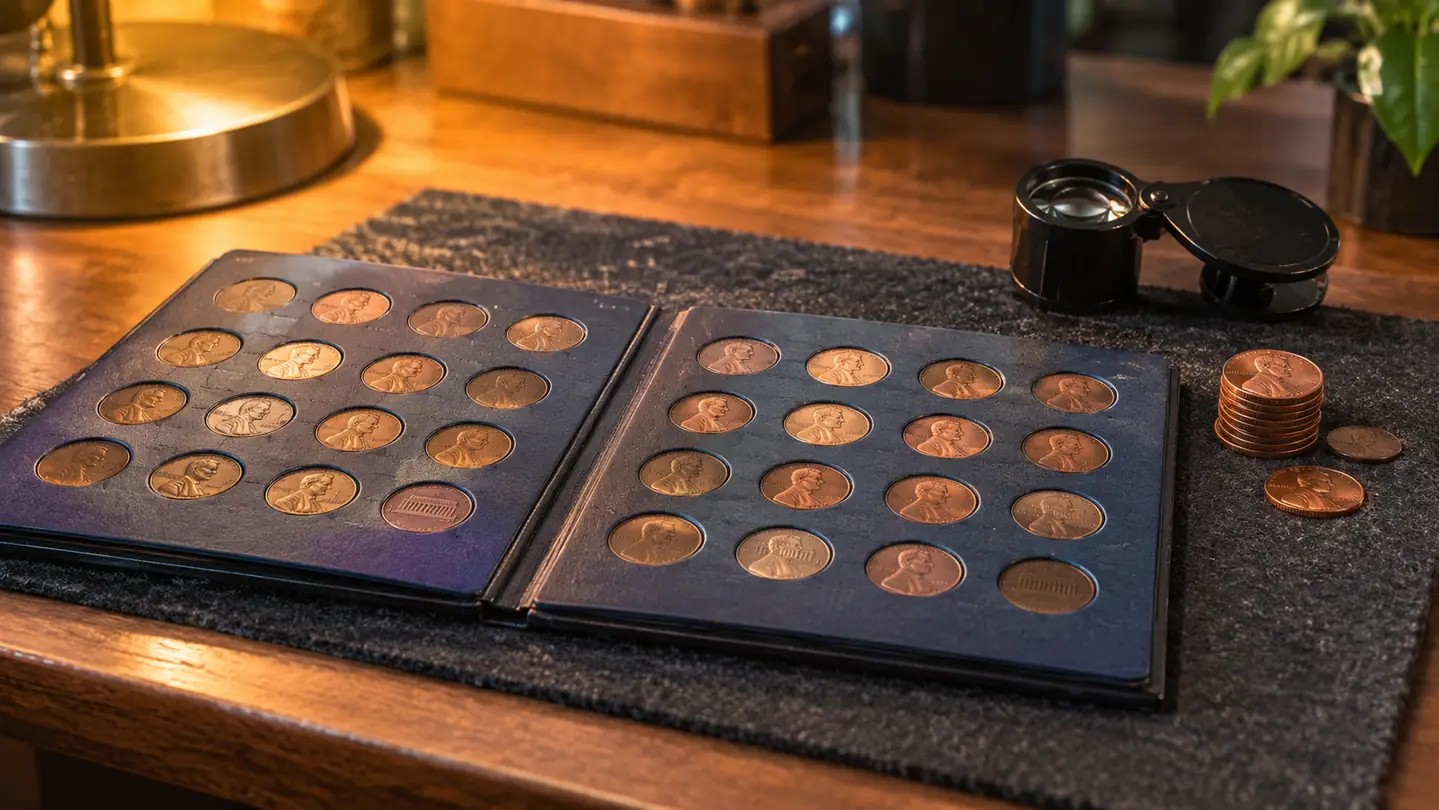
The first thing I want to say about the Whitman Lincoln Cents Folder #2 is that it is a good tool with three real problems, and the problems are not the ones the one-star reviews complain about. I have filled one of these from 1941 through 1974, and my granddaughter Maddie, who is nine, has been filling a second one on weekends since the spring. Between the two of us I have watched this folder do exactly what it was built to do, and I have watched it annoy the daylights out of both of us in the same afternoon.
So this is not going to be a page that tells you it is wonderful and sends you off to buy it. It is going to tell you where the slotted pages genuinely earn their place, where they will fight you, and what you have to do on your end so a coin does not come out worse than it went in.
The Quick Verdict
A sturdy, honest folder that does one job well: holding a full run of 1941-1974 Lincoln cents in order without touching them. The press-in slots are unforgiving, the pages are not archival, and the labeling is thin. Worth it anyway, if you handle coins the way they should be handled.
Amazon Check Today's Price →See the current listing for the 1941-1974 Whitman folder
Same folder I have on my desk. If you are filling the mid-century run, this is the one that fits it.
Amazon Check Today's Price on Amazon →What Nobody Tells You Before You Buy It
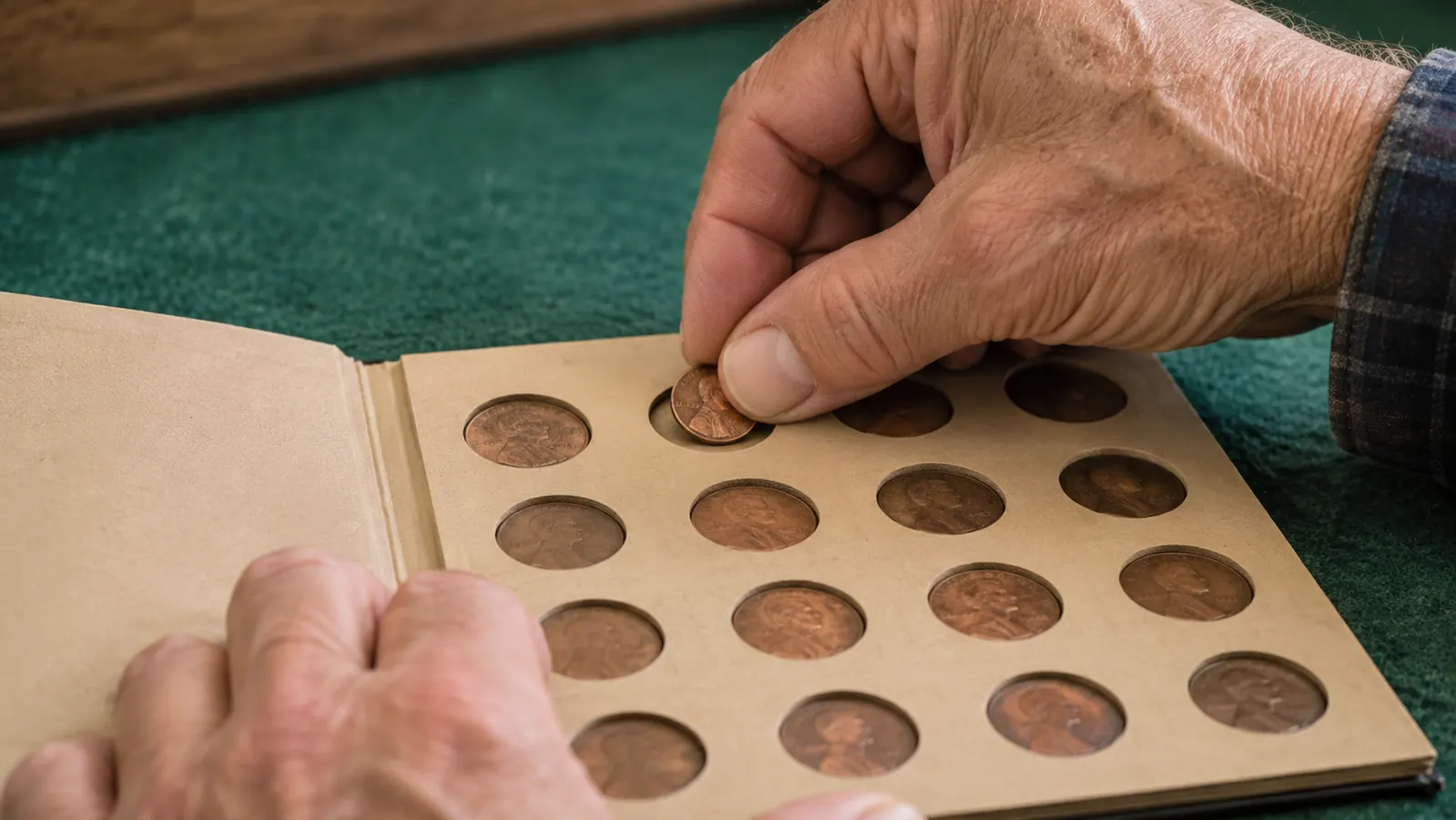
Here is the part the product listing does not say, and it is the part that matters. This is a press-in folder. Not a push-in-with-two-fingers folder, not a slide-it-under-a-plastic-strip album. A press-in folder. You set a coin over a round opening and you press until the cardboard gives and the coin drops into the recess, and the two little tabs at the edges of the slot fold back over the rim to hold it.
That press is the whole design. It is also where every complaint about this folder starts.
The cardboard is stiff. It is meant to be. A floppy page would let coins work loose every time you closed the cover, and I have owned albums like that, and I have found a 1943 steel cent rattling around in the spine of one. Whitman made a stiff page on purpose. But stiff cardboard means the first dozen insertions in a fresh folder take real attention, and a thumb that slips during that press is a thumb that slides across a coin face.
I learned that the hard way in the spring, on a 1948-D that had a nice even brown to it and no problems I could see. I had the folder angled toward the lamp, I pressed with the pad of my thumb, the coin went in crooked, and I dragged it about a quarter inch to seat it. There is a faint scuff across the jawline now. Not a disaster and not nothing. The correct move is to lift the coin out and start again, and it costs you five seconds.
Fingers carry oil. Oil on a copper cent is not a small thing. Copper holds onto it, dust sticks to the oil, and a few years later you are looking at a fingerprint that has etched its way into the surface and will not come off without a fight you should not pick. That is not a knock on Whitman. That is the cost of admission for any folder with open slots, and you need to know it going in.
Set the coin, press the tabs, and never let a bare thumb drag across the face to seat it. That one habit decides whether your coins come out the other side the way they went in.
Where the Slots Actually Help
Now the good part, and it is genuinely good, because the alternative for most people is a coffee can.
My grandfather left me a coffee can of wheat cents when I was eleven. I have written about that can more than once and I will probably write about it again, because it taught me everything I know about how coins get damaged. Fifty-odd cents in a tin, sliding against each other for thirty years, and maybe a third of them came out with rim dings and bag marks that no amount of careful handling since has undone. Contact damage is real, and it is cumulative, and it never reverses.
The slots prevent that. Each cent sits in its own recess, held by the tabs at the rim, and the face is not touching anything except the air in the opening. Close the folder, put it on a shelf, come back in a year, and nothing has moved. For a date-and-mint-mark run of ninety-some cents, that is the entire point, and the folder delivers it.
There is a second thing the slots do that nobody mentions and that I have come to value as much as the first. The folder forces the run into order. You cannot dump a handful of cents on the desk and call it a collection. You have a hole for 1943 and a hole for 1943-D and a hole for 1943-S, and you either find three coins or you look at three empty holes until you do. That structure is why Maddie has stuck with it. She is nine. She does not care about toning or strike. She cares that there is a specific empty space with a specific date printed under it, and that she can go to the jar on my desk and hunt for that exact coin.
That is also why I bought a second folder for her instead of handing over mine. Two folders, two runs, no arguing about whose 1946 is whose. She keeps hers in a drawer in the spare room, I keep mine in the box in the closet, and every Saturday she brings it out and we go through the holes she still has to fill. Right now she is stuck on 1942. That is not a hard date and I have four of them, but she wants to find her own, so we look.
A jar teaches you nothing. A folder with holes in it teaches you the whole series, whether you meant to learn it or not.
The Three Problems, Straight
Problem one: the tabs. The little cardboard tabs that fold over the coin rim are the weakest part of the design. On a fresh page they hold firm. Bend one back a second time, though, and the crease softens, and after that it holds with less conviction. I have had two tabs get loose on my own folder over the years, both from removing a coin I had second thoughts about. The coin did not fall out, but it was no longer what I would call secure.
I know exactly which two holes those are, and that is worth saying. One is a 1944-S. The other is a 1950 I pulled out to compare against a sharper one, then put back because the sharper one had a spot of corrosion on the reverse. Both tabs still do their job. They just do it with a little less grip than the untouched tabs around them, and the only reason I can tell you that is that I decided at the start to notice.
The fix is simple and I would do it from the start: decide before you press. Look the coin over under good light, make your call, then commit. If you think you might upgrade the coin later, do not put it in this folder yet. Put it in a cardboard flip and set it aside until you are sure.
Problem two: the material. These pages are not archival. That word gets thrown around loosely, so let me be exact about what I mean. Archival means the paper and adhesive will not off-gas anything that attacks the metal over decades. This folder makes no such claim, and at its age and construction I would not assume it. It is not PVC, which is the genuinely destructive stuff, and I would not tell you to be afraid of it. But it is also not something I would trust to sit in an attic for forty years.
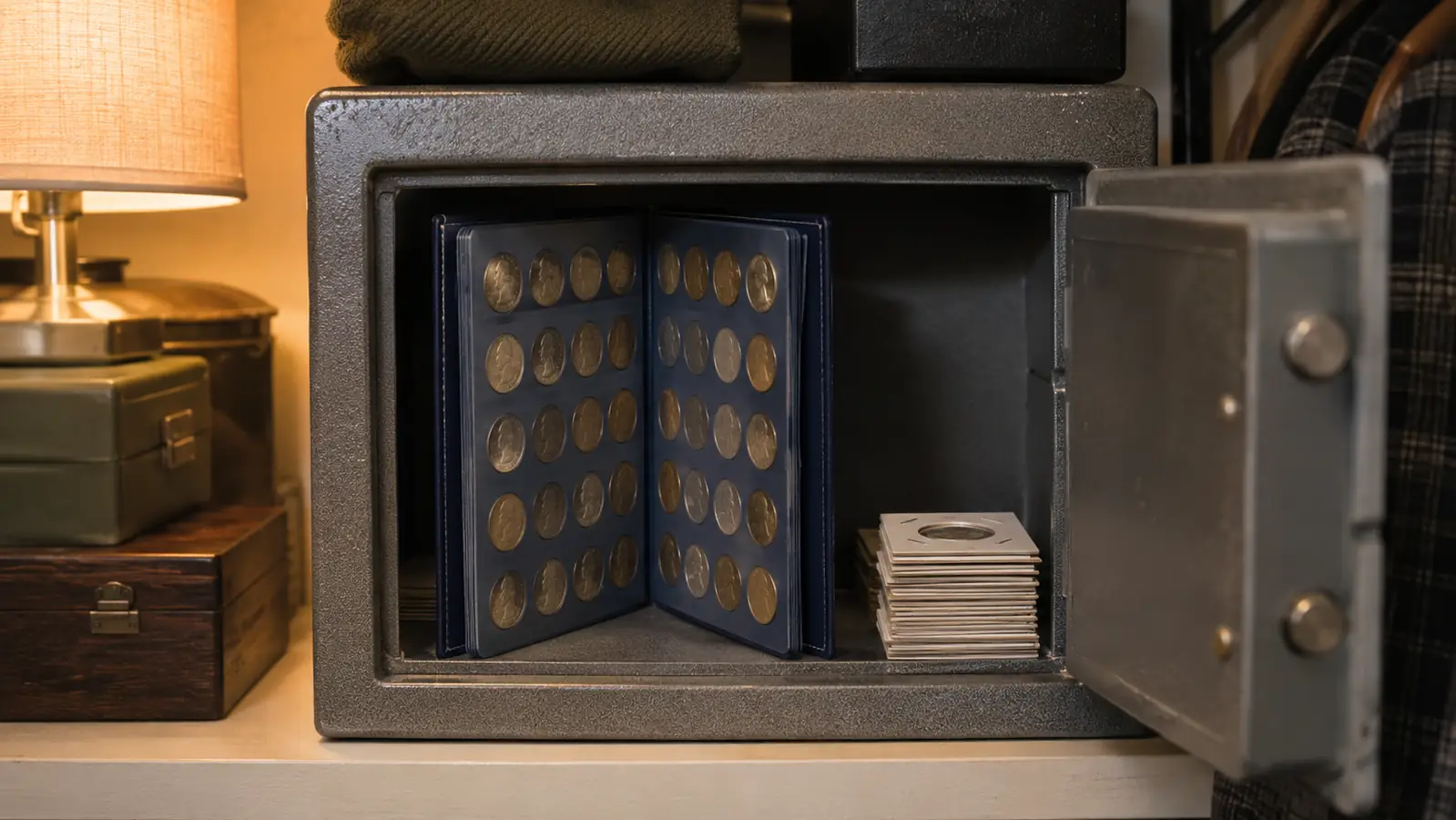
Which brings me to how I store mine, and this is the single most useful thing in this whole article. The folder goes in a fireproof box in the bedroom closet, standing on edge, not stacked under anything. Before it goes in, I drop a small silica packet in the corner of the box. Dayton summers are humid, and humidity is what turns a nice brown cent into a green-spotted one. The folder cannot control that. The box can, a little.
Problem three: the labeling. The dates are printed under each opening, which is what you need, but there is no room to write anything else. No place to note that you found a particular coin in your grandfather's can, no place to note a grade, no place to note that the 1955 in that hole is a decent one. If you keep records, and if you are handing a collection down to somebody, you will keep a separate sheet of paper. That is a small annoyance and it is a real one.
What I Liked
- Each cent sits in its own recess held at the rim, so coin faces never touch another coin
- Printed dates and mint marks under every opening turn a jar of cents into an ordered run
- The stiff pages lie flat and do not sag, even with a full run of ninety-some cents in them
- 7.88 by 5.76 by 0.28 inches and 3.21 ounces, so it shelves like an ordinary paperback
- Cheap enough that buying a second copy for a kid learning the hobby is an easy yes
Where It Falls Short
- The cardboard tabs lose grip after a second bend, and there is no way to tighten them again
- The pages are not archival, so long-term protection is entirely on your storage
- No space anywhere on the page to write a grade, a source, or a note to whoever inherits it
- Press-in insertion is unforgiving of a careless thumb, and a slip leaves a mark that stays
- Copies that sat in a warehouse can arrive smelling of basement and need airing out first
The Size of It, and What That Means at the Desk
The folder measures 7.88 by 5.76 by 0.28 inches and weighs 3.21 ounces. What that means in practice is that it lies flat and stays flat, it does not need a book to hold it open, and it packs into a shoebox or a closet shelf without a fight. A full run of cents is heavy for its size, and the folder does not sag even when it is full.
I checked it against a paperback, because a paperback is what people actually have on a shelf to compare with. It is a shade taller and a shade narrower than a mass-market paperback, and about as thick as one. That is the whole footprint. If you have shelf space that holds paperbacks, you have shelf space that holds this.
The 0.28-inch thickness is worth knowing because it is thin enough that you should not stack heavy things on top of it. I keep mine on edge in the box, standing like a book, for that reason. Flat with a few pounds on top for a decade is how you get a folder that curls and tabs that press into the coins underneath.
One more practical note on the pages themselves. The publication date on this thing is 1996, and the print run has been going for decades, which is why it costs what it costs and why it is everywhere. That also means you may get a folder from a batch that has been sitting in a warehouse. If the cardboard smells like a basement when you open it, set it out in a dry room for a few days before you put a single coin in it. Cheap insurance, and it has saved me a headache twice.
What I Would Tell a Beginner
If you have a shoebox of cents and no plan, this folder is the plan. Fill it in order and you will learn the series, because you will spend an hour hunting for a 1943-S and you will come out the other side knowing which mint marks exist and which ones are hard.
But do three things first. Wash and dry your hands, and then do not touch the coin faces again. Work on a felt pad over a table, not over a carpet, because a dropped cent on a rug is a cent you will find in six months with a fresh scratch on it. And keep the folder closed when you are not working in it, because an open folder on a desk is an open folder for a cat to walk across, or for a glass of tea to get knocked over. I have no pets and I still keep it closed.
And here is the honest part: this folder will not make a coin worth more. Nothing you put in it will turn a common 1957 Lincoln cent into a scarce one. What it does is keep the coin you already have from getting worse, which after thirty years of watching coins get worse is a thing I have stopped taking for granted.
Who This Is For
You are filling the 1941 to 1974 run and you want the whole thing in one place, in order, for a modest outlay. That is the person this folder was built for, and for that person it is the right buy. It is also right for somebody teaching a kid, because the holes and the printed dates do the teaching. Maddie has learned more from empty holes than from anything I have said to her, and I say a fair amount.
It is also a sensible buy if you have already got your cents in a can or a bag and you want to stop the sliding. Anything is an upgrade over loose, and this is a better upgrade than most.
Who Should Skip It
Skip it if your coins are better than the folder. If you are working with uncirculated or near-uncirculated cents, do not press them into cardboard tabs. That is not what this is for. Those coins go in inert holders, individually, and they stay there. A folder is a working collection tool, not a preservation tool, and confusing the two is how nice coins get hurt.
Skip it if you want to write anything down. There is no room on the page, as I said, and if record-keeping matters to you the lack of it will bother you every time you open the cover.
And skip it if you are buying it to hand down as a finished set to somebody who will not know how to store it. An unprotected folder in a humid closet is worse than a box of flips. The folder only does its job if the person keeping it knows the job.
That is the whole honest review. It is a 1996-design cardboard folder that has been doing one job for longer than most of us have been collecting, and it does that job. It is not archival, the tabs have a finite number of bends in them, and there is nowhere to write a note. Handle your coins the way they deserve, store the folder dry and upright, and the Whitman folder will hold your run of Lincoln cents for as long as you need it held.
The folder I keep on my own shelf, for the run it was made for
If you are filling 1941 through 1974 and you want them in order without touching, this is the one. Decide before you press, and keep the box dry.
Amazon Check Today's Price on Amazon →