
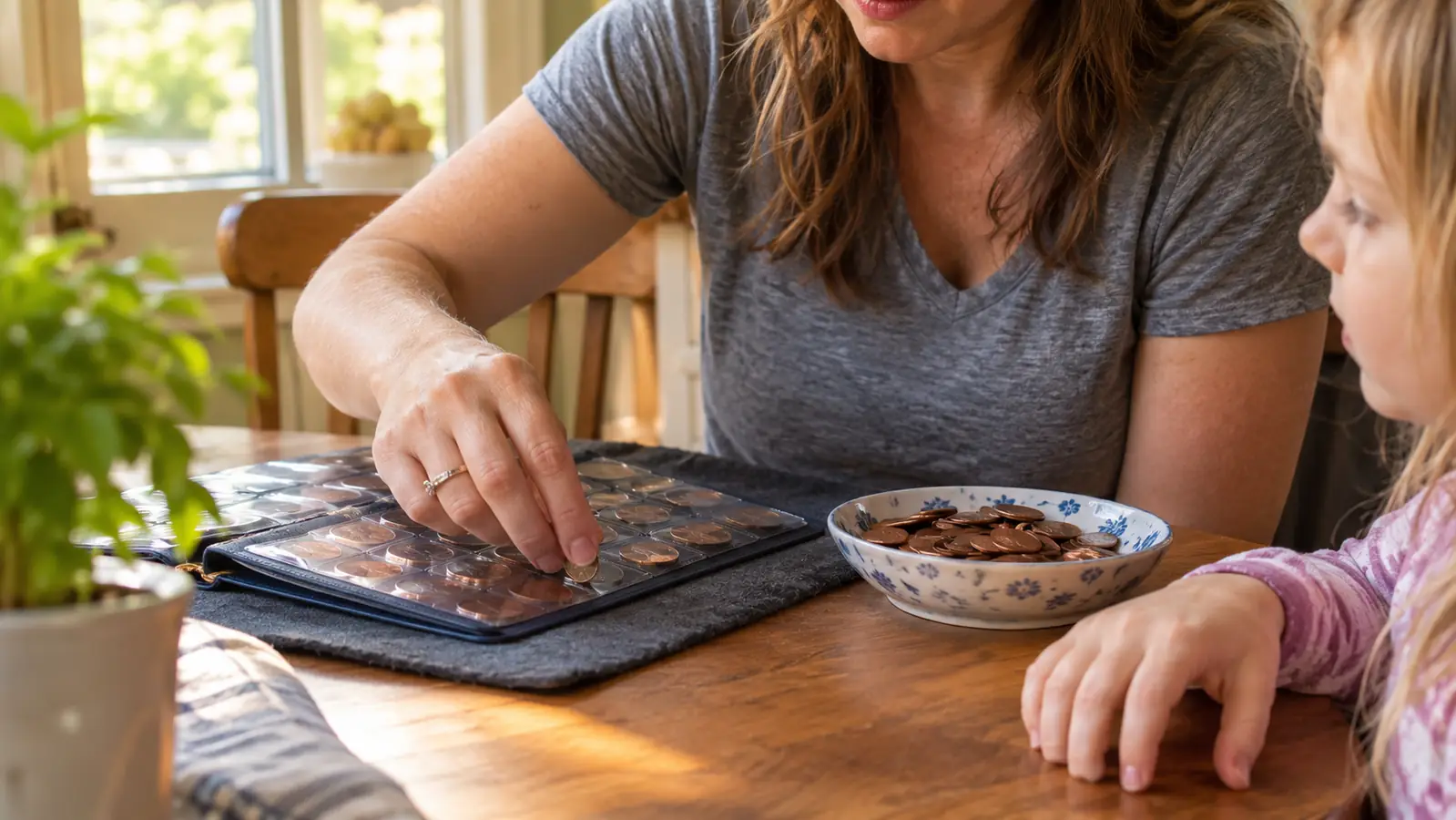
Maddie was seven the first time she pulled the coffee can off my closet shelf and asked what was inside. Wheat cents, I told her, most of them common, every one of them mine since I was eleven and my grandfather handed me that same can. She poured about forty of them onto the kitchen table and started stacking them into towers. Nothing about that afternoon was wasted, but nothing about it was collecting either. A pile on a table teaches a kid that old coins are interesting. A folder teaches her what she actually has, and what she is still missing.
That is the whole reason a Whitman Lincoln Cents Folder #2, 1941-1974 lives in my desk drawer instead of a second coffee can. The folder runs from the middle of the wheat years through the memorial reverse that started in 1959 and on to 1974, which happens to be the stretch that turns up in family cans and pocket change. A folder like this one has a slot for each year in that range, and an empty slot is a question a nine year old wants to answer. I have watched Maddie dig through a pile for forty minutes because one hole was sitting there, blank.
Start with the years that are already in the jar
The Whitman Lincoln Cents Folder #2 covers 1941 through 1974, which is the stretch most family cans are full of. Pull the lid off, dump the pennies onto a felt pad, and give a kid somewhere to put them besides a tower.
Amazon Check Today's Price on Amazon →Five Steps, Start to Finish
Step 1: Set the table before a single cent comes out
Wash your hands, dry them completely, and skip the hand lotion for the afternoon. Skin oil and salts sit on copper and show up years later as dull fingerprints that will not come off without an abrasive, and an abrasive takes the surface of the coin with it. I learned that on a 1919 wheatie I still carry as a reminder. Set out a felt pad or a folded towel so the coins land on something soft, put a lamp on the near side of the pad, and keep the drinks at the far end of the table.
Give each of you a small dish or a muffin tin. Sorting goes faster when the coins have somewhere to go, and a nine year old with a dish in front of her will sort for an hour where a nine year old with a loose pile will quit in ten minutes. Put a tray under the whole setup. Cents roll, and a cent that hits a kitchen floor at the wrong angle picks up a rim ding that never comes out.
One more piece of setup, and this one matters. The folder lists a reading age of fourteen and up, and I would not hand it to a nine year old to fill alone. It is not the reading. It is the hand control. The slots are snug and the coins are small, so a kid who is rushing will bend a rim getting one seated. Plan to sit next to her for the first two sessions. After that she will not want you hovering, and you should let her have it.
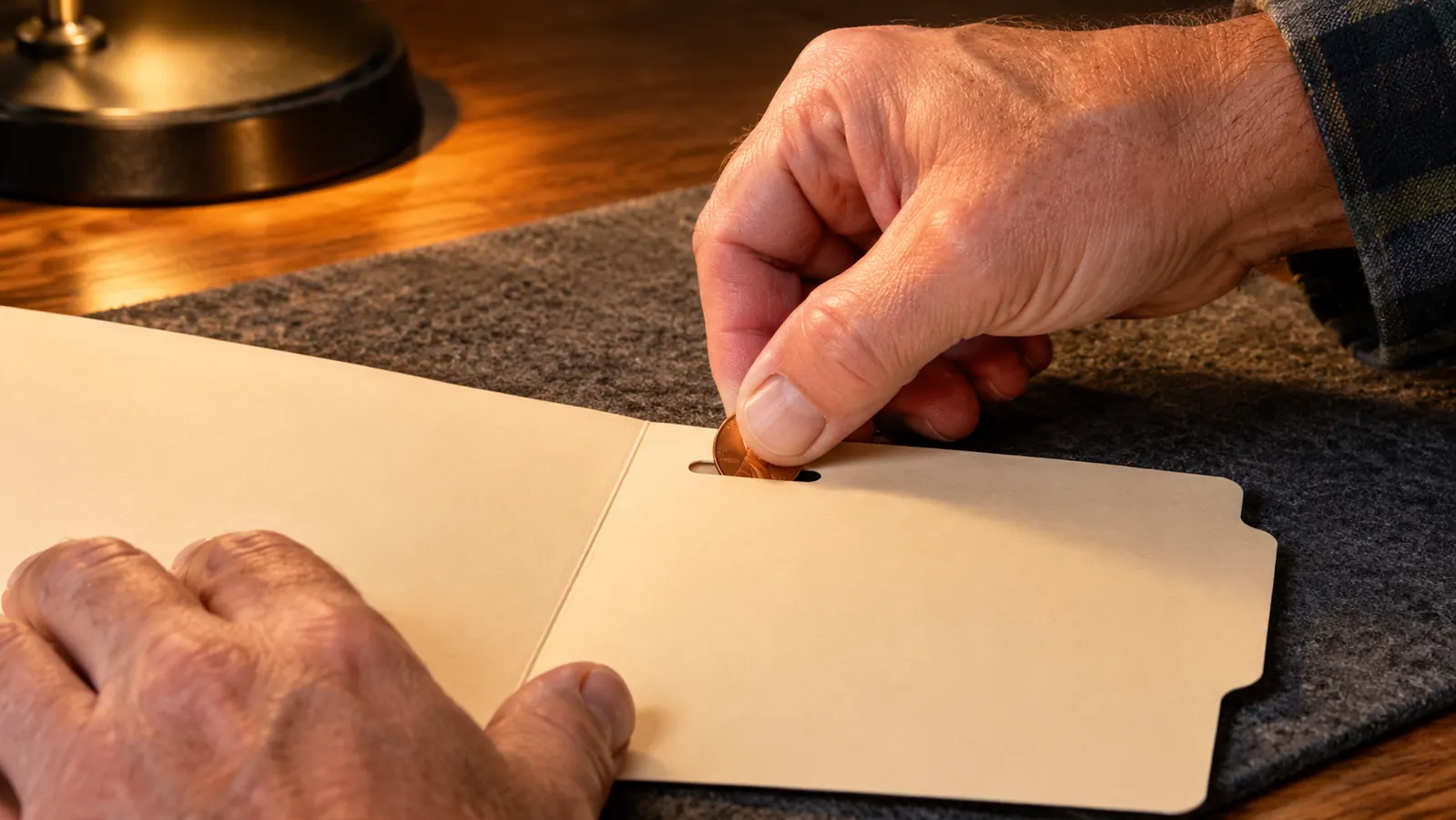
Step 2: Sort by decade, not by year
Dump the can and sort into decades first. Forties, fifties, sixties, seventies, and one small pile for anything bent, dark or unreadable. Sorting a two hundred coin pile by exact year is the fastest way to lose a kid's attention, and by decade the job takes one afternoon and actually finishes. Once the decades are separated, the year sorting is something she can do with the folder open in front of her, and that is the part she will remember.
Teach the one split that matters. Cents from 1959 on carry the memorial building on the back, and 1958 and earlier carry the wheat stalks. Then there are the 1943 steel cents, which look and feel different, gray instead of copper, and a magnet will pick one right up. Those are steel, not copper. Keep them in their own small dish so they do not get stirred into the copper pile and confuse the sorting halfway through.
Everything that is a double goes back into the jar. So does anything bent, corroded, or worn past reading. Explain the rule once and then hold to it yourself, because she is watching whether you follow your own instructions. A folder is a set, not a warehouse. A kid who learns early that a damaged coin goes in the spares jar will still be making that call when she is my age.
Step 3: Read the date and the mint mark before anything goes into a hole
Before a coin goes into a hole, read the date, then look under the date for a small letter. A D means Denver, an S means San Francisco, and nothing at all means Philadelphia. Good light at the right angle matters more than a loupe at this stage, though a loupe helps a kid feel like she is doing real work. If she cannot read the date in the light you have, the light is wrong, not the coin.
This is the step where the folder earns its place on the table. The slot tells you the year it wants, so the coin and the hole have to agree before anything gets pressed in. A 1946 seated in a 1945 hole will go in just fine, and it will sit there looking correct to everybody who does not read the print. Ten years from now that is a wrong coin in your set and a small job to find it.
Some years will be hard to fill, and that is the part that keeps her coming back. I do not tell her what any of it is worth, because I do not know and neither does anyone who is being straight with you. I tell her which years turn up less often and let her do the hunting. The hunt is the hobby. The folder is just the scoreboard she checks at the end.
Step 4: Seat the cent with two thumbs
Seat the cent with two thumbs. One thumb on the left edge, one on the right, press down and slightly outward toward the corners until the paper grips. If the coin rocks when you let go, press the other two edges, then run a thumb flat across the face to settle it. That is the whole technique. It takes about four seconds a coin once she has the motion, and she will want to do all of them herself.
Do not hand a nine year old a pen, a screwdriver, or the handle of a butter knife to press a coin into a slot. That is how rims get bent and faces get scratched, and it is how a folder of decent coins turns into a folder of damaged ones. If a coin does not want to seat, the hole is the wrong year. Stop, read the date again, and walk the coin over to where it actually belongs.
When a page is done, close the folder and press it flat with your palm for a second. That is all the settling it needs. Then open it back up and check that nothing popped loose before it goes on the shelf. Maddie and I do that together, and she has caught two that lifted. She is proud of those two, and she should be.
Step 5: Put it away the same day, in the same place
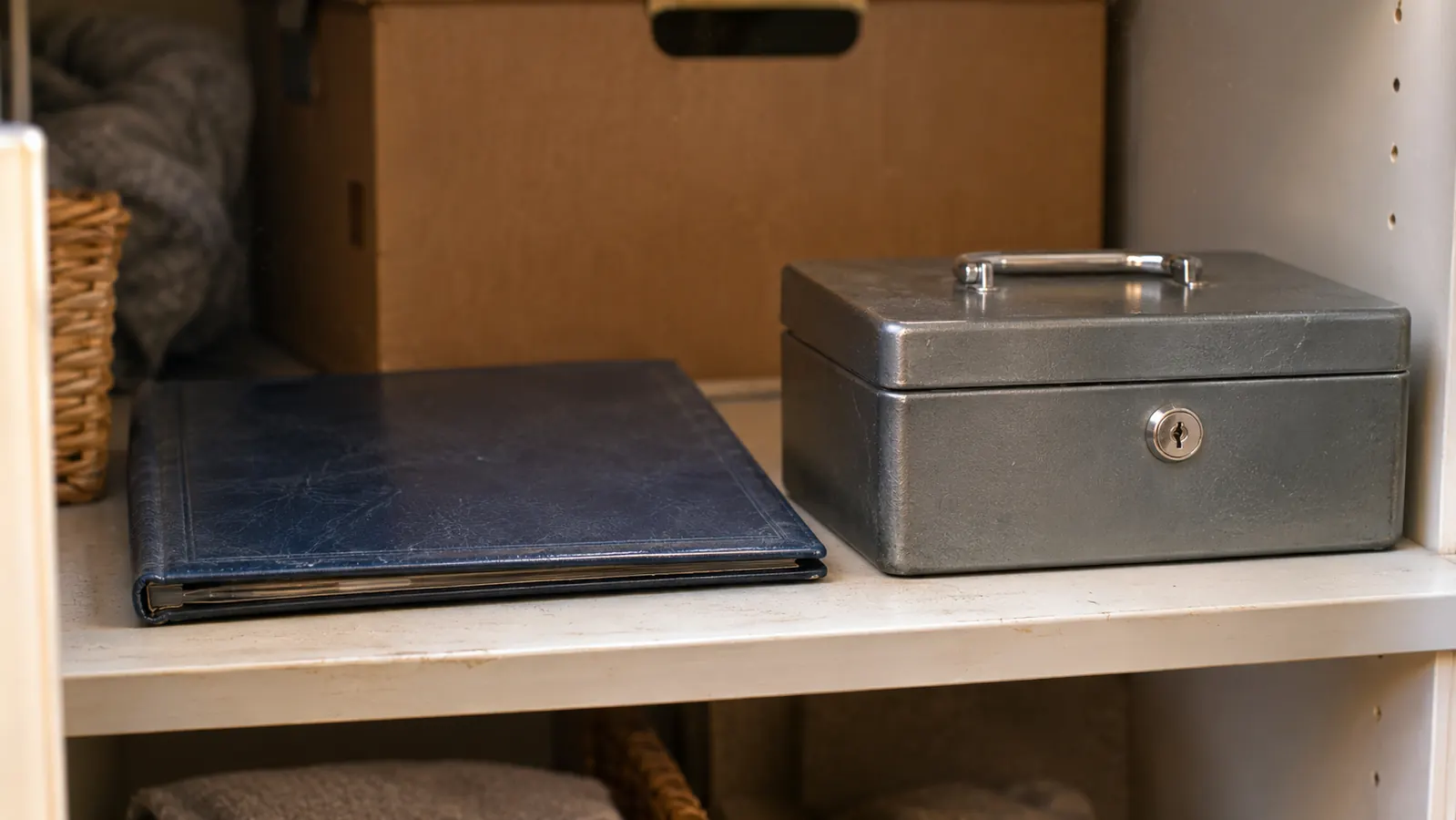
Paper and copper both react to moisture, and the rooms in a house that hold moisture are the attic, the basement and the garage. My folder goes on a closet shelf in the spare bedroom, the room where the desk and the lamp live, and it stays dry there year round. If you have a fireproof box, the folder belongs inside it. Mine sits in one on that same shelf. The box is for fire, and also for the simple fact that a closed box gets opened less.
No tape, no rubber bands, and no plastic bags of unknown origin pressed around the folder. Some plastics give off vapors that do a slow, permanent kind of damage, and you will not see it for a year. No writing on the coins. No cleaning them, ever. A cleaned copper cent is a damaged copper cent, and it will look wrong to the next person who handles it, even if it looks shiny to you tonight.
Put the folder back in the same place every single time. Habit protects a collection, not good intentions. In our house the folder comes out Saturday afternoon and goes back Saturday afternoon, and Maddie knows that the same way she knows which cabinet holds the cereal. When a nine year old can put her hands on a collection without asking permission, she will still have it in forty years.
What Else Helps
A second container for the spares, kept in plain sight. The jar of doubles and damaged cents is not junk. It is the pile she digs through when a slot opens up, and some of my better pocket change finds came out of a jar I had already sorted twice. Maddie has a coffee can of her own now and has filled about a third of it since spring. She knows every coin in there is hers to trade.
A coin club helps more than any book I could recommend. The club I belong to meets once a month, and members bring duplicates to trade and trays of coins to look at. Take the grandchild. A nine year old surrounded by adults who are careful with coins learns more in an hour of watching than in a month of me explaining. Nobody at a club meeting hands a child a coin without first showing her how to hold it by the edges.
A loupe and a lamp are worth more than anything else on the table, and neither one has to cost much. I use a ten power loupe that lives in the desk drawer and a plain shaded desk lamp I can angle. That is the whole kit. The folder, the felt pad, the lamp, the loupe, and a dish for the spares. Everything else is optional and most of it is clutter.
If you want a place to start, start with what is already in the house. Most family cans run heavy on the twenties, thirties and forties, and a folder that begins at 1941 will take a good share of them. The Whitman Lincoln Cents Folder #2 stops at 1974, so the modern change you hand her goes into the spares jar instead of a slot. That is fine. Let her see the difference between a cent that has been passed around for fifty years and one minted last year, and she will understand why the old ones matter.
Expect her to lose interest some weekends. Leave the folder on the shelf and let her ask. I have made the mistake of pushing, and the quickest way to end a hobby is to turn it into homework. When she asks whether we can work on pennies, that is the day it happens. Not before, and not on a schedule I set for her.
The first cent Maddie ever seated in a hole was a 1944 that had been sitting in my grandfather's coffee can since before she was born, and she put it in the right year on the first try.
One folder, one kid, one Saturday at a time
A folder turns a can of loose pennies into a set with holes to fill, and holes are what keep a nine year old at the table. The Whitman Lincoln Cents Folder #2 covers 1941 to 1974, which is most of what is already in the jar.
Amazon Check Today's Price on Amazon →