
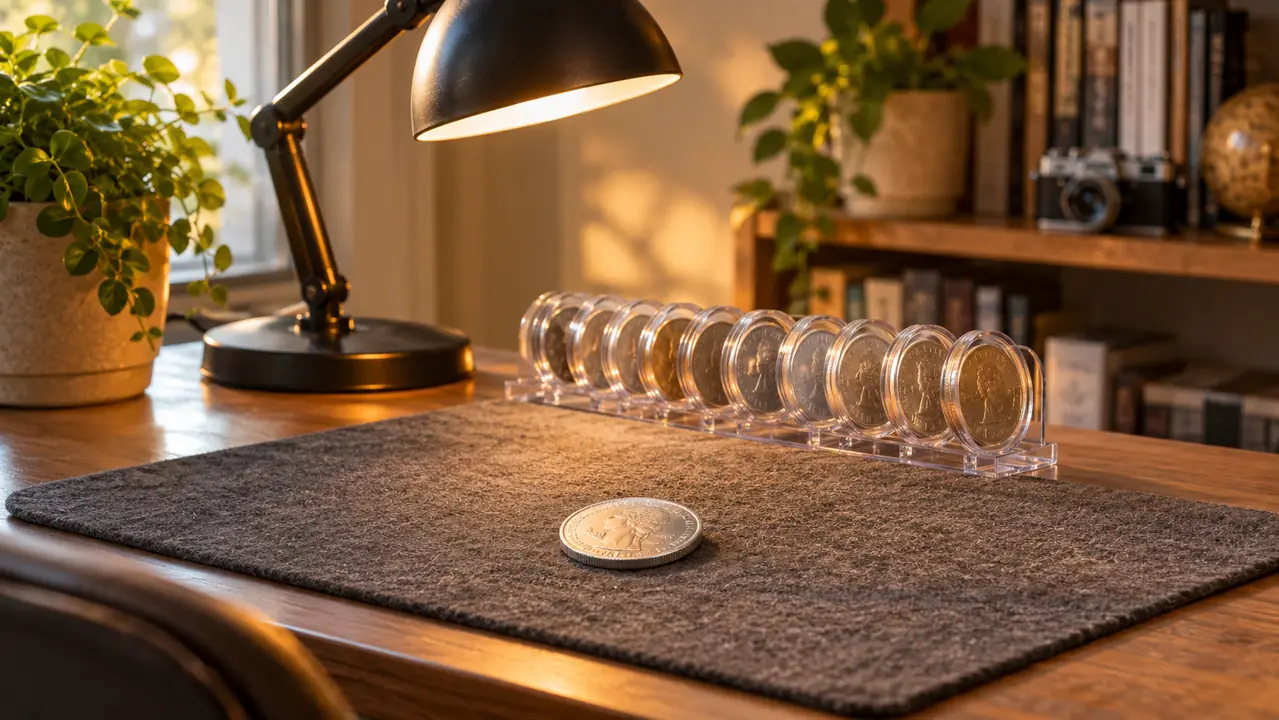
Maddie handed the Morgan dollar across the desk and I heard the sound I have learned to hate. Not a ring. A scrape. She had carried it loose in her jacket pocket for two days because she wanted to show a friend at school, and now there was a fresh line across the cheek of it that was not there on Saturday. She is nine, she is in her first year in the hobby, and she learned the lesson the hard way. So did I, about forty years ago, with a wheat cent my grandfather left me in a coffee can. That is why there is a drawer of Utron capsules in the desk now, and why I hand one out before I hand out a coin.
Here is the trouble with nearly every beginner storage method. Paper envelopes let the coin slide, and sliding picks up grit. Cardboard flips are fine until a staple scratches a face, which happens more often than people admit. Soft plastic sleeves from the craft store can be the worst of the three, because some soft plastics break down over the years and leave a residue on the surface that no amount of careful wiping removes. A Morgan dollar is 38.1mm across and heavy for its size, so it moves more than a cent moves and it takes more hits when it does. A rigid round capsule with a foam ring answers all of that at once. The Utron 60 pack puts 60 capsules and seven washer sizes in one box, which covers a starter run of dollars and the cents Maddie keeps in the same drawer, without buying three separate products to do it.
Sixty capsules, seven washer sizes, one box that ends the pocket problem
The 38mm foam ring is the one that seats a Morgan dollar. The rest of the sizes wait for the smaller coins. Keep a handful on the desk so the next coin through the door has somewhere to go.
Amazon Check Today's Price on Amazon →Five Steps, In Order
Step 1: Match the Washer to the Coin Before You Open Anything
The Utron box holds seven foam washer sizes: 38mm, 33mm, 30mm, 27mm, 25mm, 20mm and 17mm. Morgan dollars take the 38mm ring. Half dollars and the bigger copper take the 33mm or the 30mm. Wheat cents usually drop into the 20mm, though a worn one will sometimes sit better in the 17mm. Do not guess from memory. Set the coin down on the felt, hold the ring beside it, and look at the gap before you commit to anything.
A loose washer lets the coin rattle every time the case moves, and a rattle is a scuff on a schedule. A tight washer means you are pressing the coin into foam to make it fit, and pressing is how rims get dings. The right fit holds the coin flat with the rim just touching the foam and no pressure at all. When Maddie picks a ring on her own she gets it right about half the time, so we check the fit together. That is not a knock on her. It is a knock on guessing.
One more word on sorting, because it saves time. Dump the dollars onto the felt, keep the cents in a separate pile, and work one size at a time. It is a good deal easier to find the 38mm rings when you are not also hunting a 20mm in the same pile. Sixty capsules in one box sounds like more than you need, right up until you are five coins in and the lids have gone everywhere.
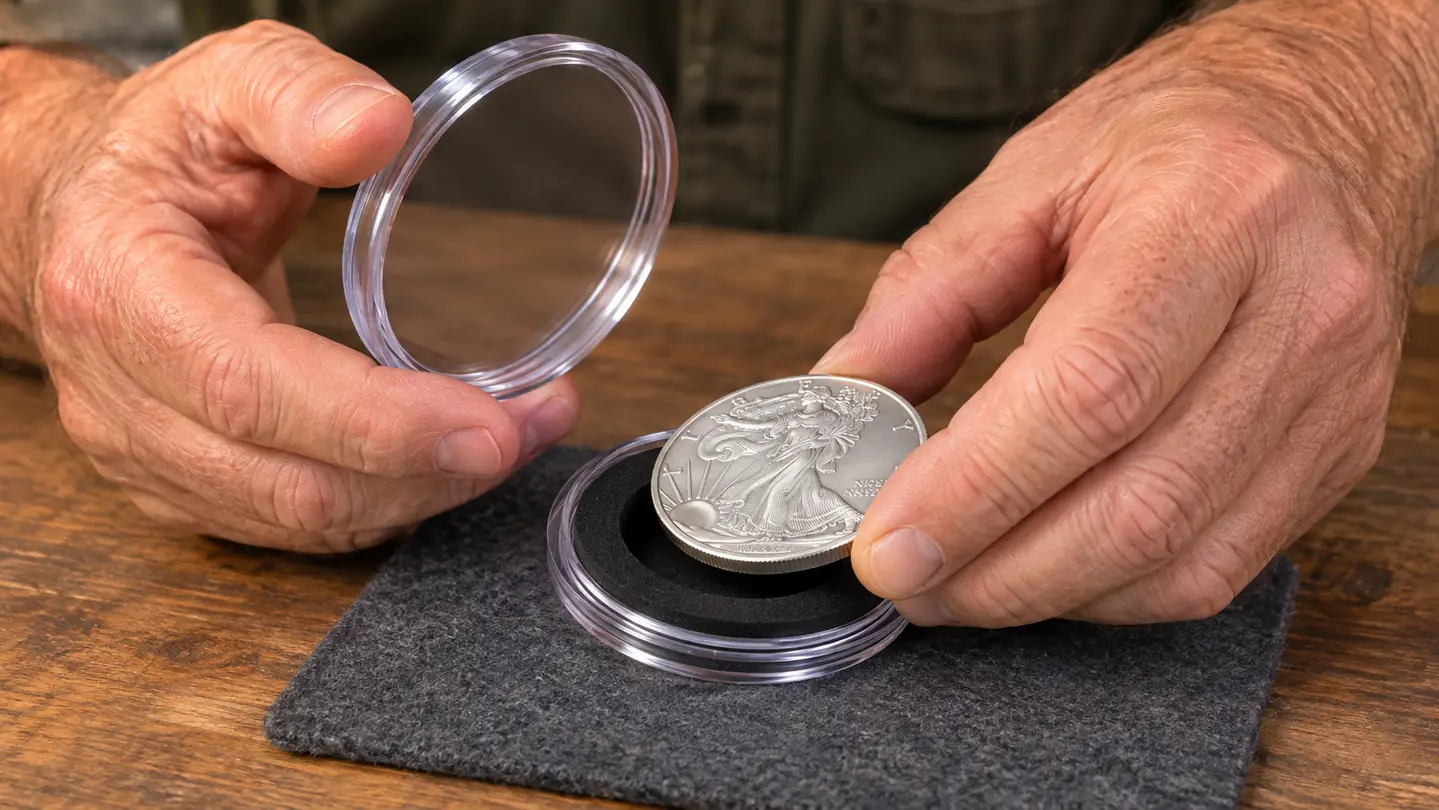
Step 2: Wash Your Hands, Then Work Over Something Soft
Finger oil is the quiet damage. You will not see it on the first day. You see it years later as a dull haze shaped like a thumbprint, sitting on a bright field, and it does not come off with anything short of a dip. A dip on a circulated coin is a bad trade. So wash with plain soap, dry all the way through on a cloth towel, and then keep your hands away from your face, your hair and your lunch. Carol has watched me do this for forty years and still finds it funny. It is still cheaper than a ruined coin.
Work over cloth. I use a felt pad on the desk in the spare bedroom. A folded dish towel does the same job. The point is that when a coin slips, and one will, it lands on something soft instead of oak or tile. Maddie and I lost a wheat cent to the kitchen floor in her first month. It did not break, but it picked up a rim nick that had not been there ten seconds earlier. That is the entire lesson, and it cost a common cent instead of a Morgan.
Cotton gloves are a matter of taste. I do not wear them for circulated silver, and I do wear them for anything I would call uncirculated. Put them on before the coin comes out of the capsule, not after. Otherwise you have already done the thing the gloves were for.
Step 3: Seat the Coin, Then Close the Case Squarely
Set the washer flat in the capsule base, drop the coin in, and give the whole thing a small shake next to your ear. If you hear movement, the ring is wrong and you go back to step one. If it sits still, you are ready to close.
Line the two halves up and press around the rim with both thumbs, working your way around the circle instead of squeezing from the middle. The rounded outer corners make that easier than it sounds, because there is no sharp edge digging into your thumb while you work around it. Press until the two halves meet and stop moving. If they will not meet, do not force them. Take the case apart, check that the foam ring is not pinched at the seam, and start again. Forcing a case is how you crack the case and chip an edge in the same motion.
A loose ring lets the coin rattle every time the case moves, and a rattle is a scuff on a schedule.
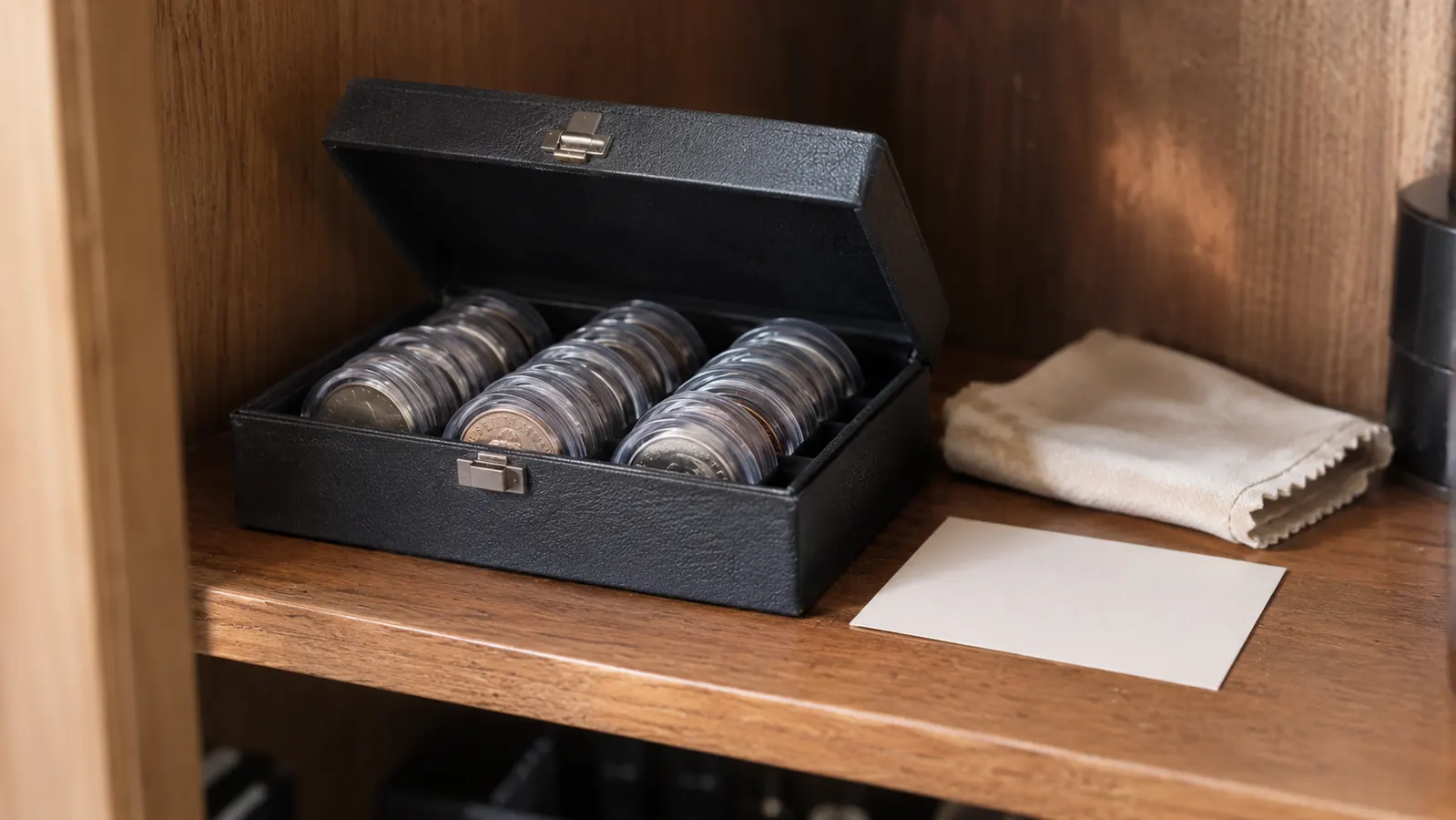
Step 4: Store Them Upright, Somewhere Steady
Utron capsules go into a box standing on edge, the way coins sit in a roll. Stacking them flat puts weight on the faces. Over one year that probably does no harm. Over twenty it does no good. Standing them up costs nothing and takes less room than you would think.
Where the box lives matters more than what the box is. Mine is a small fireproof box on the closet shelf in the spare bedroom. A closet is good because it sits inside the house, away from exterior walls, and it does not swing with the weather the way a garage or an attic does. A basement is the opposite of good. It is the dampest room in most houses, and damp is what turns a capsule into a small greenhouse. Kitchen and bathroom are out for the same reason. Steady, dry and out of the light. That is the whole rule.
Keep coins away from rubber. Elastic bands, rubber washers, old batteries, the drawer where the spare keys and the flashlight live. The things we store in drawers are often the things that give off fumes over time, and a closed case slows that down without stopping it. Give the coins their own box, their own shelf, and a lid that shuts.
If your house runs damp in the summer, a small packet of silica gel in the corner of the box is cheap insurance and hurts nothing. Swap it out when it stops feeling dry. That is not a substitute for putting the box in the right room to begin with. It is a second line of defense, and the first line is the shelf.
Step 5: Handle the Capsule, Not the Coin, and Check Twice a Year
Once a coin is cased, you handle the case. That is the whole benefit, and it disappears the moment you pop the lid every time somebody wants a look. A capsule is clear enough to read a date and a mint mark straight through it, which means Maddie can pass a coin around the kitchen table without six thumbs landing on a field. Get in the habit of turning the case over instead of turning the coin.
Twice a year, pull the box out and look at every capsule under the lamp. You are checking three things. Is the coin still flat in its ring. Has any haze or spotting appeared since the spring. Is there a crack starting at the rim of a case. Twenty minutes covers sixty coins. Put a note card in the box with the date on it, because in two years you will not remember whether you did this in April or not at all.
If you find something, deal with it then. A coin that has started to tone is not an emergency, and a cracked case is a two minute fix if you have a spare in the drawer, versus a slow afternoon of sorting if you do not. That is the argument for the box of sixty over the pack of ten. Spares are the difference between a small job and a lost weekend.
The part I did not expect was what the routine teaches. Maddie now washes her hands without being told, picks the ring, checks the seating with a shake, and sets the case in the box on edge. She does it because we do it the same way every Saturday, not because I gave a speech about it. Storage rules that live in a speech get forgotten. Storage rules that live in a Saturday morning get kept.
What Else Helps
A few small things make the routine easier to keep. A desk lamp you can pull close, so you are not tilting a coin toward a window and dropping it. The felt pad from step two, which you already have. A soft brush for the outside of the cases, since dust on a capsule does not hurt the coin but does make it hard to see. A notebook, because in ten years you will not remember which Morgan came from which dealer, or which ones you already looked at in the spring. And a box with a lid, because capsules loose in a drawer is just the pocket problem wearing a different hat.
The other thing that helps is other people. The club meets once a month and Maddie comes along when she wants to. Half of what I know about storage I learned by standing next to somebody older than me and watching how he opened a box and how he set a coin back down. You cannot get that from a product page. The capsules are what give you a safe place to put the coin when the meeting is over and the table gets cleared.
One caution on cleaning. A capsule does not clean a coin, and it does not stop a coin from toning. It slows the handling damage down and it keeps grit off the surface, which is a smaller claim than most people hear. If a coin has a real problem, that is a separate job with separate risks, and the safest first move is to leave it alone and ask somebody at the club who has been at it longer than you. Casing a coin is not a repair.
Seven ring sizes, sixty cases, and one less coin rattling around a jacket pocket
The 38mm ring seats a Morgan dollar, the case holds it flat, and you can read the date without touching the face. Keep a few in the desk drawer before the next coin comes home.
Amazon Check Today's Price on Amazon →